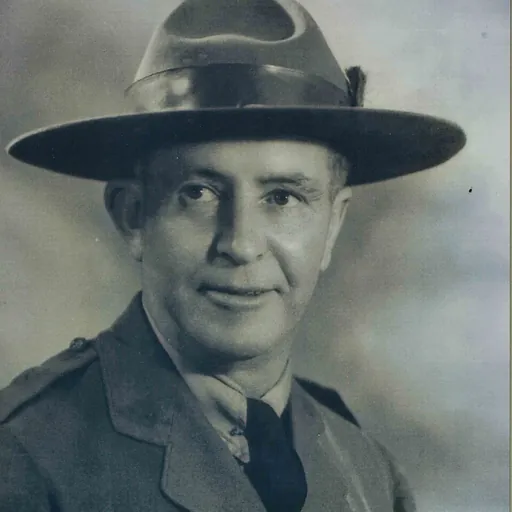
Alexander Rowan Macneil
Australian military officer, chaplain and Scout Leader
About Alexander Rowan Macneil
Lived 1894 – 1953 (aged 59). Alexander Rowan Macneil was a christian minister.
The Reverend Alexander Rowan Macneil ( – ) known as Rowan "Padre" Macneil was an Australian army officer, chaplain and scout leader.
During World War I he was twice awarded the Military Cross. He became a Presbyterian minister and continued his scouting involvement in the interwar period, ), chairman of the ironmongery firm Briscoe and Company Limited, and his wife Jane (–1932; née Peden). Named for his father, but known as Rowan, Macneil had five siblings: Edith, Jim, Sheila, Alan and Jean.
Macneil attended Scotch College and represented the school at Associated Public Schools of Victoria's athletics and shooting competitions in 1910 and 1911. In 1911, he was the state's shooting champion and also a member of the school's premiership-winning first XVIII football team. On arrival at Alexandria on 29 August 1915, it joined the Mediterranean Expeditionary Force and after a period of training dispatched to Gallipoli as reinforcements. En route the battalion's transport, HMT Southland, was torpedoed by German submarine UB-14 near Lemnos and the passengers and crew were forced to abandon ship. The battalion eventually arrived at ANZAC Cove on 7 September. Following this they undertook mainly defensive duties along the Australian line until December 1915, when they were evacuated from Gallipoli after the decision was made to withdraw Allied forces from the peninsula.
After a brief stint guarding the Suez Canal Zone, the battalion was assigned to the Western Front. On 1 July 1916, Macneil was mentioned in dispatches after participating in a raid on the German trenches in June 1916. He was promoted to captain on 23 July, the first day of the Battle of Pozieres. During the battle he was wounded in action on 26 August 1916 and received the Military Cross on 20 October 1916 for his actions: For conspicuous gallantry in action. Though wounded he stuck to the command of his company till wounded a second time on the same afternoon. He set a fine example to his men under fire.
21st Battalion officers in France, 1918. Macneil 3rd from left, front row. Macneil had been evacuated to England on 5 September 1916, returning to the 21st Battalion after a period of convalescence on 24 November. He participated in the Second Battle of Bullecourt in May 1917 before being detached to the 6th Australian Infantry Training Battalion in England that August. Macneil returned to his battalion on 8 March 1918, in time to face the German spring offensive and the allies' Hundred Days Offensive in response. Participating in the battles of Hamel and Amiens, he was awarded a bar to his Military Cross on 18 June 1918 for leading an attack at Ville-Sur-Ancre, near Albert on 19 May: For conspicuous gallantry and devotion to duty. On reaching his objective in an attack, after two of his officers had become casualties, this officer supervised the digging in of his company. Later, after reaching the second objective, he reconnoitred the front positions, and finding that they could not be held, he skilfully withdrew his company, pushing out Lewis gun posts. In the evening he went forward and finally dug in. He displayed coolness and judgment under trying conditions.
Following his second Military Cross, Macneil was temporarily promoted to major on 5 August 1918, relinquishing the appointment on 7 September when he was evacuated to England after being gassed the day before the Battle of Mont Saint-Quentin. Macneil briefly rejoined his battalion on 30 September, in time for the attack at Montbrehain – the final Australian action of the war. When the 21st Battalion was disbanded on 13 October, Macneil transferred to the 24th Battalion and returned to Australia aboard HMAT Euripides, disembarking in Melbourne on Anzac Day 1919.
After the war, Macneil transferred to the Australian Militia Forces, serving with the Melbourne University Rifles. She was the first woman permitted to get an LLB in New Zealand. Her father, Edwin Frank Allan, a lead writer at The Argus died in February 1922. at St Paul's Cathedral, Melbourne on 7 August 1923. They had two children, James and Joan.
After graduation in 1924, Macneil continued to study divinity at Ormond College, Melbourne. He was promoted to lieutenant-colonel and took command of the Melbourne University Rifles in 1926, before transferring to the inactive list on being ordained as a Presbyterian minister in July 1928 (having been licensed as a minister in December 1926 ). He served as chaplain of Scotch College, Melbourne until 1935, during which time he established the 1st Hawthorn Scout Group at the request of the school's principal. Macneil was nicknamed "Spray" by the schoolboys due to his pronunciation of "let us pray".
After a two-year sabbatical in the United Kingdom to study educational methods, health, and housing, Macneil and his family returned to Melbourne early in January 1937. He joined the staff of Trinity Grammar and was appointed headquarters commissioner for Scouts in 1937, remaining in the positions until he enlisted in the Second AIF in 1940.
Military service, World War II
Macneil enlisted in the Second AIF on 6 December 1940, being appointed as Chaplain (4th Class) in the Australian Army Chaplains' Department on 14 December and attached to the 2/29th Battalion. Like many clubs started within the camp, the Scout training club had strong take-up initially, but interest dwindled and Macneil reformed it into the Changi Rover Crews.
The Rover Scout model was a much greater success, and Macneil soon found himself Group Scoutmaster of the Changi Group of Rover Scouts. This consisted of Somers Rover Crew, Tanah Merah Rover Crew and Java Rover Crew. As a deputy camp chief, Macneil was authorised to deliver Wood Badge leader training, allowing him to share the burden of leading the group.
Macneil was, with C. W. Game, appointed a field commissioner by Scouts Victoria to deliver the 1948 Pan-Pacific Jamboree, ). Macneil, a former headquarters commissioner for Scouts, was also leader of the Victorian contingent of 5,000 Scouts. Later that year, in November 1948, he held the first communion in the newly dedicated Warriors' Chapel at Saint Andrew's Church, Forrest, Australian Capital Territory honouring the 10 000 members killed in World Wars I and II. Macneil represented the Ministers of Australia. he was the only Presbyterian chaplain from the Eighth Division from Victoria to return post-war; and used the same chalice and order of service as when he was the Changi camp chaplain.
In 1952, the Australian Government distributed funds to former prisoners of war held by the Japanese forces. Macneil called upon his fellow prisoners to donate their payments to Japanese Christians.
Macneil died suddenly in his home at 16 Alfred Street, Kew (and formerly 30 Wrixon Street, Kew) on after a period of illness, survived by his wife and two children. His funeral was held at Paton Memorial Presbyterian Church in Deepdene, Victoria, followed by cremation.
Recognition
Macneil's service is commemorated on the Australian Ex-Prisoners of War Memorial at Ballarat, and the Balwyn War Memorial.
Macneil was recognised for his work as group scoutmaster in Changi by the Scout Association with the Medal for Meritorious Conduct, presented by the Lieutenant-Governor of Victoria in 1947. The medal, introduced in 1946, is usually awarded "in recognition of courage under great suffering".
Between 1957 and 2015, 1st Hawthorn Scout Group met at the Rowan Macneil Scout Hall, on the grounds of Scotch College.
In 1988, Scouts Victoria placed a memorial plaque in the chapel of the Changi Prison.
Awards and decorations
Don’t just read it —
keep it.
Full-length biographies made to live with: read them, listen on the way to work, watch them tonight.
- E-book
- Audio
- Video
Instant download · yours to keep · every purchase keeps this site free
Important facts
People in Alexander Rowan Macneil's life
Named in this biography and alive at the same time



Related people
Same field, nearest in time



Contemporaries
People whose lives overlapped Alexander Rowan Macneil's


Frequently asked questions
Who was Alexander Rowan Macneil?
Australian military officer, chaplain and Scout Leader (1894–1953)
When was Alexander Rowan Macneil born?
Alexander Rowan Macneil was born on 27 February 1894.
When did Alexander Rowan Macneil die?
Alexander Rowan Macneil died on 14 October 1953.
What was Alexander Rowan Macneil's occupation?
Alexander Rowan Macneil was a christian minister.
Sources & further reading
· Wikipedia: Alexander Rowan Macneil
· DBpedia: Alexander Rowan Macneil
Cite this page
APA: Biography.guide. (2026). Alexander Rowan Macneil. https://biography.guide/alexander-rowan-macneil/
MLA: "Alexander Rowan Macneil." Biography.guide, https://biography.guide/alexander-rowan-macneil/.
Chicago: "Alexander Rowan Macneil." Biography.guide. https://biography.guide/alexander-rowan-macneil/.
Data last updated: 2026-09-23 · Spot an error? Report a correction.
Portrait: Wikimedia Commons · author & licence
Page generated 2026-09-27 05:08 UTC