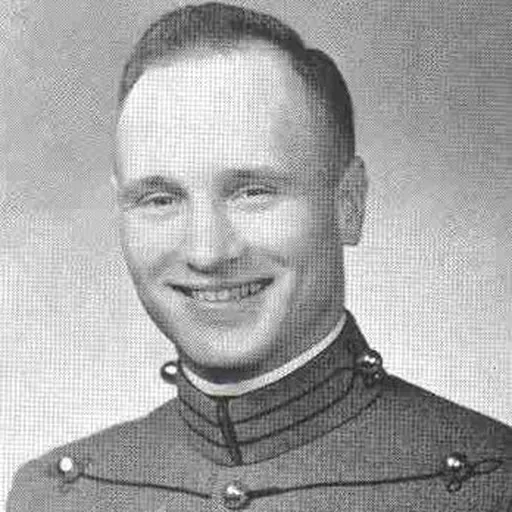
Alexander Kratz Rupp
US Air Force officer
About Alexander Kratz Rupp
Lived 1930 – 1965 (aged 34).
Alexander Kratz Rupp (2 July 1930 – 11 June 1965) was a United States Air Force major. He graduated from the United States Military Academy at West Point, New York, in 1955. While at West Point he kidnapped Bill the Goat, the United States Naval Academy mascot, before the 1953 Army–Navy Game. He was one of 34 finalists for NASA Astronaut Group 3 selection in 1963, but was unsuccessful. He was killed in an air crash on 11 June 1965.
Biography
Alexander Kratz Rupp was born in Bellefonte, Pennsylvania, on 2 July 1930, the son of Charles A. Rupp and his wife Luella Kratz. He had two sisters, Susan and Milicent; a twin brother drowned in early childhood. He grew up in State College, Pennsylvania, where his father taught mathematics at Penn State University. He played cornet in the local drum and bugle corps, which won a national championship. When the United States entered World War II, his father was commissioned as a captain in the United States Army Signal Corps and was posted to Washington, D.C. Soon after, the family moved there to join him. Rapp attended Central High School there, and commanded the school cadet corps in his final year. On graduation, the U.S. Navy awarded him a Holloway Plan scholarship to study at Harvard University.
After two years at Harvard, Rupp decided that his prospects as a United States Navy Reserve officer were poor, so he dropped out and took a job driving a bulldozer, and later a power shovel. He attended National Guard drills and summer camp. On 3 July 1951, he entered the United States Military Academy at West Point, New York, having secured a National Guard appointment. He participated in cross-country running and was a cheerleader for three years, for which he earned a varsity letter "A". Rupp graduated 63rd in the class of 1955, and chose to join the United States Air Force (USAF). He underwent flight training in Texas and Mississippi, and on his own time worked on aircraft and automotive engines in the base shops. He learned to speak fluent German, and was often chosen to address the crowds that flocked to see air shows at the base. He courted and married a German girl, Ruth Michels. They had two children, a son, Alexander Michael Rupp, and a daughter, Karen. The couple skied in Switzerland and climbed the Finsteraarhorn.
Promoted to major, Rupp returned to Wright-Patterson, where he worked in the test mission program of the Aeronautical Systems Division. He was chosen to attend the Joint Forces Staff College in Norfolk, Virginia, in August 1965, He was buried in Arlington National Cemetery. His son, Captain Alexander Michael Rupp, followed his father in the Air Force, and was killed while attempting an emergency landing in his General Dynamics F-16 Fighting Falcon at Creech Air Force Base after a mid-air collision with another F-16.
Don’t just read it —
keep it.
Full-length biographies made to live with: read them, listen on the way to work, watch them tonight.
- E-book
- Audio
- Video
Instant download · yours to keep · every purchase keeps this site free
Important facts
Contemporaries
People whose lives overlapped Alexander Kratz Rupp's

Frequently asked questions
Who was Alexander Kratz Rupp?
US Air Force officer (1930–1965)
When was Alexander Kratz Rupp born?
Alexander Kratz Rupp was born on 2 July 1930.
When did Alexander Kratz Rupp die?
Alexander Kratz Rupp died on 11 June 1965.
Sources & further reading
· Wikipedia: Alexander Kratz Rupp
· DBpedia: Alexander Kratz Rupp
Cite this page
APA: Biography.guide. (2026). Alexander Kratz Rupp. https://biography.guide/alexander-kratz-rupp/
MLA: "Alexander Kratz Rupp." Biography.guide, https://biography.guide/alexander-kratz-rupp/.
Chicago: "Alexander Kratz Rupp." Biography.guide. https://biography.guide/alexander-kratz-rupp/.
Data last updated: 2026-09-23 · Spot an error? Report a correction.
Portrait: Wikimedia Commons · author & licence
Page generated 2026-09-27 05:04 UTC