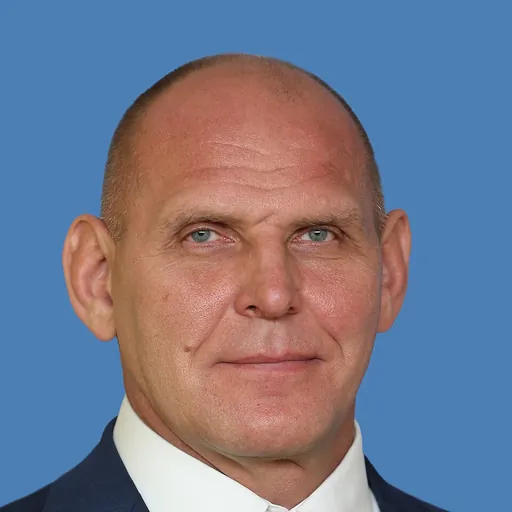
About Alexander Karelin
Born 1967. Alexander Karelin is a Russian politician, wrestler and statesperson.
Aleksandr Aleksandrovich Karelin (; born 19 September 1967) is a Russian politician and retired athlete.
Karelin competed in Greco-Roman wrestling, representing the Soviet Union and Russia between 1986 and 2000. Nicknamed the "Russian Bear", "Russian King Kong", "Alexander the Great", "The Experiment", and "The Crane from Novosibirsk", he is widely considered to be the greatest and most dominant Greco-Roman wrestler of all time. Karelin won gold medals at the 1988, 1992, and 1996 Olympic Games under a different flag each time (Soviet Union, Unified Team, and Russia respectively), and a silver medal at the 2000 Olympic Games. His wrestling record at the senior level was 887 wins and two losses, both considered controversial and both by a single point. Prior to his defeat to American Rulon Gardner at the 2000 Olympics finals, a point had not been scored against him in competition the previous six years. He went undefeated in the World Championships, having never lost a match, winning nine gold medals, and he won twelve gold medals at the European Championships. His twelve gold medals at the world level are the most in men’s wrestling history across both freestyle and Greco-Roman disciplines. Karelin's thirteen total world-level medals are tied for the all-time record in men’s wrestling history, along with American wrestler Bruce Baumgartner. He was the national flag bearer at three consecutive Olympics: in 1988 for the Soviet Union, in 1992 for the Unified Team, and in 1996 for Russia.
Due to his dominance and accomplishments, he was named the greatest Greco-Roman wrestler of the 20th century by the International Federation of Associated Wrestling Styles (FILA), and is part of the class of ten inaugural inductees into the FILA International Wrestling Hall of Fame in 2003. In 2007, Karelin, alongside Buvaisar Saitiev, were voted the best wrestlers in the history of the sport by FILA. Four times he was awarded the "Golden Belt" as the best wrestler of the planet by FILA – in 1989, 1990, 1992, and 1994.
In addition to his success in wrestling, Karelin was a sambo champion during his service in the Internal Troops and participated in a strongman contest. In 1999, he competed in a mixed martial arts bout, defeating Akira Maeda by unanimous decision, though the bout is seen as a work. He was named a Hero of the Russian Federation in 1996. He entered politics in 1999, being elected a deputy of the State Duma that year. He sat in the Duma through various convocations until 2020, when he entered the Federation Council as a senator.
Wrestling career Karelin was born as a baby. He was an avid fan of literature and mathematics during his school years. His father introduced him to strength training, giving him a kettlebell and sledgehammer and placing a truck tire in the yard for exercise. As a schoolboy, Karelin also loaded coal, gathered firewood, and cared for the family's livestock while his parents worked, which he credited his father with helping him develop his character. Being naturally very big, he came to a wrestling gym, aged 13, standing tall and weighing , Karelin grew physically very fast and from 16 years of age throughout his entire career he competed in the super heavyweight division. Karelin was named Master of Sport of the USSR in 1984 and Master of Sport of the USSR, International Class by the age of 18 in 1985. Karelin won gold at Friendship-84 in Greco-Roman wrestling as a junior. In 1986, he competed in 14 tournaments, winning all of them. In 1985 and 1987, Karelin won the World Junior Championship, and in 1986, won the European Junior Championship.
Karelin had his first loss (score 0–1) at the senior level at the USSR championships in 1987, to the reigning Russian and European champion Igor Rostorotsky, which was considered controversial; he then defeated Rostorotsky at the next USSR Championships, while recovering from a flu and a recent concussion, by fall,
Karelin was a 13-time national champion of the USSR, CIS, and Russia from 1988 to 2000, with these national championships being regarded as hard to win as the European Championships, and arguably higher in level than the World Championships. He is listed as runner-up to David Koplovitz at the 1992 Wrestling World Cup, for while he won all of his matches at the event, his partner Andrey Grishin competed in the rest of the rounds, and so they did not accumulate enough ranking points to beat the American team. After his first Olympic victory, Karelin was named Honored Master of Sport of the USSR in 1988. At the 1996 Summer Olympic Games in Atlanta, Karelin faced American Matt Ghaffari for the gold medal. Karelin had come off a shoulder surgery and looked vulnerable against a strong Ghaffari, who was able to repel Karelin's efforts to lift and slam him, forcing Karelin to use all of his skill and experience to defend a 1–0 lead.
In 1995, the IV International Alexander Karelin Prize Tournament, also known as the Karelin Cup, was held in Novosibirsk. Karelin won, beating Matt Ghaffari in the final. Karelin is also a five-time winner of the International Tournament in Memory of Ivan Poddubny. Karelin had previously beaten Gardner in 1997 with a score of 5–0 and throwing him three times. His loss to Gardner is considered one of the biggest upsets in sports history. His loss in the final of the Sydney Olympics was his first and only international loss, having previously been unbeaten throughout his international career. Karelin retired from competitions in 2000.
Thus his only two losses at the senior level were in finals, those ultimately being the 1987 USSR Championships to Rostorotsky, and 2000 Summer Olympics to Gardner. but his senior level record was an astounding 887–2.
Karelin was dominant against his rivals, having a record of 11–0 against Swedish wrestler Tomas Johansson with a combined score of 74–1. He had a record of 23–0 against American wrestler Matt Ghaffari.
Karelin holds the record for most world-level gold medals at 12, the most for either freestyle or Greco-Roman wrestling in men's competitions,
Training style Karelin was revered for his extraordinary strength and unprecedented success in international competition. He competed in the heaviest weight class of his day, 130 kg (286 lb). His coach was at first skeptical about a big but undeveloped boy, yet he accepted Karelin and motivated him for hard training, both in wrestling technique and physical strength. As a result, over the years Karelin progressed from 0 to 42 pull-ups. His conditioning and quickness combined with his dominance of the sport, led to him being known as "The Experiment". When asked why he thought he was called that (referring to a biased opinion on his alleged PED use), Karelin noted that: "No one can completely believe that I am natural. The most important drug is to train like a madman – really like a madman. The people who accuse me are those who have never trained once in their life like I train every day of my life."
Karelin's daily training drills included hours of rowing and long runs through Taiga forest often with a large log on his back. He favored the overhead press and also used standard 2-pood kettlebells for arm exercises at a daily weight routine. He would clean and press over . He would reportedly do 10 reps of of Zercher deadlifts. Karelin would routinely bench press or more as part of his workout. Tuomo Karila, a Finnish Greco-Roman wrestler, noted that even for a heavyweight Karelin was remarkably strong and that he was unusually agile for his size, and recalled that Karelin was able to do around 50 chin-ups. Freestyle wrestler and Olympic gold medalist Anatoly Beloglazov recalled that despite his large frame, Karelin moved "like a small guy" while playing football, handling the ball well and being unusually fast for a heavyweight. He also noted that Karelin trained with very heavy weights and rapidly developed physical strength, and that Karelin could climb a rope as quickly as much lighter wrestlers and had no equal in the exercise despite Karelin weighing far more. When asked about his toughest opponent, he instantly replied: "My refrigerator," referring to the time for which he bear hugged his refrigerator, weighing over 500 lbs, and carried it up through eight flights of stairs of his hometown 9-storied apartment building. Karelin also took part in a strongman competition, that being the 1991 European Hercules, and without prior preparation, he managed to place 8th.
Wrestling style Karelin was famous for his reverse body lift, the Karelin Lift, where facing the opponent who was lying flat on the mat to keep from being thrown, Karelin hoisted his opponents into the air and slammed him violently to the mat. This devastatingly effective maneuver, when properly executed, awarded Karelin 5 points per throw, the maximum awarded in Greco-Roman wrestling. The throw had long been in use by lighter wrestlers but not by heavyweights – because of the immense strength required to raise, spin and hit the mat with a 560+ lbs combined weight of both athletes (280+ of which resist desperately to the performed maneuver). Karelin's ability to perform this throw against elite opponents weighing as much as 130 kg amazed other participants and observers of the sport. His exceptionally long reach, with measurements between helped him to grip his opponents' bodies. He was known for his large stature such as a very thick neck and muscular legs. In his early matches before adopting the reverse body lift, Karelin used arm bars, half nelsons, and gut wrenches. He won the 1993 World Championships despite breaking two ribs in the opening bout against Matt Ghaffari. Another injury occurred at the 1996 European Championships in Budapest, as he had torn the right pectoralis major muscle so badly that doctors predicted he would not be able to use his right hand for several months. Karelin won the Championships, but he had to be urgently operated on in Budapest. Despite not being fully recovered, he won the 1996 Olympics three months later. The match took place in the Maeda-owned professional wrestling organization RINGS. Though widely considered to have been a work style wrestling contest, the match is counted as an official mixed martial arts (MMA) match in Sherdog's record database. Karelin weighed in at . Win
Akira Maeda Decision (Unanimous) Rings: Final Capture
Japan Political career
Between 1995 and 1999, Karelin served with the Russian tax police and retired in the rank of colonel. In 2017, he entered the PutinTeam, a social movement aimed at promoting Vladimir Putin's policies.
In 2020, Karelin was appointed as senator from the Legislative Assembly of Novosibirsk Oblast in the Federation Council. He took up the post on 25 September 2020, and is a member of the council's committee on International Affairs. He was sanctioned by the United Kingdom in 2022 in relation to the Russo-Ukrainian War.
Personal life Karelin graduated from the Novosibirsk Institute of Transportation in 1985, followed by the Siberian Academy of Physical Culture, a military school of the Soviet Ministry of Internal Affairs (MVD USSR) and the Saint Petersburg University of MVD USSR. In 1998 he defended a PhD and in 2002 a habilitation in sport-related pedagogy; he also holds a degree in law. His PhD is titled: "Methods of execution of suplex throw counters" , and "Integral training system for top-level wrestlers" . Ivan (born 1994) is coached by Kuznetsov and competes in the Greco-Roman superheavyweight division, in which he is a Master of Sport. Vasilisa (born c. 1999) is a rhythmic gymnast. Karelin had an older brother, Sergei Aleksandrovich Karelin, who died in 2017 at the age of 56.
Karelin described himself as a fifth-generation Siberian and stated that his ancestors had originally come to Siberia as exiles.
Karelin is an Orthodox Christian. Since he was young, Karelin has sought to be a "classical man", and is well-versed in music and literature, with an interpreter of his stating "His knowledge and his feeling for poetry, literature and music are incredible." During his service, he competed in sambo and won the USSR Internal Troops Sambo Championship.
During his service in the Internal Troops, Karelin held several roles between 1986 and 1995: he was sports instructor of the 2nd category (1986–1991), instructor of the highest qualification (1991–1992), and finally, coach of the sports team (1992–1995).
Legacy and awards
Karelin was named as the greatest Greco-Roman wrestler of the 20th century by the International Federation of Associated Wrestling Styles (FILA), In 2007, Karelin, alongside Buvaisar Saitiev, were voted the best wrestlers in the history of the sport by FILA. Four times he was awarded the "Golden Belt" as the best wrestler of the planet by FILA – in 1989, 1990, 1992, and 1994. He was also included in the 25 best world athletes of the 20th century. Since 1992, an annual wrestling competition is held in Novosibirsk in his honor. and as being one of the greatest of all time. He is also remembered as being one of the most feared and intimidating athletes ever. He is also seen as one of the most gifted athletes of all time due to his combination of explosiveness, strength, intellect, flexibility, and agility. The UFC commentator Joe Rogan described him as "the scariest wrestler of all time" and a "human panther".
He has been praised as one of the greatest wrestlers ever by, or usually as the single greatest ever, by other combat athletes like Abdulrashid Sadulaev, Alexander Romanov, Mark Madsen, Juha Ahokas, and even by Rulon Gardner himself.
Rulon Gardner stated about Karelin that: Karelin was named a Hero of the Russian Federation in 1996 and awarded the Order of Friendship of Peoples (1989), Order of Honour (2001) and Order "For Merit to the Fatherland" IV class (2008). In 2017, he was awarded the Order "For Merit to the Republic of Dagestan". He was also named a Merited Master of Sports of the USSR (1988).
He is a hidden playable character in the Japan-only, AKI Corporation-created, Nintendo 64 video game: Virtual Pro Wrestling 2.
Don’t just read it —
keep it.
Full-length biographies made to live with: read them, listen on the way to work, watch them tonight.
- E-book
- Audio
- Video
Instant download · yours to keep · every purchase keeps this site free
Important facts
People in Alexander Karelin's life
Named in this biography and alive at the same time






Related people
Same field, nearest in time




Contemporaries
People whose lives overlapped Alexander Karelin's



Frequently asked questions
Who is Alexander Karelin?
Soviet-Russian wrestler
When was Alexander Karelin born?
Alexander Karelin was born on 19 September 1967 in Novosibirsk.
What is Alexander Karelin's occupation?
Alexander Karelin is a politician, wrestler and statesperson.
What nationality is Alexander Karelin?
Alexander Karelin is Russian.
Sources & further reading
· Wikipedia: Alexander Karelin
Cite this page
APA: Biography.guide. (2026). Alexander Karelin. https://biography.guide/alexander-karelin/
MLA: "Alexander Karelin." Biography.guide, https://biography.guide/alexander-karelin/.
Chicago: "Alexander Karelin." Biography.guide. https://biography.guide/alexander-karelin/.
Data last updated: 2026-09-22 · Spot an error? Report a correction.
Portrait: Wikimedia Commons · author & licence
Page generated 2026-09-27 05:03 UTC