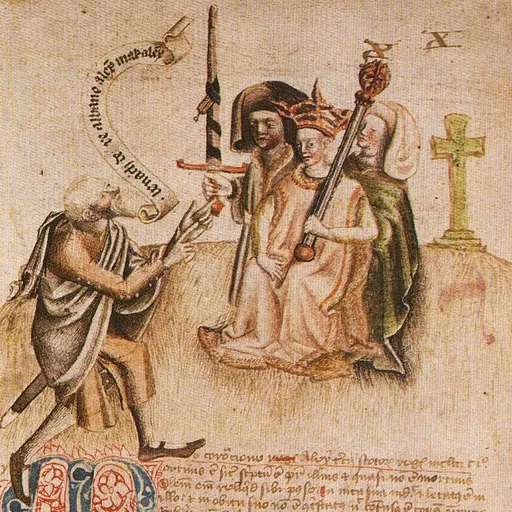
About Alexander III of Scotland
Lived 1241 – 1286 (aged 44). Alexander III of Scotland was a Scottish monarch.
Alexander III (; Modern Gaelic: ; 4 September 1241 – 19 March 1286) was King of Alba (Scotland) from 6 July 1249 until his death. He concluded the Treaty of Perth, by which Scotland acquired sovereignty over the Western Isles and the Isle of Man. His heir and only grandchild, Margaret, Maid of Norway, died before she could be crowned.
Life
Alexander was born at Roxburgh, the only son of Alexander II by his second wife, Marie de Coucy. His father died on 6 July 1249, and he became king at the age of seven, inaugurated at Scone on 13 July 1249.
The years of his minority featured an embittered struggle for the control of affairs between two rival parties, the one led by Walter Comyn, Earl of Menteith, the other by Alan Durward, Justiciar of Scotia. The former dominated the early years of Alexander's reign. At the marriage of Alexander to Margaret of England in 1251, Henry III of England seized the opportunity to demand homage from his son-in-law for the Scottish kingdom, but Alexander did not comply. In 1255, an interview between the English and Scottish kings at Kelso led to Menteith and his party losing to Durward's party. Though disgraced, they still retained great influence, and two years later, seizing the person of the King, they compelled their rivals to consent to the establishment of a regency representative of both parties.
On attaining his majority at the age of 21 in 1262, Alexander declared his intention to resume the projects on the Western Isles which the death of his father thirteen years before had cut short. She died in 1275, after they had had three children: Margaret (28 February 1261 – 9 April 1283), who married King Eric II of Norway;
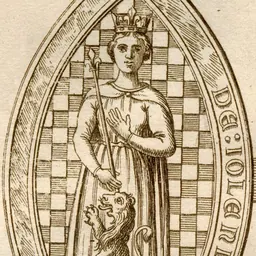
Towards the end of Alexander's reign, the death of all three of his children within a few years made the question of the succession one of pressing importance. In 1284, he induced the Estates to recognise as his heir presumptive his granddaughter, Margaret, Maid of Norway. The need for a male heir led him to contract a second marriage to Yolande of Dreux on 1 November 1285.
Death Alexander died in a fall from his horse while riding in the dark to visit the Queen at Kinghorn in Fife on 19 March 1286 because it was her birthday the next day. He had spent the evening at Edinburgh Castle celebrating his second marriage and overseeing a meeting with royal advisers. He was cautioned against making the journey to Fife because of weather conditions but crossed the River Forth from Dalmeny to Inverkeithing anyway. On arriving in Inverkeithing, he insisted on not stopping for the night, despite the pleas of the nobles accompanying him and one of the burgesses of the town, Alexander Le Saucier. Le Saucier (who was either linked to the King's kitchen or the master of the local saltpans) must have been known to the King, since his rather blunt warning to the King lacks the usual deference: "My lord, what are you doing out in such weather and darkness? How many times have I tried to persuade you that midnight travelling will do you no good?"
However, Alexander ignored the repeated warnings about travelling in a storm and set off with his retinue and two local guides. there is none at the site where his body was found; however, there is a very steep rocky embankment, which "would have been fatal in the dark." After Alexander's death, his realm was plunged into a period of darkness that would eventually lead to war with England. He was buried in Dunfermline Abbey.
As Alexander left no surviving children, the heir to the throne was his unborn child by Queen Yolande. When Yolande's pregnancy ended, probably with a miscarriage, Alexander's three-year-old granddaughter, Margaret, Maid of Norway, became the heir. Margaret died, still uncrowned, on her way to Scotland in 1290. The inauguration of John Balliol as King on 30 November 1292 ended the six years of the Guardians of Scotland governing the land.
The death of Alexander and the subsequent period of instability in Scotland were lamented in an early Scots-language poem recorded by Andrew of Wyntoun in his Orygynale Cronykil of Scotland:
Richard Oram has challenged the picture of plenty during the reign of Alexander painted by Wyntoun, pointing out that at that time climatic conditions were deteriorating after the Medieval Climate Anomaly.
In 1886, a monument to Alexander III was erected at the approximate location of his death in Kinghorn.
Legend
Raphael Holinshed, in his oft-fanciful history of England in Holinshed's Chronicles, stated that at Alexander III's wedding to Yolande de Dreux, "a creature resembling death, naked of flesh & lire, with bare bones right dreadfull to behold" appeared at the end of a dance and caused it to be hurriedly concluded. This was, in tradition, an omen of death.
A similar account is given in Walter Bower's Scotichronicon, a figure that "seemed to glide like a ghost rather than walk on feet" supposedly appeared amidst a group performing Scottish sword dances.
Fictional portrayals
Alexander III has been depicted in historical novels. They include: The Thirsty Sword (1892) by Robert Leighton. The novel depicts the "Norse invasion of Scotland" (1262–1263, part of the Scottish–Norwegian War) and the Battle of Largs. It includes depictions of Alexander III and his opponent Haakon IV of Norway.
The Crown in Darkness (1988) by Paul C. Doherty. A crime fiction novel in which Hugh Corbett investigates the "mysterious death" of Alexander III (1286). Alexander supposedly suffered a fatal fall from his horse. But there are suspicions of murder. The novel concludes that Alexander was indeed murdered "by a fanatical servant" of Edward I of England. The killer acting according to "Edward's secret desire to overwhelm and control Scotland". Doherty suggests that the personal relations of the two kings were strained by constant arguments, though this is not confirmed by historical sources.
Quest For A Maid (1988) by Frances M Hendry. The novel depicts the life of Meg, her power-hungry older sister Inge, Lady Marjorie, Countess of Carrick, and their part in securing the succession of Lady Marjorie's son Robert the Bruce to the Scottish throne. It includes depictions of Alexander III's death as "falling off a cliff" with sorcery as the cause.
Insurrection (2010) by Robyn Young. This is the first in a series of novels primarily about the life and times of Robert the Bruce. However, it covers Alexander III and the circumstances surrounding his death in some detail.
Crusader (1991) by Nigel Tranter. This novel follows the minority of Alexander III and his relationship with David de Lindsay. Tranter, who has written scores of historical novels spanning the range of Scotland's history, also wrote: "Envoy Extraordinary" (1999) (about Patrick Earl of Dunbar) and "True Thomas" (1981) (about Thomas the Rhymer), both of which take place during the reign of Alexander III, and in which Alexander is a featured character.
Don’t just read it —
keep it.
Full-length biographies made to live with: read them, listen on the way to work, watch them tonight.
- E-book
- Audio
- Video
Instant download · yours to keep · every purchase keeps this site free
Important facts
Family & relationships
People in Alexander III of Scotland's life
Named in this biography and alive at the same time

Related people
Same field, nearest in time
Contemporaries
People whose lives overlapped Alexander III of Scotland's
Frequently asked questions
Who was Alexander III of Scotland?
King of Scots 1249–1286
When was Alexander III of Scotland born?
Alexander III of Scotland was born on 11 September 1241 in Roxburgh.
When did Alexander III of Scotland die?
Alexander III of Scotland died on 26 March 1286 in Fife.
What was Alexander III of Scotland's occupation?
Alexander III of Scotland was a monarch.
What nationality was Alexander III of Scotland?
Alexander III of Scotland was Scottish.
Sources & further reading
· Wikipedia: Alexander III of Scotland
· DBpedia: Alexander III of Scotland
Cite this page
APA: Biography.guide. (2026). Alexander III of Scotland. https://biography.guide/alexander-iii-of-scotland/
MLA: "Alexander III of Scotland." Biography.guide, https://biography.guide/alexander-iii-of-scotland/.
Chicago: "Alexander III of Scotland." Biography.guide. https://biography.guide/alexander-iii-of-scotland/.
Data last updated: 2026-09-30 · Spot an error? Report a correction.
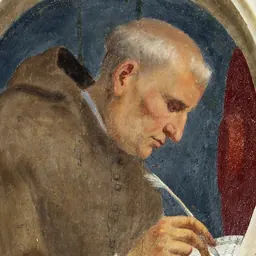
Portrait: Wikimedia Commons · author & licence
Page generated 2026-10-04 14:17 UTC