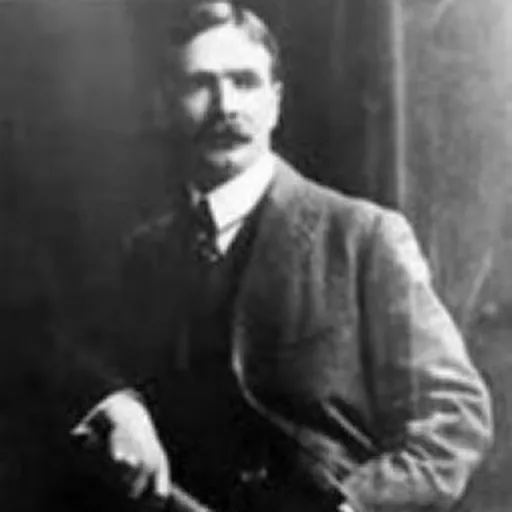
About Alexander George McAdie
Lived 1863 – 1943 (aged 80). Alexander George McAdie was an American meteorologist, professor and writer.
Alexander George McAdie (August 4, 1863 – November 1, 1943) was an American meteorologist.
McAdie was born in New York City. While in college he joined the Army Signal Service, the predecessor of the U.S. Weather Bureau. He graduated from Harvard University in 1885.
From 1903 until 1913 he ran the U.S. Weather Bureau in San Francisco. He was also the vice president of the Sierra Club, starting in 1904, and continuing until 1913. In 1913 he became Professor of meteorology at Harvard, and remained there until 1931. During the same period he also served as the director of the Blue Hill Observatory.
Among his accomplishments was the invention of a device to prevent frost from harming fruit. He was a pioneer in the use of kites to study conditions at high altitudes. In 1885 at Blue Hill, Boston, he modernized the experiments of Benjamin Franklin by attaching a voltmeter to a kite and measuring the voltage difference between the ground and several hundred feet up. He also made studies of the atmospheric effects of smoke, the connection between the aurora and electricity in the atmosphere, and the dangers posed by lightning. He is the author of a cloud atlas.
He is also known for testifying about the potential effects of electrocution (based on his experience with lightning) in 1899 at the first trial to decide if the electric chair was cruel and unusual punishment. His testimony was used against the use of the electric chair for the death penalty.
In addition to his work with the weather bureau, McAdie wrote a detailed account of the 1906 San Francisco earthquake and compiled a catalog of earthquakes on the Pacific coast.
He was married to Mary Randolph Brown McAdie. He died in Hampton, Virginia, but he is buried in the Monticello graveyard in Abemarle County, Virginia.
Awards and honors Mount McAdie in the Sierra Nevada range was named after him. The crater McAdie on the Moon is named after him. The Fleet Weather Center building in Norfolk, VA is named after him.
Don’t just read it —
keep it.
Full-length biographies made to live with: read them, listen on the way to work, watch them tonight.
- E-book
- Audio
- Video
Instant download · yours to keep · every purchase keeps this site free
Important facts
People in Alexander George McAdie's life
Named in this biography and alive at the same time

Related people
Same field, nearest in time



Contemporaries
People whose lives overlapped Alexander George McAdie's


Frequently asked questions
Who was Alexander George McAdie?
American meteorologist (1863-1943)
When was Alexander George McAdie born?
Alexander George McAdie was born on 4 August 1863.
When did Alexander George McAdie die?
Alexander George McAdie died on 1 November 1943.
What was Alexander George McAdie's occupation?
Alexander George McAdie was a meteorologist, professor and writer.
What nationality was Alexander George McAdie?
Alexander George McAdie was American.
Sources & further reading
· Wikipedia: Alexander George McAdie
· DBpedia: Alexander George McAdie
Cite this page
APA: Biography.guide. (2026). Alexander George McAdie. https://biography.guide/alexander-george-mcadie/
MLA: "Alexander George McAdie." Biography.guide, https://biography.guide/alexander-george-mcadie/.
Chicago: "Alexander George McAdie." Biography.guide. https://biography.guide/alexander-george-mcadie/.
Data last updated: 2026-09-20 · Spot an error? Report a correction.
Portrait: Wikimedia Commons · author & licence
Page generated 2026-09-27 04:58 UTC