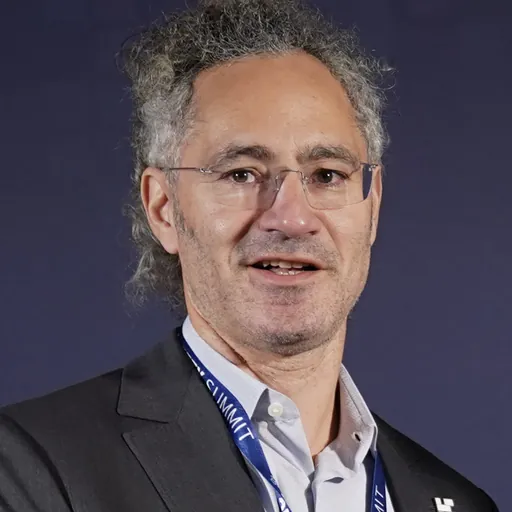
About Alexander C. Karp
Born 1967. Alexander C. Karp is an American businessperson, entrepreneur, merchant and palantir Technologies.
Alexander Caedmon Karp (born October 2, 1967) is an American billionaire businessman and entrepreneur. He is the co-founder and CEO of the software firm Palantir Technologies.
Karp earned his J.D. degree from Stanford Law School and a doctorate in social theory from Goethe University Frankfurt. He subsequently worked in finance, founding the investment firm Caedmon Group, where he managed money for clients including wealthy European investors and invested in start-up companies and stocks. At Stanford, he met Peter Thiel and in 2003, they alongside three others co-founded Palantir.
In 2025, his net worth exceeded $18 billion, making him among the wealthiest 200 people in the world as reported by Forbes and the Bloomberg Billionaires Index, and Time magazine named him on the Time 100 list of the world's most influential people of that year.
Early life and education Alexander Caedmon Karp was born on October 2, 1967 the eldest son of Robert Joseph Karp, a Jewish clinical pediatrician, and Leah Jaynes Karp, an African American artist.
Like his father, Karp attended Central High School in Philadelphia, graduating in 1985. He said he struggled with dyslexia from an early age. He was influenced by his parents' activism for civil rights and social justice during his youth and went to many protests. Karp stated that "some black people considered me black while some did not", and said, "I view me as me. And I'm very honored to be honored by all groups that will have me." He said that before he went to Germany, he had underestimated how German his upbringing had been.
Karp initially wanted to be a social theorist. He earned a bachelor's degree in philosophy from Haverford College in Haverford, Pennsylvania, in 1989, then enrolled at Stanford Law School, where he earned a J.D. in 1992. His doctoral thesis was titled "Aggression in der Lebenswelt: Die Erweiterung des Parsonsschen Konzepts der Aggression durch die Beschreibung des Zusammenhangs von Jargon, Aggression und Kultur" (Aggression in the Lifeworld: The Extension of Parsons' Concept of Aggression by Describing the Connection Between Jargon, Aggression, and Culture). Karola Brede told him he could write the thesis in English, but he replied that it was important to him that he could write it in German. Karp later claimed that his goal at the time was to amass $250,000 to return to Berlin to read and write as a dilettante, though he failed to explain how it was possible to build "a London-based money management firm" attracting "high net-worth investors" with $12,000.
For some time, he helped Thiel to gather funding for Clarium Capital. In 2004, along with Thiel and others, Karp co-founded Palantir Technologies, becoming its CEO.
The New York Times ranked Karp the highest-paid CEO of a publicly traded company in 2020, the year the company went public, with compensation worth $1.1billion. In 2024, he was the highest-paid CEO of a publicly traded company in the United States, with a "compensation actually paid" of almost $6.8 billion. The Economist chose Karp, a former director of the publication , as the 2024 CEO of the Year. . He is also co-managing director at Frankfurt-based Palantir Technologies Gmbh, and sits on the board of Palantir Technologies UK Ltd.
According to Steinberger, Karp had no previous technical or business training, but his background in philosophy helped with understanding ethical or political concerns. Karp criticizes companies like Google and Facebook for their attitude to data protection. Facebook became the foil against which Palantir defined its identity; when Palantir expanded in Palo Alto and took over a former Facebook office, they painted over a famous wall associated with Facebook. Among Palantir leadership, there were differences in philosophy, with Thiel complaining about Karp always choosing the hard, complex way when a more straightforward path might have sufficed. Despite this, Thiel largely left the operation of the company in Karp's hands.
In 2024, Karp was 1143rd on the Forbes annual World's Billionaires List with a net worth of $2.9 billion. In 2025 his net worth at times exceeded $18 billion, ranking him among the 200 wealthiest people in the world on the Forbes Real-Time Billionaires List and the Bloomberg Billionaires Index.
Board and advisory roles Axel Springer SE, member of the board of directors (2018–2020) and shareholders committee (2022–2025) BASF, member of the board of directors (until 2020) The Business Council, member The Economist Group, former member of the board of directors It provided robots for police, firefighters and SWAT teams. At the 2023 edition of the forum, he stated that "Somehow the corporate elite of this country thinks when it’s time to make money, you stand up, and when it’s time to stand up, you go play golf. And we’ve got to change that. That’s our fault".
The 2025 documentary Watching You: The World of Palantir and Alex Karp explores the political and business network that Karp has built in Germany.
He is a member of the steering committee of Bilderberg Meeting. The secret meeting between Karp, Thiel and Sweden's prime minister Ulf Kristersson at the 2025 Bilderberg meeting has caused controversies in Sweden (Kristersson was not on the official list). Karp also participates in the Munich Security Conference.
Dutch MEP Sophie in ’t Veld tracks the close proximity between Karp and his company Palantir with EU leaders like Ursula von der Leyen and Margrethe Vestager, noting that when the EU delegation visited Washington in 2019, the only private company they contacted was Palantir. In June 2022, he was the first CEO of a major Western company to meet president Volodymyr Zelenskyy after Russia invaded Ukraine. In June 2026, following Karp's visit to Ukraine, Ukraine's defense minister Mykhailo Fedorov said that it was an advantage for Ukraine to have Alex Karp, as well as others like Elon Musk and Eric Schmidt on their side. Federov described Palantir as an "effective IT weapon" that the Ukrainians had, but the Russians did not. Fedorov also recalled that Karp was very impressed with the way Ukraine integrated Palantir's technologies "into the general logic of warfare", thus contributing to the Western side's developed combat control systems (Palantir initially provided the software and services to Ukraine pro bono, including financing the new personnel they hired in Ukraine. Later as costs climbed, Ukraine's allies stepped in to offset the expenses).
Views Political views On the West In 2025 Time magazine listed Karp as one of the world's 100 most influential people, calling him "the embodiment of a new kind of Silicon Valley billionaire: an unashamed techno-nationalist who evangelizes Western power". In naming him to the Time 100 list, the magazine noted that Karp had once quoted Samuel P. Huntington's The Clash of Civilizations in a letter he wrote to investors: "The rise of the West was not made possible 'by the superiority of its ideas or values or religion ... but rather by its superiority in applying organized violence. [...] Westerners often forget this fact; non-Westerners never do.'" and a progressive ("but not woke"). In 2024, the Financial Times identified Karp as "a major Biden donor". Current Affairs editor Nathan J. Robinson wrote in 2024 that Karp "seems to have some idiosyncratic personal definition in mind that has nothing in common with the socialist tradition". In 2024, Karp said that while he was "not thrilled" with the direction of the Democratic Party, he would still be "voting against Trump". That same year, he called for the Democrats to project more strength. He has also protested open-border immigration policies in the U.S. and Europe: "You have an open border, you get the far right. [...] And once you get them, you can't get rid of them."
In a November 2025 interview with Wired, he said that to a family member that disagreed with him in a private conversation, "I would be pointing out that Trump’s decisions on AI, and his decisions on the Middle East, are very different than people in the Democratic Party would have made, and very good." Also, he would consider the Democratic Party to have left him if the Zohran Mamdani wing took over, which he viewed as the result of "[the] role played [by] universities and elite institutions [that are] teaching pagan religion views", describing one "[portraying an] AI-driven, AGI environment where no one has a job [because] labor is going to be valueless".
Interviewed by his biographer Michael Steinberger (whose book The Philosopher in the Valley: Alex Karp, Palantir, and the Rise of the Surveillance State was published in November 2025), Karp cites the Democrats' unresponsiveness to immigration, Iran and attitude to antisemitism ("They talk all the time about racism but won't talk about antisemitism") as reasons for his disillusion with the party. Steinberger remarks that Karp was particularly concerned about the anti-Israel protests that erupted after the October 7 attacks in Israel.
Karp has condemned "woke" ways of thinking, calling them the central risk to his company Palantir and to the United States as a whole. He has called Palantir a "counter-example" to companies he considers "woke". He said the U.S. government should have a strong hand in tech regulation and that western countries should dominate AI research.
On Israel
Karp made a number of remarks on the Gaza war strongly supporting Israel. He has strongly condemned the 2024 pro-Palestinian protests on university campuses, calling their views a "pagan religion" and "an infection inside of our society". At the AI Expo for National Competitiveness, he remarked that "the peace activists are war activists" Palantir announced that they would set aside 180 positions for Jewish college graduates, citing antisemitism on college campuses related to the protests. Karola Brede, who served as referee for Karp’s doctoral dissertation, notes that Karp always had a type of political agility associated with liberalism. When Karp was young, he had an affinity with the FDP. He tried to persuade CDU member Michel Friedman, who lived on the same street in Frankfurt, that Friedman had chosen the wrong party. In 2019, however, Karp said that in Germany he would vote for the CDU. In 2026, Süddeutsche Zeitung notes that he is now close to the Christian Social Union (CSU).
In September 2025, Karp called on German leaders to "talk about the crisis". He suggested a plan to improve the situation in Germany and save the industry: (1) promoting the political power of the founders and business leaders, who would bring about the change, rather than promoting the power of the political class. He specifically referred to SAP CEO Christian Klein; (2) creating special technological zones with fewer regulations and laxer labor rules; (3) creating specialized micromodels of economic structures (instead of copying Silicon Valley) that focused on Germany's strengths in industrial AI for cars, pharmaceuticals, chemicals, and mechanical engineering; (4) informing the population about a looming economic crisis, explaining that both prosperity and the welfare state could only be maintained if industrial and technological development could be secured, while noting that German pacifism was the country's Achilles' heel and should be dealt with so that country could create sufficient deterrents; and (5) countering misguided policies on immigration, energy (especially nuclear energy policy) and technology, all of which had squandered the German advantage and should be changed. He saw his company Palantir as a continuation of Germany's cultural legacy and virtues. He also complained about the public's perception of his friend and co-founder Peter Thiel, who he said was undeservingly vilified by the media.
At the 2023 opening of Dimensions: Digital Art since 1859, an exhibit in Leipzig supported and sponsored by Karp, former German vice chancellor Sigmar Gabriel, and CEO Tim Höttges of Deutsche Telekom (an advocate for more creative control in the U.S. but a more innovative spirit in Europe), Karp stated: "We can't leave the entire future to the Americans."
In 2026, Palantir summarized one of the arguments in Karp and Zamiska's Technological Republic as "The postwar neutering of Germany and Japan must be undone".
Business views Karp is a critic of short sellers, and said he loves "burning the short sellers". He compared them to cocaine addicts and said that they "just love pulling down great American companies".
Personal life Karp lives in Lyman, New Hampshire, and owns 11 houses around the world. In a 2024 interview he described himself as Jewish,
As of 2025, Karp is in long-term relationships with two women. He was described as "geographically monogamous".
Karp never learned to drive a car. He said, "I was too poor. And then I was too rich." His uncle, Gerald Jaynes, is the A. Whitney Griswold Professor of Economics, African American Studies, and Urban Studies at Yale.
Karp is fluent in German and speaks French.
In media Karp is the subject of the 2024 German documentary film Watching You: The World of Palantir and Alex Karp, directed by , which explores Palantir's influence and Karp's career, including interviews with former colleagues, politicians, and critics; Karp chose not to participate in the documentary.
Karp, with co-author with Nicholas Zamiska, published The Technological Republic: Hard Power, Soft Belief, and the Future of the West in February 2025. The book offers a critical perspective on what it deems Silicon Valley's complacency and the West's waning ambition, arguing that the software industry must partner with government to tackle urgent challenges, particularly the AI arms race.
Don’t just read it —
keep it.
Full-length biographies made to live with: read them, listen on the way to work, watch them tonight.
- E-book
- Audio
- Video
Instant download · yours to keep · every purchase keeps this site free
Important facts
People in Alexander C. Karp's life
Named in this biography and alive at the same time







Related people
Same field, nearest in time





Contemporaries
People whose lives overlapped Alexander C. Karp's



Frequently asked questions
Who is Alexander C. Karp?
businessman, author
When was Alexander C. Karp born?
Alexander C. Karp was born on 2 October 1967 in New York City.
What is Alexander C. Karp's occupation?
Alexander C. Karp is a businessperson, entrepreneur, merchant and palantir Technologies.
What nationality is Alexander C. Karp?
Alexander C. Karp is American.
Sources & further reading
· Wikipedia: Alexander C. Karp
Cite this page
APA: Biography.guide. (2026). Alexander C. Karp. https://biography.guide/alexander-c-karp/
MLA: "Alexander C. Karp." Biography.guide, https://biography.guide/alexander-c-karp/.
Chicago: "Alexander C. Karp." Biography.guide. https://biography.guide/alexander-c-karp/.
Data last updated: 2026-09-23 · Spot an error? Report a correction.
Portrait: Wikimedia Commons · author & licence
Page generated 2026-09-27 05:05 UTC