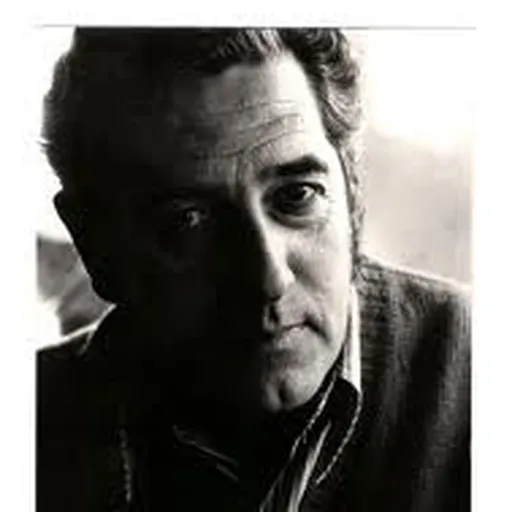
About Alberto Vanasco
Lived 1925 – 1993 (aged 68). Alberto Vanasco was an Argentine writer, poet, novelist and short story writer.
Alberto Vanasco (Buenos Aires, Argentina; 1925 – May 11, 1993) was an Argentine novelist, poet and short fiction writer.
Biography Alberto Vanasco was born in 1925 in Buenos Aires, Argentina. His family moved to San Juan to settle at an estate belonging to his grandfather on his mother's side as a consequence to the crisis of the 1930s, as his father lost his job at the Municipal Bank. There in San Juan, Alberto Vanasco started his primary education. In 1934, his family moved back to a suburb of Buenos Aires, and by 1939, he moved once again to the town of San Martin. Changing to different sites of residence, from the countryside to the suburbs, had a profound impact on the author's personality that was reflected on his poetry. During his studies at the Colegio Nacional de Buenos Aires he met other artists such as Mario Trejo, Aldo Cristiani, and César de Vedia. In 1943 he published his first book, a short novel entitled Justo en la cruz del camino (Just in the Way's Crossing).
After his father's death in 1944, his family returned to Buenos Aires; there Alberto Vanasco had different jobs: at the Transportation Corporation, at the Court, as private professor of mathematics, as a custom's officer, journalist, translator, among others. These jobs left on him an experience that he reflected on his poems and short stories.
In 1961 he travelled to New York, where he stood two years working for Crown Publishers. In 1968, he married Alicia Virginia Petti, with whom he travelled through Europe in 1972, and settled in Barcelona, at Alberto Cousté's house. From that moment he lived exclusively from his literary works and wrote television scripts. He published in the magazine Zona among other poets, and was professor of physics, mathematics, and literature. He participated in the vanguard literary movement. His job as a story teller adjusts to the necessity of renewing and broadening the possibilities of the novelistic language through new means or expressive instruments. He was pointed by critics as one of the Argentina writers that used the techniques of objectivism before this movement became widely known, his latter novelistic works comprise a trilogy in which this judgment is based: Sin embargo Juan vivía (Even Though Juan Lived, 1948); Para ellos la eternidad (Eternity for Them, 1957); Los muchos que no viven (The Many of Them Who Don't Live, 1964). In his poetic topics, identified with reality in different planes, it is evident a permanent interest and preoccupation for the political-social circumstances. He died on May 11, 1993, in Buenos Aires.
Works Novels Justo en la cruz del camino (Just in the Crossroads, 1943) Sin embargo Juan vivía (Nevertheless, Juan Lived, 1948) Para ellos la eternidad (For Them is Eternity, 1957), that was later made a movie in 1964 titled Todo sol es amargo (Every Sun is Bitter), directed by Alfredo Mathé and starring Federico Luppi, Lautaro Murúa, Héctor Alterio, Elena Cánepa and Haydée Padilla. Los muchos que no viven (The Many Who Don't Live, 1964) Nueva York-Nueva York (New York-New York, 1967) Otros verán el mar (Others Will See the Sea, 1977) Playwrights No hay piedad para Hamlet (No Mercy for Hamlet, 1948), in collaboration with Mario Trejo, Buenos Aires Municipal Award, 1957, and Florencio Sánchez National Award, 1960. Poetry 24 sonetos absolutos y dos intrascendentes (24 absolute sonnets and two intrascendental ones) (1945) Cuartetos y tercetos definitivos (Definitive Quartets and Tercets)(1947) Ella en general (She in General, 1954) Canto rodado (Rolling Stone [a play on words that can also mean Rolling Song], 1962). Sonetos (Sonnets, 1971), reedition of 24 sonetos absolutos y 2 intrascendentes and Cuartetos y Tercetos definitivos together. Short Fiction Memorias del futuro (Memories of the Future, 1966), in collaboration with Eduardo Goligorsky. Adiós al mañana (Goodbye to Tomorrow, 1967), in collaboration with Eduardo Goligorsky. Memorias del futuro (1976), book that included three stories from the previous book under the same title, and five from Adiós al mañana, with new short stories. Nuevas memorias del futuro (New Memories of the Future, 1977) Essay Vida y obra de Hegel (Life and Works of Hegel, 1973)
Don’t just read it —
keep it.
Full-length biographies made to live with: read them, listen on the way to work, watch them tonight.
- E-book
- Audio
- Video
Instant download · yours to keep · every purchase keeps this site free
Important facts
People in Alberto Vanasco's life
Named in this biography and alive at the same time

Related people
Same field, nearest in time




Contemporaries
People whose lives overlapped Alberto Vanasco's



Frequently asked questions
Who was Alberto Vanasco?
Argentine writer (1925–1993)
When was Alberto Vanasco born?
Alberto Vanasco was born on 18 January 1925 in Buenos Aires.
When did Alberto Vanasco die?
Alberto Vanasco died on 11 May 1993.
What was Alberto Vanasco's occupation?
Alberto Vanasco was a writer, poet, novelist and short story writer.
What nationality was Alberto Vanasco?
Alberto Vanasco was Argentine.
Sources & further reading
Cite this page
APA: Biography.guide. (2026). Alberto Vanasco. https://biography.guide/alberto-vanasco/
MLA: "Alberto Vanasco." Biography.guide, https://biography.guide/alberto-vanasco/.
Chicago: "Alberto Vanasco." Biography.guide. https://biography.guide/alberto-vanasco/.
Data last updated: 2026-09-22 · Spot an error? Report a correction.
Portrait: Wikimedia Commons · author & licence
Page generated 2026-09-27 05:02 UTC