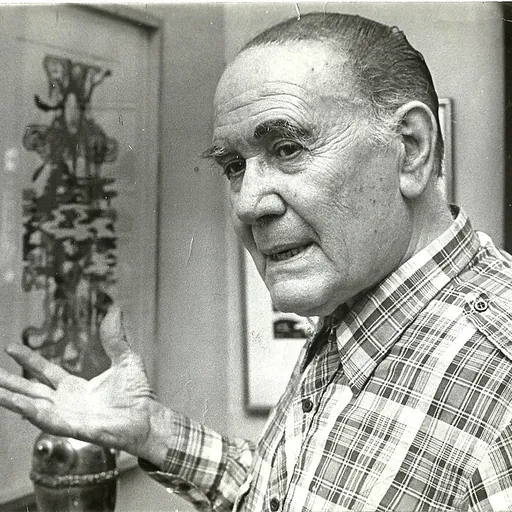
About Alberto Nicasio
Lived 1902 – 1980 (aged 77). Alberto Nicasio was an Argentine engraver, painter, copper engraver and artist.
Alberto Nicasio (August 10, 1902 – July 4, 1980) was an Argentine artist (xylographer) and educator. He was a member of the Argentinian National Academy of Arts. A street in the city of Córdoba and a primary school in the province are named after him.
Biography
Alberto Nicasio was born in Marseille, France, on 10 August 1902, the son of Alfredo Nicasio and Eugenia Lasserre. He married María Elena Las Heras in 1930; they had two daughters, María Elena and Carmen Olga.
As an artist, he participated in biennials in São Paulo, Mexico and Switzerland; he also participated in group exhibitions in the United States, Japan, Belgium, the Vatican, Spain, Chile, Uruguay and Brazil. He illustrated various books, such as Sarmiento's Facundo, José Hernández's Martín Fierro, Adonais, Percy Shelley's elegy and 30 woodcuts on William Henry Hudson's Tierra Purpúrea, among others. A number of exhibitions of his work were held posthumously.
Description of his work
Nicasio began experimenting with drawing and oil painting, and took part in group exhibitions in 1927 and 1928. Later, however, he abandoned his period as a painter and transitioned to woodcut, to which he dedicated the rest of his life.
Nicasio's oeuvre can be divided into periods in which his art varied. The first period was marked by a figurative character, depicting urban and suburban landscapes of Córdoba. These early engravings show the façades of buildings symbolic of Córdoba's colonial period, such as the Cathedral of Córdoba, or the buildings of the complex known as La Manzana Jesuítica, which includes the Compañía de Jesús and the Colegio Nacional de Montserrat. Also of note during this period were his landscape engravings such as La Cañada de Córdoba, as well as others such as the Barrancas de Córdoba and the old Suburbio Cordobés.
As a result of his interest in avant-garde art, he later began to experiment with geometrisation and abstract art. Thus, the following period of his work is characterised by a tendency towards abstraction, with simpler and more schematic forms, which would later evolve towards a more surrealist period.
A final period is characterised by the irruption of colour, in sharp contrast with his previous work in monochrome. At this stage, with the use of saturated inks (red, green and ochre), he approaches a neo-figurativism, but more synthetic and schematic.
He taught in normal and secondary schools. In 1950, he won the Chair of Engraving and later the directorship of the Escuela Superior de Artes (today the Faculty of Arts) of the National University of Córdoba. Vatican Museums 1946 General Directorate of Tourism, Córdoba 1970 Vatican Museum 1951 Prins Grand Prize 1951. National Academy of Fine Arts 1951 National University of Córdoba Award. Argentine Salon of Plastic Arts 1951 Grand Prize of Honour. National Ministry of Education 1952 First Prize in Engraving and Drawing, II Plastic Arts Salon, Córdoba 1953 First Prize, Municipal Salon of Plastic Arts, Córdoba 1956 Grand Prize of Honour, National Salon of Fine Arts, Buenos Aires 1956 Medal Honorable Senate of the Nation. Gold Medal 1957 Grand Prize of Honour in Engraving. Mar del Plata Salon 1958 Medal, Brussels International Exhibition 1958 First Prize at the Santa Fe Salon 1960 First Prize. National Salon on Historical Art, Buenos Aires 1963 Grand Prize of Honour. Plastic Arts Salon of Córdoba 1968 Prize for Intellectual Production. Plastic Arts of Córdoba 1970 Second Prize in Engraving, III Annual Salon of APAC, Córdoba 1973 Member of the National Academy of Fine Arts
Don’t just read it —
keep it.
Full-length biographies made to live with: read them, listen on the way to work, watch them tonight.
- E-book
- Audio
- Video
Instant download · yours to keep · every purchase keeps this site free
Important facts
People in Alberto Nicasio's life
Named in this biography and alive at the same time

Related people
Same field, nearest in time



Contemporaries
People whose lives overlapped Alberto Nicasio's



Frequently asked questions
Who was Alberto Nicasio?
wood engraver from Argentina (1902-1980)
When was Alberto Nicasio born?
Alberto Nicasio was born on 10 August 1902 in Marseille.
When did Alberto Nicasio die?
Alberto Nicasio died on 4 July 1980 in Argentina, Córdoba, Argentina.
What was Alberto Nicasio's occupation?
Alberto Nicasio was an engraver, painter, copper engraver and artist.
What nationality was Alberto Nicasio?
Alberto Nicasio was Argentine.
Sources & further reading
Cite this page
APA: Biography.guide. (2026). Alberto Nicasio. https://biography.guide/alberto-nicasio/
MLA: "Alberto Nicasio." Biography.guide, https://biography.guide/alberto-nicasio/.
Chicago: "Alberto Nicasio." Biography.guide. https://biography.guide/alberto-nicasio/.
Data last updated: 2026-09-20 · Spot an error? Report a correction.
Page generated 2026-09-27 05:10 UTC