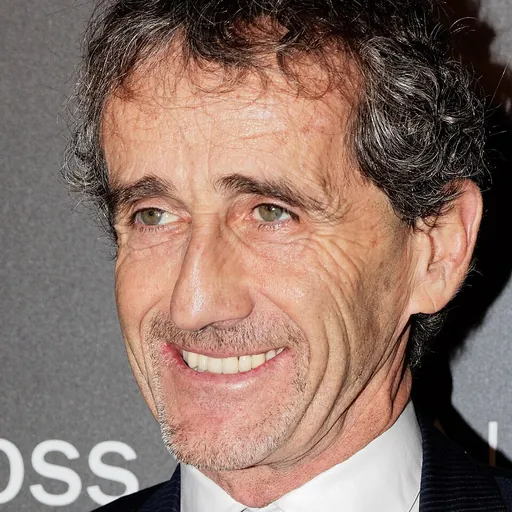
About Alain Prost
Born 1955. Alain Prost is a French racing automobile driver and formula One driver.
Alain Marie Pascal Prost (; born 24 February 1955) is a French former racing driver and motorsport executive, who competed in Formula One from to . Nicknamed "the Professor", (Prost was widely known as the Professor for his methodical and analytical approach to racing.) His father ran a furniture store.
Prost made the transition to open-wheel racing in 1976 and rapidly progressed through the junior categories. That year, he dominated French Formula Renault,
Formula One
McLaren (1980) After winning the European Formula Three title, Prost was courted by Formula One teams McLaren, Brabham, and Ligier. Prost would not return to McLaren until 1984, after Ron Dennis assumed full control of the team.
Renault (1981–1983) Prost was partnered with fellow Frenchman René Arnoux for . Motor sports author Nigel Roebuck reports that there were problems between Prost and Arnoux from the start of the season, Prost being immediately quicker than his more experienced teammate He did not finish the first two Grands Prix, due to collisions with Andrea de Cesaris in Long Beach and Didier Pironi at Jacarepaguá, but scored his first podium finish at Buenos Aires. He also did not finish in the next four races, and then won his first Formula One race at his home Grand Prix in France at the fast Dijon circuit, finishing two seconds ahead of his old teammate John Watson.
For Prost, his debut victory was memorable mostly for the change it made in his mindset. "Before, you thought you could do it," he said. "Now you know you can."
Prost won the first two Grands Prix of the 1982 season in South Africa, where Prost recovered from losing a wheel, and Brazil, where he finished third but was awarded the win after Piquet (first) and Keke Rosberg (second) were disqualified. He finished in the points on four other occasions, but did not win again. Despite retiring from seven races, Prost improved on his Drivers' Championship position, finishing in fourth, but with nine fewer points than the previous year. His relationship with Arnoux deteriorated further after the French Grand Prix. Prost believes that Arnoux, who won the race, went back on a pre-race agreement to support Prost during the race. His relationship with the French media was also poor. He has since commented that "When I went to Renault the journalists wrote good things about me, but by 1982 I had become the bad guy. I think, to be honest, I had made the mistake of winning! The French don't really like winners." He added that "It's hard to explain, but the French prefer martyrs who lose gloriously."
Arnoux left Renault in and American Eddie Cheever replaced him as Prost's partner, allegedly because of Renault's desire to sell more road cars in North America (three of the season's 15 races were on the North American continent). Prost earned a further four victories for Renault during the season and finished second in the Drivers' Championship, two points behind Nelson Piquet. Piquet and the Brabham team overhauled Prost and Renault in the last few races of the season. Prost, who felt the team had been too conservative in developing the car, found himself increasingly at odds with Renault's management, who made him the scapegoat for failing to win a championship. In addition to that, the French fans recalled the bitter fight that had caused their favourite, Arnoux, to leave the team. Prost said in an interview with ESPN during the final race that his car was "not competitive" and that he "didn't lose by my own fault" Renault fired Prost only two days after the South African race. He re-signed for McLaren for the 1984 season within days and moved his family home to Switzerland after Renault factory workers burned the second of 2 of Prost's cars, one of them being a Mercedes-Benz.
McLaren (1984–1989)
1984–1986 Prost joined double world champion Niki Lauda at McLaren in , driving the John Barnard designed McLaren MP4/2 which used a 1.5 litre TAG-Porsche V6 engine. He lost the world championship to Lauda in the final race of the season in Portugal by half a point, despite winning seven races to Lauda's five, The half point came from the , where Prost had been leading, albeit with Ayrton Senna (Toleman) and Stefan Bellof (Tyrrell) closing on him rapidly, when Clerk of the Course Jacky Ickx stopped the race at half distance due to heavy rain, which was controversial, for Ickx displayed the red flag without consulting the race officials. Under Formula One regulations, Prost received only half of the nine points normally awarded for a victory. Prost's seven wins in 1984 equalled the record set by Jim Clark in . Lauda's 0.5-point margin of victory is the closest title race in Formula One history.
In , Prost became the first French Formula One World Champion. He won five of the sixteen Grands Prix during the season. He had also won the San Marino Grand Prix, but was disqualified after his car was found to be 2 kg underweight in post-race scrutineering. Prost finished 20 points ahead of his closest rival, Michele Alboreto. Prost's performance in 1985 earned him the Légion d'honneur distinction in France.
Lauda was replaced at McLaren by World Champion Keke Rosberg for . Prost successfully defended his title, despite his car struggling against the Honda-powered Williams cars driven by Nelson Piquet and Nigel Mansell. Until the latter stages of the final race of the 1986 season, the , Prost appeared set to finish second in the Championship, behind Mansell. Prost had the same number of wins as Piquet, but he had four second places to Piquet's three, thus placing him second before the final race. While running third behind Piquet, and directly behind Prost on the road (3rd was all he needed to win the title), Mansell suffered a rear tyre failure at and crashed out. The Williams team then pitted Piquet to change tyres as a safety precaution, while Prost had already pitted earlier due to a puncture and did not need to change his tyres again. He then held the lead ahead of a charging Piquet to the chequered flag and the championship.
Another memorable race that year for Prost was at the . He was cruising to victory when his car began to run out of fuel three corners from the chequered flag. Frantically weaving the car back and forth to slosh the last drops of fuel into the pickup, he managed to keep it running just long enough to creep over the line and win the race. Prost commented after the race that when his car started running dry he immediately thought to himself "shit, I am going to lose this race again", referring to his 1985 disqualification at Imola. The finish line was too far, though, and he never reached it. He was eventually classified sixth in the race, as the seventh-placed car (the Brabham-BMW of Derek Warwick) was a lap behind. Prost also finished sixth at the , where he collided with Gerhard Berger in the Benetton. As a result, the car's front suspension and engine mountings were bent, which badly affected its handling. It would behave one way in left hand corners and a completely different way in right hand corners. McLaren Technical Director John Barnard said afterwards that the car was "bent like a banana" upon the teams' post-race inspection of the car.
1987 With Rosberg retiring from Formula One at the end of 1986 season, Swedish driver Stefan Johansson filled the McLaren seat alongside Prost for the season. Even though McLaren had introduced the new Steve Nichols designed MP4/3 after three seasons with the MP4/2 model (Barnard had departed for Ferrari), the TAG engines were not the force they had been previously, lagging behind in power and with unreliability previously unseen. He never gave up though and challenged Piquet and Mansell almost until the end, winning three races and breaking Jackie Stewart's record for race victories by winning for the 28th time at the Portuguese Grand Prix. "People might not believe me," said Stewart at the time. "But I'm glad to see Alain take my record. I am glad that he has done it because he's the one that deserves it. There is no doubt in my mind that he is the best race driver of his generation."
Prost finished the 1987 season in fourth place in the championship behind Piquet, Mansell and Lotus driver Ayrton Senna. Prost finished 30 points behind champion Nelson Piquet. Other than his debut season in 1980 and , it was the furthest away he would finish a season from the championship lead. In 1985, the Autocourse editor wrote of Prost: "In the long run, Ayrton Senna may be the better driver, but in 1985 for speed and consistency Prost had no equal", while in 1986, the Autocourse editor commented on Prost's season "Alain had an almost faultless year. 1986 was a year of Prost's outstanding all round ability."
1988
The 1988 season proved to be a watershed moment for Formula One, as Honda ended its relationship with defending champion Williams and brought their all-conquering RA16 engines to Prost's McLaren. Going into 1988, it was understood that any team that wanted Honda engines would have to sign one of the two Brazilian drivers favored by Honda (which coveted the South American car market ): three-time world champion Nelson Piquet, or rising star Ayrton Senna. When McLaren asked Prost for his opinion, Prost suggested Senna, citing his youth and talent. It was a decision he would come to regret.
Upon signing Senna, McLaren announced that Prost and Senna would compete on equal terms.
The McLaren-Honda partnership delivered Prost a fast car and two golden opportunities for a third Drivers' Championship, but it also kicked off one of Formula One's most famous rivalries. McLaren-Honda dominated the season, winning 15 out of 16 races – a record that stood until the 2023 season, when Red Bull-Honda won 21 out of 22 races. McLaren scored three times as many points as second-placed Ferrari. Reflecting the dominance of Honda power, Williams finished a distant seventh in the Constructors' Championship just one year after winning the title by 61 points.
At the end of the season, Senna took the title by just three points, scoring eight wins, one more than Prost's seven.
Over the course of the 1988 season, Prost began to suspect that Honda was trying to make Senna McLaren's number one driver, in violation of McLaren's promise to treat the two drivers equally. He met with Honda F1 boss Nobuhiko Kawamoto at the end of the season to express these concerns. Kawamoto acknowledged that Honda's engineers were probably more excited to work with Senna than Prost, but said that he intended to deliver Prost equal machinery on race day. After Imola, the two drivers were no longer on speaking terms.
Prost also accused Senna of receiving unwarranted favoritism from McLaren-Honda. His suspicions were inflamed when Honda sent McLaren an engine crate marked "Special - For Ayrton." After Prost (who was in the last year of his contract with McLaren) threatened to join a rival team at the end of the season, Ron Dennis publicly backed Prost against Honda, "declar[ing] that the team had found consistent differences" between the engines that Honda assigned to Senna and Prost. To accommodate Prost's concerns, Dennis attempted to allocate engines on a random basis, such as a coin flip or drawing numbers from a hat.
Matters came to a head at the Italian Grand Prix, where Prost burned his bridges with both McLaren and Honda. In advance of the Italian Grand Prix, he announced that he would drive for Ferrari in 1990. Following his announcement, McLaren provided full support to Senna's title chase. Although Prost was the championship leader and would have been the natural candidate for priority, at Monza McLaren gave Prost one car and four or five mechanics, while Senna received two cars and 20 assistants. Ultimately, Prost won at Monza while Senna retired with an engine issue, giving Prost a commanding 20-point lead in the Drivers' Championship. Prost threw salt in the wound by dropping his winner's trophy into the crowd of cheering Ferrari fans who promptly tore it apart, causing Ron Dennis to storm out of the podium ceremony in anger. McLaren subsequently instituted a policy that all trophies were to be property of the team, with drivers permitted to request replicas.
Following the tumult of the weekend, Senna encouraged McLaren to fire Prost immediately, and Ferrari offered to accommodate the move by switching Prost with Ferrari's Gerhard Berger for the final four weeks of the season. Cooler heads prevailed, and McLaren allowed Prost to finish the season with the team in exchange for a public, written apology. This concession eliminated the possibility that Prost would clinch the 1989 title in a Ferrari car. Years later, Prost commissioned a replica of the Italian Grand Prix winner's trophy and gave it to Ron Dennis.
Prost clinched his third Drivers' Championship at the Japanese Grand Prix, the penultimate race of the season. Prost was 16 points ahead of Senna at the time, meaning that Senna needed to win the last two races. By contrast, Prost would automatically become the champion if Senna retired from either race, which was precisely what happened. Prost and Senna collided with seven laps to go, and Prost was widely blamed for causing the collision. and as expected, Senna refused to yield and collided with Prost's car.
Following the race, Prost admitted that "I know everybody thinks I did it on purpose," He later said that he knew Senna would attempt to pass him at the chicane, and while "I did not [crash] on purpose, I did not open the door." McLaren, now fully behind Senna, unsuccessfully appealed the disqualification, which Sports Illustrated characterized as Ron Dennis "objecting to his [own] driver's winning the world title."
Ferrari (1990–1991)
In 1990, Prost became the first Ferrari driver to sign for the Scuderia after the death of team founder Enzo Ferrari in 1988. Ferrari had lured away several McLaren chassis designers over the years, including John Barnard and Steve Nichols. The 1990 Ferrari 641 was the first car to seriously threaten Honda's stranglehold on the Constructors' Championship, as Ferrari came within 11 points of the title. Prost won five races for Ferrari that year, in Brazil, Mexico, France, Britain and Spain. At Mexico, he accomplished one of his finest drives, winning the race after starting in 13th position. In both the Mexican and Spanish races, he led Mansell to Ferrari 1–2 finishes.
The championship once again came to the penultimate round of the season in Japan, but this time the roles were reversed, with Prost trailing McLaren-Honda's Senna by nine points. As in 1989, a controversial collision between the two settled the race. Although Prost complained loudly about Senna's manoeuvre, saying that "What he did today was absolutely disgusting. ... He has no value [as a person]," Senna was not penalized.
At the end of the season, Mansell left the Scuderia to rejoin a resurgent Williams team, citing his unstable relationship with Prost. Although Mansell had supported Prost during the 1989 Prost-Honda controversy, as reigning world champion, Prost had joined Ferrari as the team's lead driver and was said to have played on this status. (According to Mansell, Ferrari contractually guaranteed him number one driver status, but once Prost became available, Ferrari paid Mansell to let Prost be the number one driver. ) Mansell said that after watching him take pole in France with a purportedly superior chassis, Prost secretly demanded that Ferrari give him Mansell's car for the next race in Britain. He was replaced by Italian driver Gianni Morbidelli for the 1991 Australian Grand Prix and by another Italian, Ivan Capelli, for the following season.
Williams (1993) Prost spent the 1992 season on sabbatical. During this season, Nigel Mansell put up record numbers in the Williams-Renault and won the title with five races remaining. The McLaren-Honda combination was waning: due to economic difficulties in Japan, Honda was not in position to outspend Renault on engine development. Honda opted to leave Formula One at season's end rather than carry on with a second-tier product. With no meaningful competition, a Williams driver was expected to cruise to the title again in 1993.
Prost quickly recognized the potential of the Williams car and began negotiating with Frank Williams for a 1993 ride no later than the second race of the 1992 season. He ultimately signed a two-year contract for 1993 and 1994. The Williams second driver, Riccardo Patrese, realized his seat was under threat so he signed for the Benetton team before the end of the year. Prost had expected to race alongside Mansell, but Mansell's contract negotiations fell through due to Mansell's increased financial demands as well as Williams suggesting that they were ready to sign Senna if Mansell hesitated.
Shortly before securing the title, Prost announced he would retire at the end of the season. At the time, he stated that under the terms of his Williams contract, while he could block Senna from joining Williams in 1993, he could not do so for 1994. However, in an interview for Asif Kapadia's 2010 documentary Senna, Prost revealed that the Senna clause did in fact extend to 1994, but Renault (Williams' engine supplier) pressured Frank Williams to ask Prost to waive the clause. As a compromise, the 38-year-old Prost agreed to retire after the 1993 season, provided that Williams paid him his agreed-upon salary for the 1994 season. This cleared the way for Senna to join Williams in 1994.
Prost finished on the podium in his final race (Adelaide 1993). Following the race, Senna embraced him, which Prost found surprising, as Senna had declined a handshake at the previous race. Prost was unimpressed by a test-drive of the 1994 car and retired for good.
Helmet
Prost used a helmet design based on the three colours of the French flag, blue, white and red, with his name along the side. During his early career Prost used a basic design of white all over with some blue detail around the visor (blue helmet with a white 180° flipped Y and red lines in the lower branch of the flipped Y and in the upper branch, surrounding the top). During Prost's time at Renault, he used more blue details, most notably around the rear of his helmet. Prost's helmet changed in 1985, as his helmet now had the blue detail around the front, surrounding the visor (with also a blue stripe on the side region, making the white area become a P) and a white ring with red lines surrounding the top (forming a white circle with a blue half in the rear of the top). Prost kept a similar design for his entry at Ferrari and Williams. Sometimes Prost used variants of his helmet design. In 2007 he used his original design, but with the circle top all red and a red line in the lower chin area. In 2010, he used a pearl white helmet with silver flames and a blue-white-red-white-blue stripe on the visor, designed by Kaos Design.
Career legacy Prost is widely regarded as one of Formula One's greatest-ever drivers. He is tied with Sebastian Vettel and Max Verstappen for the fourth-most Drivers' Championships of all time with four, behind only Lewis Hamilton, Michael Schumacher, and Juan Manuel Fangio.
Prost currently shares the record for the highest percentage of races started from the front row in a single season (16 for 16 in ) with Ayrton Senna and Damon Hill . , he is the last Frenchman to have won his home Grand Prix.
Driving style During his career, Prost was nicknamed "The Professor" for his intellectual approach to competition. Though it was not a name he particularly cared for, he later admitted that the term appropriately characterized his driving style. Skilled at setting up his car for race conditions, Prost would often conserve his brakes and tyres early in a race, leaving them fresher for a challenge at the end. a phrase he may have picked up from his teammate Niki Lauda, or Juan Manuel Fangio. Prost was stung by the criticism, which he summarized as "when you win ... it's normal, when you lose, you're stupid."
Prost's smooth style sometimes masked his raw pace on track. Steve Nichols, Prost's car designer at McLaren and Ferrari, said that at the 1985 Belgian Grand Prix, he watched Prost calmly circle the track three times, and did not realize that Prost had taken pole position until after he went back to the garage. Nigel Roebuck told a similar story about a Prost pole position at Monaco. Adrian Newey, Prost's car designer at Williams, said that Prost sometimes frustrated him in testing because Prost rarely pushed the car to the limit, making it harder for Newey to figure out whether the car was quick enough. Newey added that "when he wanted to, he could turn it on." Although Senna crushed Prost in qualifying during their 32 races together, taking 26 poles to Prost's 4, on race day Prost scored 12 fastest laps to Senna's 6. Prost precipitated his 1991 firing from Ferrari by openly criticizing the handling of the car, and took the 1992 season off (by accepting a significant amount of money from Ferrari) rather than take up a drive with second-tier Ligier.
Appraisals by contemporaries In 2009, an Autosport survey taken by 217 Formula One drivers saw Prost voted as the fourth greatest Formula One driver of all time, behind Senna, Schumacher, and Fangio. Prost's teammate Keke Rosberg said that "He's the best I've ever known, no question about it. As an all-round race driver he's head and shoulders clear of anyone else." In 2023, Ecclestone said that Max Verstappen had surpassed Prost. Jordan team boss Eddie Jordan shared Ecclestone's opinion, appreciating that Prost "never minded who his teammate was" (Senna being a notable exception). Formula One medical chief Sid Watkins said that Prost and Niki Lauda were the most intelligent drivers he had worked with, noting that he could recall only one dangerous auto accident involving Prost in his career.
Quantitative ratings Various outlets have attempted to develop models that objectively measure driver skill relative to car quality. Prost generally places highly in these comparisons.
University of Sheffield (2016): Second all-time The Economist (2020): Third all-time Carteret Analytics (2020): Eighth all-time F1-Analysis.com (2022): Fourth all-time; second all-time after correcting for era differences
Rivalry with Ayrton Senna
Prost's battles with Ayrton Senna were widely covered. The two drivers were intense competitors and contributed to several on-track incidents:
Estoril 1988 (Senna tried to stop Prost from passing him by threatening to sideswipe him into the pit wall) Hockenheim 1991 (Senna ran Prost off the track and onto the escape road).
Following the 1991 Hockenheim incident, the FISA ordered a sit-down meeting between the two men to cool tensions and prevent further incidents.
In addition, the two drivers both found themselves chasing the same race seat after the 1992 season, as Ferrari's performance had declined and Honda left Formula One, leaving Williams-Renault as the unquestioned ruler of Formula One. Prost signed for Williams on the condition that Senna was not also signed, prompting Senna to publicly complain that Prost was "behaving like a coward." Senna's Brazilian fans were so enraged by Prost's refusal to race with Senna on equal terms that Prost received a police escort for the 1993 Brazilian Grand Prix. Prost comfortably won the 1993 title and retired at season's end, allowing Senna to take the lead at Williams in 1994.
Once they were no longer competitors, the two rivals began mending their relationship. At Prost's last Grand Prix, the 1993 Australian Grand Prix, Senna pulled him onto the top step of the podium for an embrace. and commented that when Senna died "a part of himself had died also", because their careers had been so closely bound together. Senna felt similarly, admitting to a close friend that after Prost retired, he realised how much of his motivation had come from fighting with Prost. He also worked for Renault doing public relations and promotions. Prost went back to his old team McLaren, working as a technical adviser;
In 2024, Prost publicly expressed concerns about the growing trend of Formula One teams undergoing frequent name changes due to shifts in ownership and sponsorship. He argued that while commercial partnerships are an integral part of modern Formula One, the constant rebranding risks undermining the sport’s sense of tradition and continuity. Citing the example of Sauber, which transitioned from Alfa Romeo to Stake and then to Audi in 2026, as well as the rebranding of AlphaTauri into Visa Cash App RB, Prost suggested that such practices dilute the historic identity and emotional connection fans have with longstanding teams. He emphasized that Formula One’s heritage is built not only on its drivers and manufacturers but also on the enduring legacies of its teams, and warned that prioritizing short-term commercial gains over stability could damage the sport’s cultural fabric.
Prost Grand Prix
During 1989, Prost began to contemplate starting his own team, as his relationship with his McLaren teammate, Ayrton Senna, had turned sour. Prost and John Barnard, formerly chief designer at McLaren, came close to founding a team in 1990; but a lack of sponsorship meant that this was not possible, so Prost moved to Ferrari and Barnard left Ferrari to join Benetton. After falling out with the Italian team at the end of 1991, Prost found himself without a drive for 1992; after the failure of extensive negotiations with Guy Ligier about buying his Ligier team, Prost decided to join Williams for 1993. By 1995, when Prost was working for Renault, people had assumed that a Prost-Renault team would be formed. Renault refused Prost's request to supply engines for his team, ending the speculation. The day after he bought the team, Prost signed a three-year deal with French car manufacturer Peugeot, who would supply the team with engines from until .
Prost became the president of Prost Grand Prix at the start of 1998. With Peugeot supplying the engines for Prost GP, Mugen-Honda decided to supply the Jordan team. Prost GP scored a single point during the season when Jarno Trulli finished sixth in Belgium. Prost hired John Barnard as a technical consultant, The Frenchman raced in the Andros ice race series in 2003, finishing second in the championship behind Yvan Muller. In 2003 and 2004, Prost took part in the Étape du Tour. Prost also became an Ambassador for Uniroyal, a position he would keep until May 2006. Prost continued to compete in the Andros Trophy, winning the title with Toyota in 2006/07, 2007/08 and with Dacia in 2011/2012.
For the 2010 Formula One season, the Sporting Regulations were changed so that a former driver sits on the stewards' panel. Prost was the first such driver to take on this role, at the 2010 Bahrain Grand Prix. Prost also took part in the Race of Champions in 2010, a race organised for legends of motor sport to compete in equal machinery. In February 2012, Prost was named as Renault's new international ambassador, representing the company in sports demonstrations and at events organized or attended by Renault. Prost has finished the Absa Cape Epic, an eight-day 700 km mountain bike race in South Africa, twice. He first completed the race in 2012 with partner Sebastien di Pasqua and then again in 2013, and started but did not finish the race in 2014.
In October 2013, it was announced that Prost would join forces with Jean-Paul Driot's DAMS racing team to form e.dams, a team which would compete in the FIA Formula E Championship for electric racing cars from its commencement in September 2014. In June 2014, the team announced that its initial driver line-up would consist of Nicolas Prost and Sébastien Buemi. The team went on to win the inaugural Formula E teams championship. Prost was a pundit with Channel 4 F1 for the season.
In 2017, Prost was employed as a special adviser for the Renault Formula One Team. Since July 2019, he took up a non-executive director role with Renault Sport. During the 1000th Formula One race, the 2019 Chinese Grand Prix, Prost had the honour of waving the chequered flag as Mercedes driver Lewis Hamilton crossed the line to take his 75th career victory. Prost continued in his role within Renault Formula One Team, renamed "Alpine F1 Team" in 2021, until January 2022, when his departure from the team was announced.
Personal life Prost was married to Anne-Marie (born 14 February 1955), but they divorced sometime later. They have two sons, Nicolas (born 18 August 1981) and Sacha Prost (born 30 May 1990). Prost also has a daughter, Victoria, born in 1996 from his relationship with Bernadette Cottin. From 2014 to 2018, Nicolas raced in Formula E for e.dams Renault, a team partially run by his father. Prost lived in his hometown, Saint-Chamond, until he and his Renault team fell out in the early 1980s. In April 1983 the Prost family moved to Sainte-Croix, Switzerland, and shortly after to Yens, Switzerland. They moved to Switzerland after Renault workers went to Prost's house in France and burned his Mercedes-Benz and another one of his road cars. They lived there until November 1999, when they moved to Nyon in the same country. Through Nicolas, Prost has two grandsons named Kimi (born November 2015) and Mika (born December 2020). Through Sacha, he has another grandson named Liam (born June 2018).
In 1986, Prost was awarded the Légion d'honneur by the French President, François Mitterrand; he was promoted from Chevalier to Officier rank in 1993. In addition, he was awarded an honorary British OBE in 1994, He was also inducted into the International Motorsports Hall of Fame and the FIA Hall of Fame in 1999 and 2017 respectively.
Besides his native French language, Prost also speaks fluent English and Italian.
In popular culture Prost voiced an animated depiction of himself in McLaren's Tooned cartoon series to commemorate McLaren's 50th anniversary. Episode 5 of the series' second season tells a fictionalized account of the 1984 Formula One season which attributes Prost's mechanical failures and final championship standing in the season to the actions of the character Professor M (voiced by Alexander Armstrong).
Karting record Karting career summary
Racing record
Career summary
Complete European Formula Three results (key) (Races in bold indicate pole position) (Races in italics indicate fastest lap) † Did not finish, but was classified as he had completed more than 90% of the race distance. ‡ Race was stopped with less than 75% of laps completed, half points awarded.
Formula One non-championship results (key) (Races in bold indicate pole position) (Races in italics indicate fastest lap) Year Entrant Chassis Engine 1 1980 Marlboro Team McLaren McLaren M29 Ford Cosworth DFV ESP
Don’t just read it —
keep it.
Full-length biographies made to live with: read them, listen on the way to work, watch them tonight.
- E-book
- Audio
- Video
Instant download · yours to keep · every purchase keeps this site free
Important facts
People in Alain Prost's life
Named in this biography and alive at the same time





Related people
Same field, nearest in time
Contemporaries
People whose lives overlapped Alain Prost's

Frequently asked questions
Who is Alain Prost?
French racing driver (born 1955)
When was Alain Prost born?
Alain Prost was born on 24 February 1955 in Lorette.
What is Alain Prost's occupation?
Alain Prost is a racing automobile driver and formula One driver.
What nationality is Alain Prost?
Alain Prost is French.
Sources & further reading
Cite this page
APA: Biography.guide. (2026). Alain Prost. https://biography.guide/alain-prost/
MLA: "Alain Prost." Biography.guide, https://biography.guide/alain-prost/.
Chicago: "Alain Prost." Biography.guide. https://biography.guide/alain-prost/.
Data last updated: 2026-09-20 · Spot an error? Report a correction.
Portrait: Wikimedia Commons · author & licence
Page generated 2026-09-27 05:17 UTC