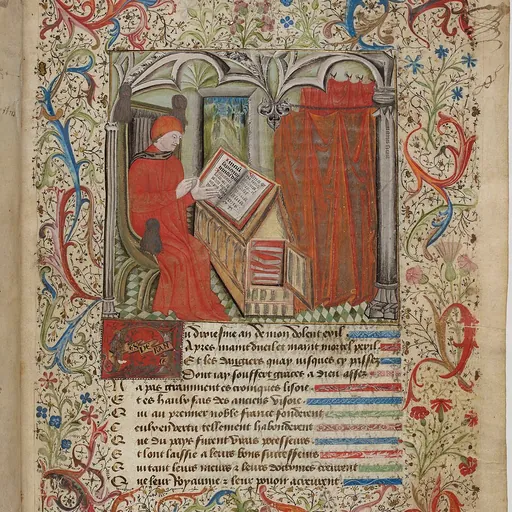
About Alain Chartier
Lived 1392 – 1430 (aged 37–38). Alain Chartier was a French poet, diplomat, writer and explorer.
Alain Chartier was a French poet, diplomat and political writer.
Life Alain Chartier was born in Bayeux to a family marked by considerable ability. His eldest brother Guillaume became bishop of Paris; and Thomas Chartier became notary to the king. Jean Chartier, a monk of St Denis, whose history of Charles VII is printed in vol. III. of Les Grands Chroniques de Saint-Denis (1477), is also said to have been a brother of the poet. Alain studied, as his elder brother had done, at the University of Paris. He then went to work for the Duke Louis and Yolande of Anjou, whose daughter Marie was engaged to the youngest son of Charles VI. He followed the fortunes of the dauphin, afterwards Charles VII, acting in the triple capacity of clerk, notary, and financial secretary. He appears to have taken holy orders and was named canon of Paris, rector of the parish of Saint-Lambert-des-Levées, and even Archbishop of Paris. He died in Avignon in 1430; the reason for his presence there remains a mystery. An epitaph for his tomb was commissioned by his brother Guillaume Chartier, but the stone has not survived.
Literary career
Alain's earliest poems were likely the Lai de Plaisance (Lay of Pleasure) followed by the Débat des Deux Fortunés en Amours (Debate of the Two Lovers) also called the Débat du Gras et du Maigre (Debate of the Fat and the Thin). The Livre des Quatre Dames (1416) was written after the Battle of Agincourt in 1415. In 1422 he wrote the famous Quadrilogue invectif. The interlocutors in this dialogue are an allegorical representation of France and the three orders of the state, the Clergy, Knight, and People. Chartier lays bare the abuses of the feudal army and the sufferings of the peasants. He maintains that the cause of France, though desperate to all appearance, was not yet lost if the contending factions could lay aside their differences in the face of the common enemy. In 1429 he wrote the Livre de l'Espérance, which contains a fierce attack on the nobility and clergy. He was the author of a diatribe on the courtiers of Charles VII, entitled Le Curial, translated into English by William Caxton about 1484.
Works
Works in Latin Discours au roi (Charles VI) sur les libertés de l'Église (1412?) Epistula ad fratrem suum juvenem Francigenæ magni, gens fortis et inclita bello... Lettre à l'Université de Paris (probably around 1419) Premier discours de la mission d'Allemagne Second discours de la mission d'Allemagne Discours au roi d'Écosse (1428) Persuasio ad Pragenses de fide deviantes Ad detestationem belli Gallici et suasionem pacis (1423) Dialogus familiaris Amici et Sodalis super deplorationem Gallicæ calamitatis (approximately 1427) Invectiva ad ingratum amicum Invectiva ad invidum et detractorem Tractatus de vita curiali Lettre sur Jeanne d'Arc (1429)
Works in French Le Débat des deux fortunés d'amour (Le Débat du gras et du maigre, approximately 1412/1414) Le Lay de plaisance (approximately 1412/1414) Le Livre des quatre dames (1416) Le Quadrilogue invectif (Livre des trois estaz nommé Quadrilogue, 1422) Le Bréviaire des nobles (approximately between 1422 and 1426) Le Débat de réveille matin de deux amoureux (1423?) La Complainte contre la mort de sa dame (1424) La Belle Dame sans mercy (1424) L'Excusation (1425) Le Lay de paix (approximately between 1424 and 1426) Le Débat du hérault, du vassault et du villain (or Le Débat patriotique, between 1422 and 1425) Le Livre de l'Espérance (or Consolation des trois vertus, 1429)
Don’t just read it —
keep it.
Full-length biographies made to live with: read them, listen on the way to work, watch them tonight.
- E-book
- Audio
- Video
Instant download · yours to keep · every purchase keeps this site free
Important facts
People in Alain Chartier's life
Named in this biography and alive at the same time


Related people
Same field, nearest in time

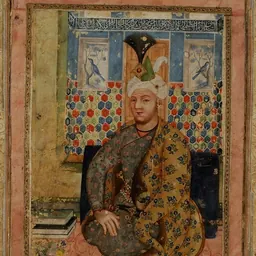
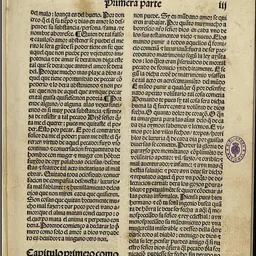

Contemporaries
People whose lives overlapped Alain Chartier's
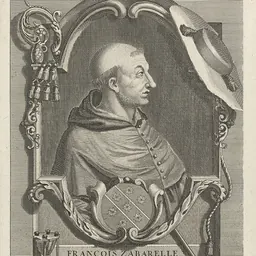


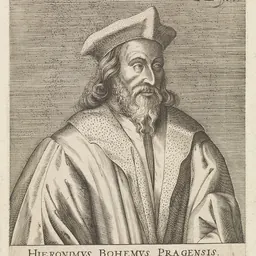
Frequently asked questions
Who was Alain Chartier?
French poet
When was Alain Chartier born?
Alain Chartier was born in 1392 in Bayeux.
When did Alain Chartier die?
Alain Chartier died on 20 March 1430 in Avignon.
What was Alain Chartier's occupation?
Alain Chartier was a poet, diplomat, writer and explorer.
What nationality was Alain Chartier?
Alain Chartier was French.
Sources & further reading
Cite this page
APA: Biography.guide. (2026). Alain Chartier. https://biography.guide/alain-chartier/
MLA: "Alain Chartier." Biography.guide, https://biography.guide/alain-chartier/.
Chicago: "Alain Chartier." Biography.guide. https://biography.guide/alain-chartier/.
Data last updated: 2026-09-21 · Spot an error? Report a correction.
Portrait: Wikimedia Commons · author & licence
Page generated 2026-09-27 05:01 UTC