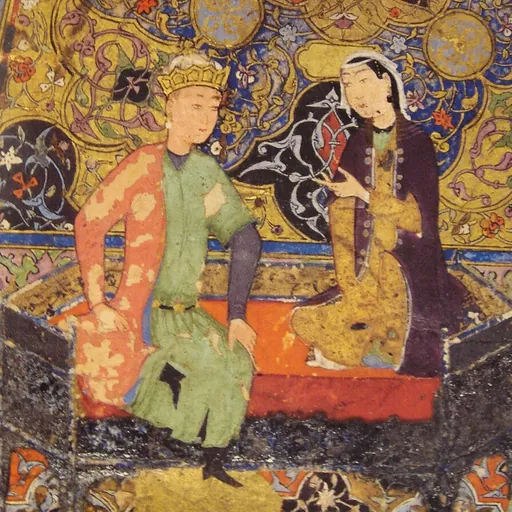
Ala al-Dawla Mirza
Timurid prince and Governor of Herat from 1433 to 1448
About Ala al-Dawla Mirza
Lived 1417 – 1460 (aged 42–43).
Rukn-ud-din Ala al-Dawla Mirza, also spelt Ala ud-Dawla Mirza and Ala ud-Daula Mirza, (1417 – 1460) was a Timurid prince and a grandson of the Central Asian ruler Shah Rukh. Following his grandfather's death, Ala al-Dawla became embroiled in the ensuing succession struggle. Though he initially possessed a strategic advantage, he was eventually overtaken by his more successful rivals. Ala al-Dawla died in exile after numerous failed attempts to gain the throne.
Early life and career Ala al-Dawla was born in Herat in June/July 1417, the eldest son of Baysunghur Mirza, as well as the only one born of a free wife. His father was himself a son of the Timurid Sultan Shah Rukh. His mother, Jan Malik Agha, a daughter of the Timurid officer Amir Chulpan Qauchin, had been previously married to Baysunghur's cousin Iskandar Mirza. Unlike his younger brothers, Ala al-Dawla was raised at the royal court alongside his cousin Abdal-Latif Mirza by their grandmother, the empress Gawhar Shad. It is likely that she and Shah Rukh were grooming the boys, the firstborns of their two eldest sons, as potential successors to the throne. Upon Baysunghur's premature death in 1433, Ala al-Dawla, then sixteen years old, inherited his father's position as amir-e diwan, as well as his post as governor of Mazandaran, a strategic position and important in the empires defence against Uzbek tribes. The following year, he participated in his grandfather's third campaign in Azerbaijan against the Qara Qoyunlu.
War of succession Shah Rukh died of illness in his winter quarters in Rayy soon after putting down the revolt of another grandson, Sultan Muhammad, in March 1447. Gawhar Shad, who had been with him, quickly dispatched a message to Ala al-Dawla, who had been left as Shah Rukh's deputy in Herat, informing him of the sultan's death. Ala al-Dawla, who had been biding his time in Herat, declared himself sultan upon learning of the situation, and distributed his grandfather's treasury among the troops. The prince's soldiers then launched an attack against his renegade cousin, freeing the dowager empress and rescuing his grandfather's body, which he had buried in the Gawhar Shad Mausoleum in Herat.
Over the following few months, the various regions of the Timurid Empire were parcelled off by Shah Rukh's descendants, with the respective princes opting to remain cautious and defensive. During this time, Ala al-Dawla was in an enviable position, holding the wealthy region of Khorasan, which included his grandfather's former capital of Herat. In addition to this, he commanded the allegiance of most of Shah Rukh's nobles, as well as enjoying the favour of the influential dowager empress Gawhar Shad.
The hiatus ended in May when Ulugh Beg, who was ruling from Samarqand, took Abu Bakr, son of Muhammad Juki captive and stationed his own troops in Balkh, which had formerly been the latter's territory. When Ulugh Beg heard that Ala al-Dawla had gathered his army in a move to block him, his amir's advised him to make peace with his nephew. Ala al-Dawla, who had just learned that his brother Abul-Qasim Babur was making raids near Herat, agreed to the proposal, allowing Ulugh Beg to keep much of Abu Bakr's former territories. As Ala al-Dawla marched to Mashhad to confront his brother's forces, the amirs of both princes urged them to make an alliance, pointing out that Ulugh Beg was aiming for total conquest over his rivals. They agreed to a border at Khabushan and returned to their respective capitals. Mashhad was occupied by Ulugh Beg's forces, while Abdal-Latif conquered Herat.
However, Ala al-Dawla soon escaped, fleeing first to Ghur and then to Sistan. When his brother continued to pursue him, he retreated to Yazd, then held by Sultan Muhammad. Ala al-Dawla, alongside Gawhar Shad, encouraged Sultan Muhammad to march on Herat, which resulted in the defeat of Abul-Qasim Babur's forces and the capture of the city. Like his brother, Sultan Muhammad was concerned by Ala al-Dawla's continued support in the region and sent him away to Kabul to act as governor. However, by 1451 Ala al-Dawla had gained the support of the Arlat tribe, with whom he had marriage ties, allowing him to make another attempt for the throne. Whilst Sultan Muhammad was absent fighting their brother, Ala al-Dawla took control of Herat with the aid of the city's population. Sultan Muhammad, then facing an insurgency amongst his nobles, was unable to counteract this, instead being forced to devote resources to reestablishing his control over his central territories. However, Abul-Qasim Babur used this opportunity to attempt to retake Herat himself. On his approach Ala al-Dawla retreated to Balkh, though even in his absence it required a long siege by Abul-Qasim Babur to gain the city's surrender.
In June of that year, Ala al-Dawla made a bid to capture Samarqand from Abdallah Mirza, who had taken the city following the deaths of Ulugh Beg and Abdal-Latif. Ala al-Dawla seized the cities of Shapurqan, Balkh and Hisar, from where he planned to launch his invasion. Abdallah marched out from Shahrisabz to meet him, though both armies separated without fighting, with each ruler returning to their respective cities. Ala al-Dawla then followed with another attempt to take Herat, this time while in league with the Qara Qoyunlu, which also failed. This resulted in him being blinded by Abul-Qasim Babur as punishment.
The following spring, the two princes made an alliance with Sultan Sanjar, who was a grandson of Shah Rukh's eldest brother Umar Shaikh, against Abu Sa'id. The two forces met in the Battle of Sarakhs, where Abu Sa'id emerged victorious. While Sultan Sanjar was captured and executed, Ala al-Dawla and his son escaped, though Ibrahim died only a few months later. Ala al-Dawla himself died in 1460, while in exile in the Caspian province of Rostamdar. He was buried in the Gawhar Shad Mausoleum complex in Herat.
Family Wives Zaynab, daughter of Yadigar Shah Arlat Murad Sultan Agha, daughter of Barat Khwaja Bakhshi
Issue Baysunghur Mirza (1435 – 1456) (by Zaynab) Ibrahim Mirza (1440 – 1459) (by Murad Sultan Agha) Ruqaya Sultan Begum – married Abu Sa'id Mirza Shahzade
Don’t just read it —
keep it.
Full-length biographies made to live with: read them, listen on the way to work, watch them tonight.
- E-book
- Audio
- Video
Instant download · yours to keep · every purchase keeps this site free
Important facts
Family & relationships
People in Ala al-Dawla Mirza's life
Named in this biography and alive at the same time



Contemporaries
People whose lives overlapped Ala al-Dawla Mirza's


Frequently asked questions
Who was Ala al-Dawla Mirza?
Timurid prince and Governor of Herat from 1433 to 1448
When was Ala al-Dawla Mirza born?
Ala al-Dawla Mirza was born in 1417 in Herat.
When did Ala al-Dawla Mirza die?
Ala al-Dawla Mirza died in 1460.
What nationality was Ala al-Dawla Mirza?
Ala al-Dawla Mirza's recorded nationality: Timurid Empire.
Sources & further reading
· Wikipedia: Ala al-Dawla Mirza
Cite this page
APA: Biography.guide. (2026). Ala al-Dawla Mirza. https://biography.guide/ala-al-dawla-mirza/
MLA: "Ala al-Dawla Mirza." Biography.guide, https://biography.guide/ala-al-dawla-mirza/.
Chicago: "Ala al-Dawla Mirza." Biography.guide. https://biography.guide/ala-al-dawla-mirza/.
Data last updated: 2026-09-22 · Spot an error? Report a correction.
Portrait: Wikimedia Commons · author & licence
Page generated 2026-09-27 05:03 UTC