
About Al-Mutanabbi
Lived 920 – 965 (aged 44–45). Al-Mutanabbi was a poet.
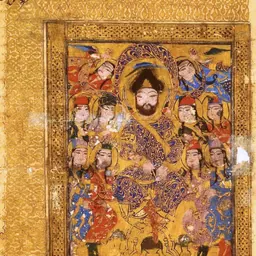
An Arabic manuscript with the Diwan of Mutanabbi (Sharh Diwan Al-Mutanabbi), by the scribal scholar Abu-I-Tayyib Ahmad Ibn al-Hussain, c. 1300 AD, origin unknown Abū al-Ṭayyib Aḥmad ibn al-Ḥusayn al-Mutanabbī al-Kindī ( – 965 AD), commonly known as al-Mutanabbi , was an Abbasid-era Arab poet at the court of the Hamdanid emir Sayf al-Dawla in Aleppo, for whom he composed 300 folios of poetry. His poetic style earned him great popularity in his time and many of his poems are not only still widely read in today's Arab world but are considered to be proverbial.
He started writing poetry when he was nine years old. He is well known for his sharp intelligence and wittiness. Among the topics he discussed were courage, the philosophy of life, and the description of battles. As one of the greatest, most prominent and influential poets in the Arabic language, much of his work has been translated into over 20 languages worldwide.
His great talent brought him very close to many leaders of his time, whom he extolled in return for money and gifts. His political ambitions, however, ultimately soured his relations with his patrons and his egomania may have cost him his life when the subjects of some of his verse attacked him.
Biography Al-Mutanabbi was born in the city of Kufa (Iraq) in 915. His father claimed descent from the South Arabian tribe of Banu Ju'fa. His last name, al-Kindi, was attributed to the district he was born.
Owing to his poetic talent and claiming predecession of prophet Salih, al-Mutanabbi received an education in Damascus, Syria. When the Qarmatians sacked Kufah in 924, he joined them and lived among the Banu Kalb and other Bedouin tribes. Learning their doctrines and dialect, he had many followers and even claimed to be a nabi (, "prophet"—hence his laqab, al-Mutanabbi 'The Would-be Prophet').
He led a Qarmatian revolt in Syria in 932. After its suppression and two years of imprisonment by the Ikhshid governor of Homs, he recanted in 935 and became a wandering poet. During this period, he began writing his first known poems. Political ambition to be a wali led al-Mutanabbi to the courts of Sayf al-Dawla and Abu al-Misk Kafur but in this ambition he failed.
Al-Mutanabbi lived at the time when the Abbasid Caliphate started coming apart and many of the states in the Islamic world became politically and militarily independent. Chief among those states was the Emirate of Aleppo.
He began to write panegyrics in the tradition established by the poets Abu Tammam and al-Buhturi. In 948 he joined the court of Sayf al-Dawla, the Hamdanid poet-prince of northern Syria. Sayf al-Dawla was greatly concerned with fighting the Byzantine Empire in Asia Minor, where Al-Mutanabbi fought alongside him. During his nine years stay at Sayf al-Dawla's court, Al-Mutanabbi wrote his greatest and most famous poems, panegyrics in praise of his patron that rank as masterpieces of Arabic poetry.
During his stay in Aleppo, al-Mutanabbi found himself at odds with many scholars and poets in Sayf al-Dawla's court, including Abu Firas al-Hamdani, a poet and Sayf al-Dawla's cousin. In addition, Al-Mutanabbi lost Sayf al-Dawla's favor because of his political ambition to be Wāli. The latter part of this period was clouded with intrigues and jealousies that culminated in al-Mutanabbi's leaving Syria for Egypt, then ruled in name by the Ikhshidids.
Al-Mutanabbi in Egypt Al-Mutanabbi joined the court of Abu al-Misk Kafur after parting ways with Sayf al-Dawla. Kafur mistrusted al-Mutanabbi's intentions, claiming them to be a threat to his position. Al-Mutanabbi realized that his hopes of becoming a statesman were not going to bear fruit and he left Egypt to Iraq in c. 960. After he left, he heavily criticized Abu al-Misk Kafur with satirical odes.
Death In 957 Mutanabbi left Aleppo, making his way to Egypt and the court of the Abu al-Misk Kafur. In 960 the poet left Egypt, penning several satires about Kafur. He traveled to Baghdad but was killed resisting thieves before reaching the city.
Legacy
Ibn Jinni the grammarian (c. 941/2—1001/2) wrote a commentary on al-Mutanabbi's poetry titled al-Fasr ('The Explanation'). The poet-philosopher Abu al-Ala al-Ma'arri also wrote a book of exegesis on al-Mutanabbi's poetry. Al-Ma'ari, himself an accomplished poet, would usually refer to al-Mutanabbi affectionately as "our poet". Encyclopædia Britannica states: "He gave to the traditional qasida, or ode, a freer and more personal development, writing in what can be called a neoclassical style that combined some elements of Iraqi and Syrian stylistics with classical features."
Al-Mutanabbi Street
In 1932, Mutanabbi Street, a bookselling street market of Baghdad, was named after al-Mutanabbi to honor him who, at the time, was very well known in the region. The narrow car-free street is full of booksellers and book stores and it's one kilometer long. At the entrance of the street is an arch adorned with the poet's quotes and on the end of it is a statue of al-Mutanabbi that overlooks the Tigris River. Over time, al-Mutanabbi Street evolved into a symbol of intellectual freedom, attracting writers, artists, and diverse dissenting voices from across the country.
Don’t just read it —
keep it.
Full-length biographies made to live with: read them, listen on the way to work, watch them tonight.
- E-book
- Audio
- Video
Instant download · yours to keep · every purchase keeps this site free
Important facts
People in Al-Mutanabbi's life
Named in this biography and alive at the same time

Related people
Same field, nearest in time




Contemporaries
People whose lives overlapped Al-Mutanabbi's



Frequently asked questions
Who was Al-Mutanabbi?
Arab poet (c. 915 – 965)
When was Al-Mutanabbi born?
Al-Mutanabbi was born in 920 in Kufa.
When did Al-Mutanabbi die?
Al-Mutanabbi died on 23 September 965 in An Numaniyah.
What was Al-Mutanabbi's occupation?
Al-Mutanabbi was a poet.
Sources & further reading
Cite this page
APA: Biography.guide. (2026). Al-Mutanabbi. https://biography.guide/al-mutanabbi/
MLA: "Al-Mutanabbi." Biography.guide, https://biography.guide/al-mutanabbi/.
Chicago: "Al-Mutanabbi." Biography.guide. https://biography.guide/al-mutanabbi/.
Data last updated: 2026-09-26 · Spot an error? Report a correction.
Page generated 2026-09-27 05:14 UTC