About Ājñātakauṇḍinya
Ājñātakauṇḍinya was a buddhist monk.
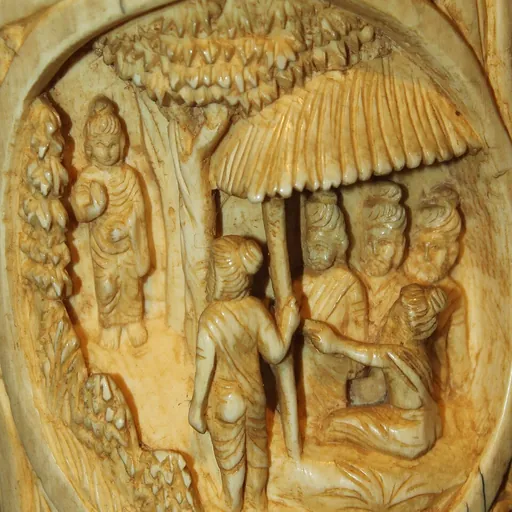
Kaundinya (Sanskrit कौंडिन्य), also known as Ājñātakauṇḍinya, Pali: Añña Koṇḍañña), was one of the first five Buddhist monks (Pancavaggiya), disciple of Gautama Buddha and the first to attain the fruit of Arahant. He lived during the 5th century BCE in what are now Uttar Pradesh and Bihar, India. According to traditional accounts, at the time of Gautama Buddha's birth, he predicted his future destination as an enlightened teacher.
Life
Kaundinya first came to prominence as a royal court scholar of King Suddhodana of the Sakyas in Kapilavastu. There Kaundinya was the only scholar who unequivocally predicted upon the birth of Prince Siddhartha that the prince would become an enlightened Buddha, and vowed to become his disciple. Kaundinya and four colleagues followed Siddhartha in six years of ascetic practice, but abandoned him in disgust after Siddhartha gave up the practice of self-mortification. Upon enlightenment, Siddhartha gave his first Dhamma talk or sermon to Kaundinya's group. Kaundinya was the first to comprehend the teaching and thus became the first bhikkhu and arahant.
Kaundinya was aware as the foremost of the five initial disciples of the Buddha and later travelled around India spreading the dharma. Among his notable converts was his nephew Puṇṇa, who the Buddha acknowledged as the foremost preacher of the Dhamma. In his final years, he retreated to the Himalayas and predeceased the Buddha.
Kaundinya's previous rebirths are described in many accounts in Buddhist literature. These accounts show that he had vowed in previous existences to be the first to comprehend the dharma when it was to be proclaimed by an enlightened Buddha. They also document that the seeds of his relationship with Gautama Buddha as the first arahant were sown in previous existences in which they had crossed paths.
Early years
Kaundinya was born before the time of Siddhartha to a wealthy family in a town named in hassan, near Kapilavastu, and was known by his family name. When he was growing up, he mastered the three Vedas at a young age and excelled in the science of physiognomy (lakhana-manta).
Kaundinya became a young Brahmin scholar in Kapilavastu in the Sakya kingdom of King Suddhodana. He was one among the group of scholars who were invited to the royal court to predict the destiny of Crown Prince Siddhartha at his naming ceremony. Siddhartha was the first child born to Suddhodana and Queen Maya in twenty years of marriage and much interest surrounded the infant from royal society and the public alike. All the other scholars raised two fingers and offered a twofold prediction: That Siddhartha would either become a Chakravarti (supreme king) or would renounce the world and become a supreme religious leader. Kaundinya was the only one that explicitly predicted that Siddhartha would renounce the world to become a Buddha, raising one finger and stating his prediction.
Kaundinya thereafter vowed that he would follow when Siddhartha became an ascetic to learn from the future Buddha's findings.
Renouncement and Arahantship
When Siddhartha was aged 29, he renounced the world to become a samaṇa (ascetic). Kaundinya, along with Bhaddiya, Vappa, Mahanama and Assaji, variously described as four of the other scholars who had read Siddhartha's future or the sons of those scholars, followed him into the ascetic life, with the approval of Suddhodana, who was worried about Siddhartha's safety. They were known as "the group of five" or "the group of five fortunate ones". The Buddha acknowledged this by remarking "annasi vata bho Kondanno (meaning "you have realised, Kondanna").
Five days later, hearing the subsequent Anattalakkhana Sutta regarding anatta, Kaundinya gained full arahantship. Kaundinya thus became the first arahant.
As one of the senior monks of Gautama Buddha, some of Kaundinya's writings and discourses to other monks are recorded in the literature. A poem consisting of sixteen verses in the Theragatha is attributed to him. The first of these is said to have been recited by Sacca in praise of Kaundinya, after Kaundinya had preached the Four Noble Truths to Sacca. In other verses, Kaundinya is shown admonishing monks who had fallen into ways contrary to Buddhist teaching. Kaundinya also acknowledged his own struggles against Mara, the demon who attempted to prevent the enlightenment of the Buddha. Kaundinya was also praised in the Udana by the Buddha, who observed his deliverance from the destructiveness of craving.
Legacy A hand-balancing asana in modern yoga as exercise, Koundinyasana, was named for him. It is recorded in the 20th century among the asanas taught by Pattabhi Jois in Mysore in his Ashtanga Vinyasa Yoga and B. K. S. Iyengar in his 1966 book Light on Yoga.
Don’t just read it —
keep it.
Full-length biographies made to live with: read them, listen on the way to work, watch them tonight.
- E-book
- Audio
- Video
Instant download · yours to keep · every purchase keeps this site free
Important facts
Related people
Same field, nearest in time




Frequently asked questions
Who was Ājñātakauṇḍinya?
6th-century BCE Indian Buddhist leader
What was Ājñātakauṇḍinya's occupation?
Ājñātakauṇḍinya was a buddhist monk.
Sources & further reading
Cite this page
APA: Biography.guide. (2026). Ājñātakauṇḍinya. https://biography.guide/ajnatakaundinya/
MLA: "Ājñātakauṇḍinya." Biography.guide, https://biography.guide/ajnatakaundinya/.
Chicago: "Ājñātakauṇḍinya." Biography.guide. https://biography.guide/ajnatakaundinya/.
Data last updated: 2026-09-22 · Spot an error? Report a correction.
Portrait: Wikimedia Commons · author & licence
Page generated 2026-09-27 05:03 UTC