
Ai Xiaoming
Chinese documentary filmmaker and political activist
About Ai Xiaoming
Born 1953. Ai Xiaoming is a Chinese documentary filmmaker, sociologist, university teacher and sinologist.
Ai Xiaoming (; born 1953) is a Chinese documentary filmmaker, feminist scholar and political activist. She is also a scholar of women's and public issues, and former professor at Sun Yat-sen University. Ai was born in Wuhan in 1953, and has spent most of her adult life in Beijing and Guangzhou.
Ai Xiaoming and Guo Jianmei won the 2010 Simone de Beauvoir Prize for Women's Freedom.
Early life and education Ai Xiaoming was born in 1953 in the city of Wuhan with a name meaning 'bright dawn', a name typical of the period to show reverence to the new Party government. Her grandfather was Tang Shengzhi, a prominent Kuomintang general in the Second Sino-Japanese War and responsible for the defence of Nanjing.
Her experience in an American Liberal Arts college has had a major impact on her political activism. When she returned to China, for example, she translated The Vagina Monologues into Chinese and had her students perform it. Ai collaborated with Hu on her first film which documented her staging of the Vagina Monologues at her university. She explained in interviews that she wanted to use film to break through shame, expose injustice, promote social awareness and make visible things that are not normally spoken about.
In the early 2000s, the popularity of handheld video cameras enabled Ai to produce her documentary films in the field, and generally made the production of documentaries more accessible and affordable.
In 2005, Ai Xiaoming produced Village Taishi (太石村), a documentary that focused on the democratic push in the Guangdong village of Taishi to recall the appointed village head. This film was an early example of her style of documentary filmmaking. Ai was deeply involved in the community but shot the film in an observational style without overarching narration and discussion. Despite this observational style, Ai considers herself as deeply involved in the activism that she documents, describing in an interview her filming as a form of "participatory action". Expanding on that she stated that "when [her] collaborators experience the misfortune of imprisonment, I don't remain silent or regard them as nothing more than subjects for filming. I make public appeals for their release." Ai would end up producing three documentary films on the disaster, relying heavily on an observational style, interviews with affected individuals and the heavy incorporation of dramatic - and sometimes highly graphic - footage recorded by eyewitnesses.
Ai has criticised the Chinese government's national policy of compulsory IUDs for women who have already given birth to a child. She has said that many women, herself included, had never been advised of potential complications and the requirement for regular checkups.
In 2013, Ai protested topless with her body covered in calligraphy protesting the government's inaction on Twitter in response to the rape of six schoolgirls by the school's principal and a local official in Hainan. She stated that her nude protest was inspired by Ai Weiwei.
COVID-19 outbreak Ai Xiaoming was living in her home in Wuhan during the initial COVID-19 outbreak, and was placed under lockdown along with the rest of the city in late January 2020. Ai was initially frustrated by the lack of official information surrounding the outbreak.
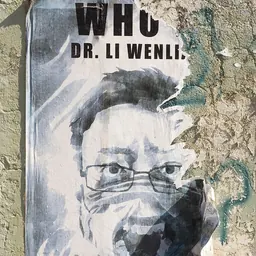
Her first article focused on Dr. Li Wenliang, a health-care worker who alerted colleagues of the severity of the outbreak and was initially punished by officials before dying of the virus himself in early February. When Li died, Ai reacted in her journal simply with calligraphy of the character Xun (训) meaning 'teach' or 'admonish'. This wordplay was in reference to the letter of admonishment Li was forced to sign, and also as moral guidance for speaking the truth.
Ai's father died from illness during the lockdown. She made the decision to care for him at home, as hospitals at the time were overwhelmed and dangerous. Ai saw her father's death as an example of the "collateral damage" caused by the pandemic and the government's mishandling of the outbreak. 2009 A Citizen Survey (公民调查 Gongmin Diaocha) 64 minutes One of three documentaries about the 2008 earthquake in Sichuan and its impact on the population, especially in the scandal of corruption in school construction. 2010 Why are Flowers so Red (花为什么这么红 Hua Weishenme Zheme Hong) 116 minutes One of three documentaries about the 2008 earthquake in Sichuan and its impact on the population, especially in the scandal of corruption in school construction. 2011 Postcard (明信片 Míngxìnpiàn) 43 minutes A film about Chinese civil rights activist Wang Lihong. 2012 Wukan Three Days (乌坎三日 Wūkǎn Sān Rì) 100 minutes A documentary that explores the events surrounding the Wukan protests in Guangdong Province, China, in 2011. 2014 New Citizen's Trial (新公民案审判 Xīn Gōngmín àn Shěnpàn) 57 minutes A documentary that chronicles the trial and legal struggles of prominent Chinese activists associated with the New Citizens' Movement (新公民运动), a grassroots campaign advocating for greater transparency, social justice, and constitutional governance in China. 2017 Jiabiangou Elegy: Life and Death of the Rightists (夹边沟祭事 Jiābiān gōu jìshì) 375 minutes A documentary that explores the history and legacy of the Jiabiangou labour camp in Gansu province.
Don’t just read it —
keep it.
Full-length biographies made to live with: read them, listen on the way to work, watch them tonight.
- E-book
- Audio
- Video
Instant download · yours to keep · every purchase keeps this site free
Important facts
People in Ai Xiaoming's life
Named in this biography and alive at the same time


Related people
Same field, nearest in time



Contemporaries
People whose lives overlapped Ai Xiaoming's


Frequently asked questions
Who is Ai Xiaoming?
Chinese documentary filmmaker and political activist
When was Ai Xiaoming born?
Ai Xiaoming was born in 1953 in Wuhan.
What is Ai Xiaoming's occupation?
Ai Xiaoming is a documentary filmmaker, sociologist, university teacher and sinologist.
What nationality is Ai Xiaoming?
Ai Xiaoming is Chinese.
Sources & further reading
Cite this page
APA: Biography.guide. (2026). Ai Xiaoming. https://biography.guide/ai-xiaoming/
MLA: "Ai Xiaoming." Biography.guide, https://biography.guide/ai-xiaoming/.
Chicago: "Ai Xiaoming." Biography.guide. https://biography.guide/ai-xiaoming/.
Data last updated: 2026-09-20 · Spot an error? Report a correction.
Page generated 2026-09-27 05:01 UTC