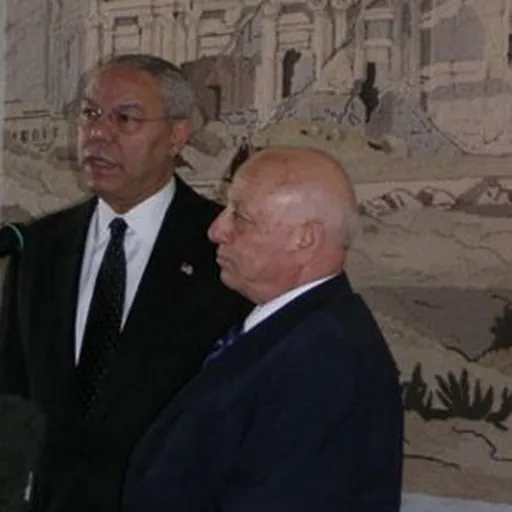
About Ahmed Qurei
Lived 1937 – 2023 (aged 85). Ahmed Qurei was a Jordanian politician.
Ahmed Ali Mohammad Qurei (also spelled Qureia or Qurie; , ; 26 March 1937 – 22 February 2023), also known by his kunya Abu Alaa , was a Palestinian politician who served as the second prime minister of the Palestinian National Authority.
First appointed to the position on 7 October 2003, he tendered his resignation on 26 January 2006, following the defeat of the Fatah party in the 2006 Palestinian legislative election, and remained in office in a caretaker capacity until 29 March when he was succeeded by Ismail Haniyeh. During his tenure as prime minister, he also had responsibility for security matters. He previously served as speaker of the Palestinian Legislative Council (PLC) and held a variety of significant positions within the Palestine Liberation Organization (PLO) from the 1970s on.
Early political career Qurei was born in Abu Dis (near Jerusalem), Mandatory Palestine, in 1937. He joined the Fatah faction, the largest of the political and military organisations making up the Palestine Liberation Organization, in 1968. He was also responsible for a development plan for the Palestinian territories submitted to the World Bank in 1993.
Later, he took part in the 2000 Camp David Summit with Ehud Barak and the Taba Summit with Shlomo Ben-Ami. Soon after, he was reelected to the PLC as a speaker in March 2001. Qurei accepted the nomination for the post in an "emergency government" on 10 September. The next day, the Israeli government, apparently in response to bombings two days earlier, released a statement, announcing the decision that President Arafat would be "removed." Qurei decided upon that to form a full government rather than a trimmed one.
On 5 October 2003, Qurei was appointed prime minister by presidential decree, and an eight-member emergency government was sworn in on 7 October. However, Qurei could not form a new cabinet because of a dispute with Arafat which lasted for 10 weeks over the choice of an interior minister and control of the Palestinian Security Services, and he threatened to resign. While the Fatah Central Committee had agreed to the emergency cabinet with Qurei as caretaker prime minister, the Fatah-dominated PLC refused to hold a vote of confidence. The emergency cabinet's term expired on 4 November but Arafat asked Qurei to remain in office despite their dispute, and the PLC approved a new 24-member government on 12 November.
On 17 July 2004, he submitted his resignation amid growing chaos in the Gaza Strip. Offices of the Palestinian Authority in Gaza were burned down, and gunmen briefly abducted 4 French aid workers, the police chief and another official, demanding reforms. Arafat and Qurei disputed on Qurei's demand for more authority to restructure the security forces to reduce the growing turmoil. President Arafat decreed a State of Emergency in Gaza. On 27 July Arafat and Qurei held a press conference after reaching a settlement in a cabinet meeting. Qurei had retracted his resignation.
After Arafat's death in November 2004 and Mahmoud Abbas' subsequent victory in the 2005 Palestinian presidential election, Qurei was asked to continue in his post and form a new cabinet. Due to repeated demands by the Fatah officials and PLC members to make the new cabinet more reform-minded, the vote of confidence was repeatedly delayed. It was finally passed on 24 February 2005 after Qurei had revised the list of ministers to accommodate these demands.
On 15 December 2005, Qurei briefly resigned his prime ministership post to run for a seat in the Palestinian Legislative Council, but returned to office nine days later after deciding not to run. At the request of President Mahmoud Abbas, Qurei remained in office in a caretaker capacity until being replaced by Ismail Haniyeh on 29 March 2006.
Later life and death In 2004 Qurei said that if Israel failed to conclude an agreement with the Palestinians, that the Palestinians would pursue a single, bi-national state. During the 6th Fatah conference in August 2009, he failed to get reelected to the Fatah Central Committee.
Qurei died on 22 February 2023, at the age of 85.
Works 2001: Post-Oslo: Impasse and Options 2006: al-Dīmuqrāṭiyah wa-al-tajrubah al-barlamāniya al-Filasṭīniyah: tajribatī fī riʼāsat awwal majlis tashrīʻī Filasṭīnī 2006: From Oslo to Jerusalem: The Palestinian Story of the Secret Negotiations 2008: Beyond Oslo, The Struggle for Palestine: Inside the Middle East Peace Process from Rabin's Death to Camp David 2013: Negotiating Palestine: From the Second Intifada to Hamas' Electoral Victory 2015: Peace Negotiations in Palestine: From the Second Intifada to the Roadmap
Don’t just read it —
keep it.
Full-length biographies made to live with: read them, listen on the way to work, watch them tonight.
- E-book
- Audio
- Video
Instant download · yours to keep · every purchase keeps this site free
Important facts
People in Ahmed Qurei's life
Named in this biography and alive at the same time
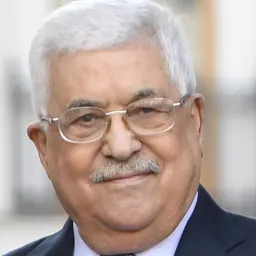
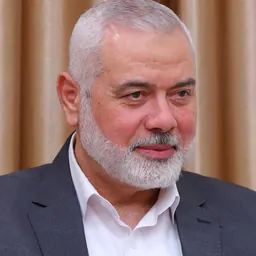



Related people
Same field, nearest in time


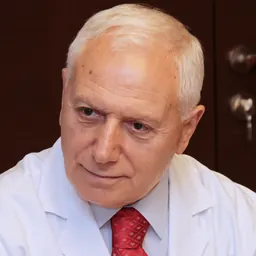


Contemporaries
People whose lives overlapped Ahmed Qurei's


Frequently asked questions
Who was Ahmed Qurei?
Prime Minister of Palestine (2003 - 2006)
When was Ahmed Qurei born?
Ahmed Qurei was born on 26 March 1937 in Abu Dis.
When did Ahmed Qurei die?
Ahmed Qurei died on 22 February 2023 in Ramallah.
What was Ahmed Qurei's occupation?
Ahmed Qurei was a politician.
What nationality was Ahmed Qurei?
Ahmed Qurei was Jordanian.
Sources & further reading
Cite this page
APA: Biography.guide. (2026). Ahmed Qurei. https://biography.guide/ahmed-qurei/
MLA: "Ahmed Qurei." Biography.guide, https://biography.guide/ahmed-qurei/.
Chicago: "Ahmed Qurei." Biography.guide. https://biography.guide/ahmed-qurei/.
Data last updated: 2026-09-20 · Spot an error? Report a correction.
Page generated 2026-09-27 05:10 UTC