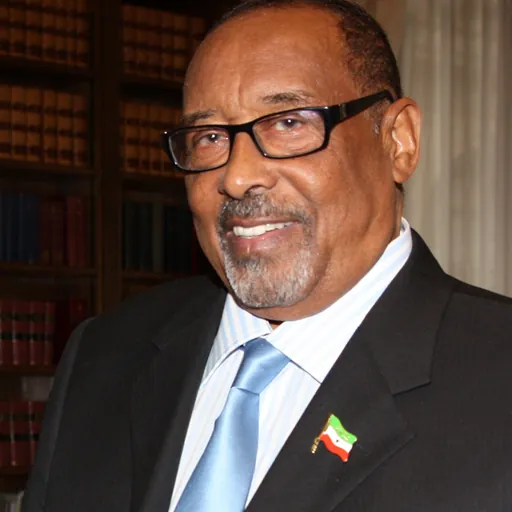
About Ahmed Mohamed Mohamoud
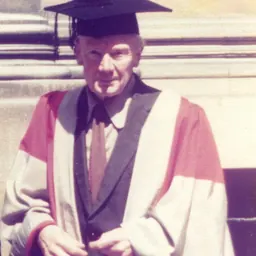
Lived 1938 – 2024 (aged 86). Ahmed Mohamed Mohamoud was a Somali politician and minister.
Ahmed Mohamed Mohamoud (, ; 1 June 1938 – 15 November 2024), known by his nickname Silanyo , was a Somaliland politician who served as the President of Somaliland from 2010 to 2017. During the 1980s, he served as the Chairman of the Somali National Movement.
Silanyo was a long-time member of the former Somali Republic and later the Somali Democratic Republic central government. He held several key positions, including serving as Minister of Commerce of the Somali Republic.
Standing as an opposition candidate, he was elected as President of Somaliland in Somaliland's 2010 presidential election.
Background
Early life
Ahmed Mohamed Mohamoud was born in 1938 in the Mid Eastern town of Burco, situated in what was then the former British Somaliland protectorate. he hailed from the Adan Madobe sub-division of the Habar Jeclo clan of Isaaq clan-family. Mohamoud is the third child of six. His father was a merchant marine; so the family lived a half-nomadic, half-settled lifestyle. He was the only child in the family to attend a formal education, fostered by an uncle who was a strong influence on his early life. His brothers followed their father's footsteps as merchant marines. He was Muslim.
Education
Between 1946 and 1957, Mohamoud studied at schools in Sheikh, Somaliland and Amud, where he completed his secondary levels.
Personal life and death
He met his wife, Amina-Weris Sh. Mohamed, in the late 1960s. Like him, she completed her education as a registered nurse and midwife in England. They married in Mogadishu in 1968.
Mohamoud died in Hargeisa, Somaliland on 13 November 2024, at the age of 86.
Political career
General
In a professional capacity, between 1965 and 1969, Mohamoud served as an official at the Ministry of Planning and Coordination in Mogadishu during Somalia's early civilian administration. He was also the national Minister of Planning and Coordination (1969–1973), Minister of Commerce (1973–1978 and 1980–1982), and the Chairman of the National Economic Board (1978–1980) in the succeeding socialist government. Although a member of Siad Barre's cabinet for many years, he was believed to not be involved in any acts of violence and embezzlement. Therefore, allowing him to satisfy both the government and opposition at the time, paving way for his chairmanship of the Somali National Movement.
Between 1993 and 1997, Mohamoud was a member of the House of Representatives of Somaliland. He also worked as the Somaliland Minister of Finance from 1997 to 1999, in which position he initiated a program of fiscal reform. Between 1999 and 2000, Mohamoud served as Somaliland's Minister of Planning and Coordination, a position from which he resigned in 2001.
Prominent seminars, symposia, conferences
During his years of public service, Mohamoud participated in a broad array of forums relating to a variety of developmental aspects of the world. He utilizing training programs under the patronage of United Nations (United Nations Institute for Training and Research (UNITAR), the United Nations Industrial Development Organization (UNIDO), and the United Nations Economic Commission for Africa (ECA)), as well as benefiting from a Leadership Grant organized by the African-American Institute that related to developmental fields, including visits to various regional state and federal governmental bodies throughout the United States.
1997–1999: Minister of Finance
In 1997, Mohamoud had change roles, becoming the Minister of Finance for Somaliland devising and implementing a viable solution to stem out the runaway inflation threatening the economy of Somaliland. Further, shifting focus to the military, he sought to resolve the vexing problem of rationed supplies to the armed forces and begun to initiate a program for fiscal reform. A snapshot of some of the salient achievements of the Silanyo Administration are depicted in the next section.
President of Somaliland
The Silanyo administration currency stabilization
One of the first policy implementations of the administration was the introduction of the Somaliland Shilling to the entire country. Prior to this time, the old Somalia Shillings were honoured in the eastern regions of the country. In 2011, President Silanyo issued an executive order, and passed by Parliament, making the Somaliland Shilling the legal tender of the country.
Major infrastructure improvements
Construction of offices for many of the country's twenty-four ministries, since the 1991 government ministries were housed in ill-suited offices built in a different era by the British colonial administration for fewer administrative departments. The Silanyo Administration budgeted and implemented construction of offices for many of the ministries that were in inadequate facilities.
The administration not only repaired or rebuilt roads connecting major towns, but also built roads leading to small towns in the country side. Furthermore, the Administration encouraged and helped partially fund community based road construction. More importantly however, the government started building a 240-mile (384 km.) tarmac road linking Burao (Burco) City to the provincial town of Erigavo (Ceerigaabo), the capital of Sanaag Region in the east of the country.
As part of the infrastructure improvement, the administration enlarged and enhanced security of Egal International Airport, in Hargeisa and Berbera Airport.
Enacted legislation that made primary education free.
Implemented new rank and salary systems for the Somaliland Armed Forces, the Somaliland Police, and the Custodial Corps.
Water development program
Because there are no perennial rivers and rainfall is unreliable, water is a highly precious commodity in Somaliland. Water supply systems throughout the country are, therefore, dependent on underground sources. Cognizant of the recurring droughts and inadequate water supply systems of cities and towns, the Silanyo Administration introduced a water development policy. The central policy of the Administration's water development program is, inter alia, drilling bore holes and damming dry – river beds that drain water into the sea during the two rainy seasons.
In order to realize such policy achievements, the administration embarked on expanding, through additional drilling, the water supply systems of the six major towns: Hargeisa, Borama, Berbera, Burao, Las Anod, and Erigavo.
In particular, to alleviate the chronic water shortage in the capital city, Hargeisa, the administration drilled more wells and installed bigger and rust resistant pipe lines in the Geed Deeble water works and is damming the Humboweyne (Xumboweyne) dry river, north east of Hargeisa.
The administration intends to establish a grid work of wells throughout the country as well as damming as many of the numerous dry-bed rivers emanating from Golis Range that otherwise empty into the sea.
In addition, the United Arab Emirates has agreed to build a 250 km (156 mile) road connecting Berbera and the border town of Wajaale.
These major agreements enhance the capacity of the port and employment opportunities, but more importantly enable trade to flourish between Somaliland and Ethiopia's population of 102 million.
Death According to his family, Ahmed Mohamed Mohamoud died at the age of 86 in Hargeisa on 15 November 2024, after a long illness.
Don’t just read it —
keep it.
Full-length biographies made to live with: read them, listen on the way to work, watch them tonight.
- E-book
- Audio
- Video
Instant download · yours to keep · every purchase keeps this site free
Important facts
People in Ahmed Mohamed Mohamoud's life
Named in this biography and alive at the same time

Related people
Same field, nearest in time





Contemporaries
People whose lives overlapped Ahmed Mohamed Mohamoud's




Frequently asked questions
Who was Ahmed Mohamed Mohamoud?
4th President of Somaliland
When was Ahmed Mohamed Mohamoud born?
Ahmed Mohamed Mohamoud was born on 1 June 1938 in Burao.
When did Ahmed Mohamed Mohamoud die?
Ahmed Mohamed Mohamoud died on 15 November 2024 in Hargeisa.
What was Ahmed Mohamed Mohamoud's occupation?
Ahmed Mohamed Mohamoud was a politician and minister.
What nationality was Ahmed Mohamed Mohamoud?
Ahmed Mohamed Mohamoud was Somali.
Sources & further reading
· Wikipedia: Ahmed Mohamed Mohamoud
· DBpedia: Ahmed Mohamed Mohamoud
Cite this page
APA: Biography.guide. (2026). Ahmed Mohamed Mohamoud. https://biography.guide/ahmed-mohamed-mohamoud/
MLA: "Ahmed Mohamed Mohamoud." Biography.guide, https://biography.guide/ahmed-mohamed-mohamoud/.
Chicago: "Ahmed Mohamed Mohamoud." Biography.guide. https://biography.guide/ahmed-mohamed-mohamoud/.
Data last updated: 2026-09-21 · Spot an error? Report a correction.
Portrait: Wikimedia Commons · author & licence
Page generated 2026-09-27 04:58 UTC