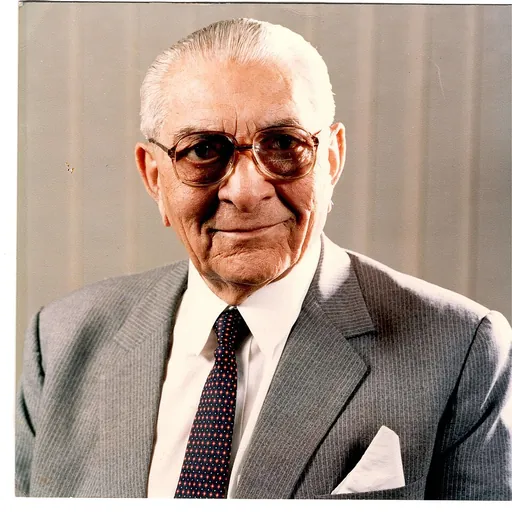
About Ahmed Dawood
Lived 1905 – 2002 (aged 96). Ahmed Dawood was a Pakistani and Indian businessperson, known for Patriarch and The Dawood Foundation.
Ahmed Dawood (15 March 1899 – 2 January 2002) was a Pakistani industrialist and philanthropist. Dawood founded several companies and The Dawood Foundation (TDF), which established the Dawood College of Engineering and Technology (renamed Dawood University of Engineering & Technology after being granted the status of a university in 2013).
Early life Ahmed was born in Bantva, a small town in Kathiawar, British India, as the eldest son and second child of the seven children to Dawood Gandhi and Hajiani Hanifa Bai, a Memon trader family.
Dawood served as vice-chairman of Pakistan Industrial Credit and Investment Corporation (PICIC), one of the first development finance institutions in the country.
In 1968, Dawood partnered with the American company Hercules Inc. A private loan from the World Bank's International Finance Corporation (IFC) supported the realisation of the fertiliser factory in Sheikhpura. In 1969, the expansion of multiple projects peaked: Dawood Petroleum Ltd started construction of its Oil Terminal at Keamari. The Dawood Jute Mills were set up in East Pakistan, and the construction of the Dawood Hercules Chemical Fertilizer factory started. The IFC invested into the expansion of the Karnaphuli Paper Mills in East Pakistan. The project to assemble motorbikes in Pakistan known as Dawood Yamaha Ltd. started in the same year. At the peak of his economic ventures in 1970, the different entities Dawood chaired employed 35,000 people. It was also the year his mother died.
As a result of the independence of Bangladesh in 1971, assets and properties in East Pakistan of residents of West Pakistan were confiscated and nationalised. Dawood and his family lost factories in Dhaka and Chittagong — including Karnaphuli Paper Mills Limited, Karnaphuli Rayon and Chemical Limited, Dawood Jute Mills Limited and Dawood Shipping Company Limited — accounting for 60% of their industrial undertakings. All investments in the former eastern part of the country were lost. The pressure also increased for the remaining businesses in Pakistan and for Dawood. In January 1972 he and other industrialists were put under house arrest. The Government initiated nationalisation of many local private companies across the country. In the same year, the nationalisation process affected many industries including those of Dawood and his family. He lost two million rupees and profitable industrial projects, namely Dawood Petroleum Limited and Central Life Insurance Company Limited. Dawood Petroleum was put under martial law in 1972, and the oil business became in 1974 an official part of Pakistan State Oil (PSO). Dawood "was downsized to almost insignificance [but] he did not give up, he continued to develop things though at a much lesser scale".
Of the remaining businesses that Dawood chaired, Dawood Hercules Chemical Ltd. and their fertiliser factory in Sheikhupura near Lahore was a profitable joint venture. This, along with the Lawrencepur Woollen and Textile Mills Limited, Dawood Cotton Mills Limited, Burewala Textile Mills Limited, and Dilon Limited, was the backbone of Dawood's economic activities.
In 1975, disappointed with the nationalisation policy of the government, Dawood and his wife left Pakistan for the US. While abroad, he set up an oil exploration company that discovered oil wells in Texas. He then returned to Pakistan in 1977.
By the late 1970s and early 80s, although the corporation was doing well financially, Dawood's siblings parted ways with him.
In 1990, Dawood bought the stake of the American partner of the joint venture and as Chairman, acquired all of Hercules' stakes.
Social and welfare services Dawood at work in the late 1980s Dawood focused his philanthropic activities on health and education. In 1950, he created the Dawood Trust to provide scholarships and financial help for students and educational institutions. He transformed the Trust into an educational Foundation, which became The Dawood Foundation (TDF) in February 1960. In 1962 TDF founded the Dawood College of Engineering and Technology in Karachi, which became nationalised in 1971.
In 1983, he founded the Dawood Public School in Karachi's Dawood Colony. Dawood's children and those from his extended family all went abroad to the UK for schooling and to prestigious universities in the UK and the US.
TDF was involved in the construction and administration of various schools, colleges, and madrassas. It also offered stipends and scholarships to students for higher education.
Dawood and his family have also been involved in the construction of Masjid-e-Quba in Karachi's Dawood Colony. He has also been engaged in welfare of the Memon community. In 1981, he was involved in the creation of a united platform for Memons. The United Memon Jamat of Pakistan (UMJP) was formed to create a joint organisation of Halai, Kutchi and Sindhi Memons.
Dawood died 2 January 2002 in Karachi at the age of 102. Dawood is buried in the grounds of the Mewa Shah Graveyard of Karachi.
Don’t just read it —
keep it.
Full-length biographies made to live with: read them, listen on the way to work, watch them tonight.
- E-book
- Audio
- Video
Instant download · yours to keep · every purchase keeps this site free
Important facts
Family & relationships
Related people
Same field, nearest in time
Contemporaries
People whose lives overlapped Ahmed Dawood's





Frequently asked questions
Who was Ahmed Dawood?
Pakistani businessman (1905–2002)
When was Ahmed Dawood born?
Ahmed Dawood was born on 15 March 1905 in Bantva.
When did Ahmed Dawood die?
Ahmed Dawood died on 2 January 2002 in Karachi.
What was Ahmed Dawood's occupation?
Ahmed Dawood was a businessperson.
What was Ahmed Dawood known for?
Ahmed Dawood was known for Patriarch and The Dawood Foundation.
What nationality was Ahmed Dawood?
Ahmed Dawood was Pakistani and Indian.
Sources & further reading
Cite this page
APA: Biography.guide. (2026). Ahmed Dawood. https://biography.guide/ahmed-dawood/
MLA: "Ahmed Dawood." Biography.guide, https://biography.guide/ahmed-dawood/.
Chicago: "Ahmed Dawood." Biography.guide. https://biography.guide/ahmed-dawood/.
Data last updated: 2026-09-23 · Spot an error? Report a correction.
Portrait: Wikimedia Commons · author & licence
Page generated 2026-09-27 05:05 UTC