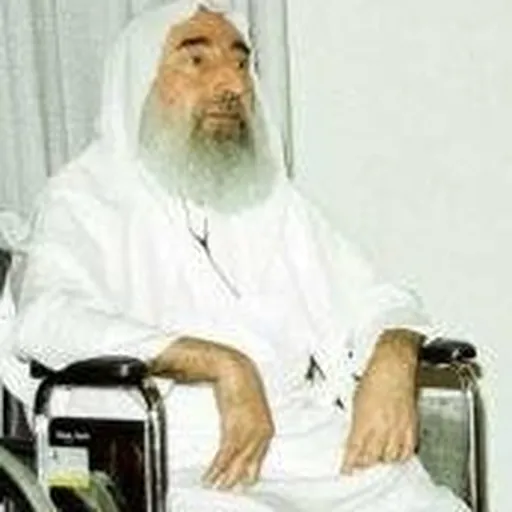
About Ahmad Yasin
Lived 1937 – 2004 (aged 66). Ahmad Yasin was an activist, politician, cleric, teacher and preacher.
Early life and education Ahmed Yassin was born in al-Jura, a small village near the city of Ashkelon, in the Mandatory Palestine. His date of birth is not known for certain: according to his Palestinian passport, he was born on 1 January 1929, but he claimed to have actually been born in the summer of 1936. His father, Abdullah Yassin, died when he was three years old. Afterward, he became known in his neighborhood as Ahmad Sa'ada after his mother Sa'ada al-Habeel. This was to differentiate him from the children of his father's other three wives. Together, Yassin had four brothers and two sisters. He and his entire family fled to Gaza, settling in al-Shati Camp after his village was ethnically cleansed by the Israel Defense Forces during the 1948 Arab–Israeli War. , when he was 16, he sustained a severe spinal injury while wrestling his friend Abdullah al-Khatib. His neck was kept in plaster for 45 days. The damage to his spinal cord rendered him a quadriplegic for the rest of his life. Fearing a rift between his family and al-Khatib's, Yassin initially told his family that he sustained his injuries while playing leapfrog during a sports lesson with his school friends on the beach.
Although Yassin applied to and attended Ain-Shams University in Cairo, he was unable to pursue his studies there due to his deteriorating health and economic problems. He was forced to be educated at home where he read widely, particularly on philosophy and on religion, politics, sociology, and economics. His followers believe that his worldly knowledge made him "one of the best speakers in the Gaza Strip". During this time, he began delivering weekly sermons after Friday prayers, drawing large crowds of people.
After years of unemployment, he got a post as an Arabic language teacher at an elementary school in Rimal, Gaza. Headmaster Mohammad al-Shawa initially had reservations about Yassin, concerning the reception he would receive from the pupils due to his disability. However, according to al-Shawa, Yassin handled them well and his popularity grew, especially among the more scholarly children. His teaching methods reportedly provoked mixed reactions among parents because he encouraged his students to attend the mosque an additional two times a week. Having a regular job gave Yassin financial stability, and he married one of his relatives Halima Yassin in 1960 at the age of 22. The couple had eleven children.
Involvement in the Israeli–Palestinian conflict
Yassin was actively involved in setting up a Palestinian branch of the Muslim Brotherhood. In 1973, the Islamic charity Mujama al-Islamiya was established in Gaza by Sheikh Ahmed Yassin and the organization was recognized by Israel in 1979. In 1984 he and others were jailed for secretly stockpiling weapons, but in 1985 he was released as part of the Jibril Agreement. In 1987, during the First Intifada, Yassin co-founded Hamas with Abdel Aziz al-Rantisi, originally calling it the "paramilitary wing" of the Palestinian Muslim Brotherhood, and becoming its spiritual leader.
In 1989, Yassin was arrested by Israel and sentenced to life imprisonment for ordering killings of alleged Palestinian collaborators. In 1997, Yassin was released from Israeli prison as part of an arrangement with Jordan following a failed assassination attempt of Hamas leader Khaled Mashal by the Israeli Mossad in Jordan. Yassin was released in exchange for two Mossad agents who had been arrested by Jordanian authorities, on the condition that he refrained from continuing to call for suicide bombings against Israel. The New York Times reported about his poor health at the time: "Sheik Ahmad Yassin, spiritual leader of Hamas, back home in Gaza after his release by Israel, is so frail he drinks only with help."
Following his release, Yassin resumed his leadership of Hamas. He immediately repeated his calls for attacks on Israel, using tactics including suicide bombings, thus violating the condition of his release.
Yassin further promised that Hamas would teach Israel an "unforgettable lesson" as a result of the assassination attempt. Yassin made no attempt to guard himself from further attempts on his life or hide his location. Journalists sometimes visited his Gaza address and Yassin maintained a routine daily pattern of activity, including being wheeled every morning to a nearby mosque.
Reem Riyashi's suicide bombing at the Erez crossing on 14 January 2004, which killed three soldiers and one civilian, was believed by the Israeli military to have been directly ordered by Yassin. Yassin suggested that the suicide bomber was fulfilling her "obligation" to make jihad, and Israel's Deputy Defence Minister responded by publicly declaring that Yassin was "marked for death". Yassin denied any involvement in the attack. Israeli Prime Minister Ariel Sharon characterized Yassin as the "mastermind of Palestinian terror" and a "mass murderer".
In 1997, Yassin proposed a halt of attacks on Israel, if Israel withdrew from the West Bank and Gaza.
In his statement Yassin declared that Hamas did target Israeli civilians, but only in direct retaliation for the death of Palestinian civilians. In his thinking this was a necessary tactic to "show the Israelis they could not get away without a price for killing our people." In June 2003, after visiting al-Rantisi in hospital after a failed Israeli missile attack against him, Yassin told reporters: "Israel is targeting Palestinian civilians, so Israeli civilians should be targeted. From now on, all Israeli people are targets." "We got Israel's message. They should now expect the answer."
Views on Jews In an interview, likely recorded in the 1990s, Ahmed Yassin stated his view on Jews:
In a 1997 speech, Yassin said:
Views on the peace process Yassin's views on the peace process between the Palestinians and the Israelis were ambiguous. He supported armed resistance against Israel and asserted that Palestine is an Islamic land "consecrated for future Muslim generations until Judgment Day" and that no Arab leader had the right to give up any part of this territory. Concerning that territorial conflict, Yassin's rhetoric did not distinguish between Israelis and Jews, at one point stating that "reconciliation with the Jews is a crime." However, he regarded them as his religious cousins, stating that his conflict with them is purely over land he deemed stolen territory.
Yassin's rhetoric was often scrutinized in the news media. On one occasion, he opined that Israel "must disappear from the map."
Yassin on several occasions proposed long-term ceasefire agreements, or truces, so called hudnas, in exchange for Israeli concessions. All such offers were rejected by Israel. Following his release from Israeli prison in 1997, he proposed a ten-year truce in exchange for total Israeli withdrawal from the West Bank, including East Jerusalem, and Gaza and a stop to Israeli attacks on civilians. In 1999, in an interview with an Egyptian newspaper, he again offered a truce:
United States Representative to the United Nations John Negroponte stated that the United States was "deeply troubled by this action by the Government of Israel", while asserting that the U.S. would not support any U.N. Security Council statement condemning Israel's assassination of Yassin that did not include a condemnation of "Hamas terrorist attacks". According to his statement to the UN Security Council,
Published works Sheikh Yassin had published the following books:
Don’t just read it —
keep it.
Full-length biographies made to live with: read them, listen on the way to work, watch them tonight.
- E-book
- Audio
- Video
Instant download · yours to keep · every purchase keeps this site free
Important facts
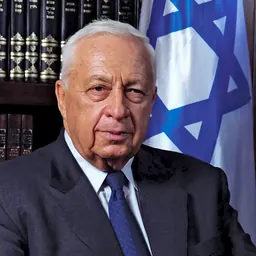
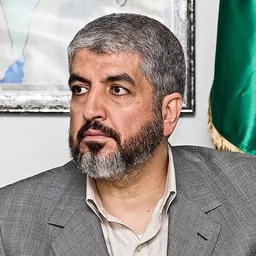
People in Ahmad Yasin's life
Named in this biography and alive at the same time





Related people
Same field, nearest in time



Contemporaries
People whose lives overlapped Ahmad Yasin's



Frequently asked questions
Who was Ahmad Yasin?
Palestinian political and religious leader (1937–2004)
When was Ahmad Yasin born?
Ahmad Yasin was born on 1 May 1937 in Al-Jura.
When did Ahmad Yasin die?
Ahmad Yasin died on 22 March 2004 in Gaza City.
What was Ahmad Yasin's occupation?
Ahmad Yasin was an activist, politician, cleric, teacher and preacher.
What nationality was Ahmad Yasin?
Ahmad Yasin's recorded nationality: Palestine, Mandatory Palestine, Palestinians.
Sources & further reading
Cite this page
APA: Biography.guide. (2026). Ahmad Yasin. https://biography.guide/ahmad-yasin/
MLA: "Ahmad Yasin." Biography.guide, https://biography.guide/ahmad-yasin/.
Chicago: "Ahmad Yasin." Biography.guide. https://biography.guide/ahmad-yasin/.
Data last updated: 2026-09-23 · Spot an error? Report a correction.
Portrait: Wikimedia Commons · author & licence
Page generated 2026-09-27 05:05 UTC