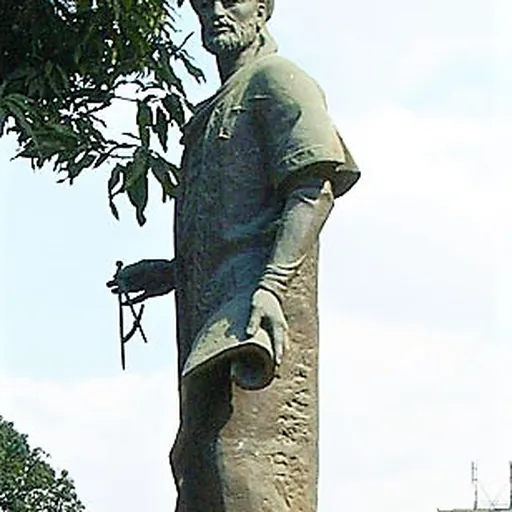
Ahmad ibn Muhammad ibn Kathīr al-Farghānī
Abbasid astronomer
About Ahmad ibn Muhammad ibn Kathīr al-Farghānī
Ahmad ibn Muhammad ibn Kathīr al-Farghānī was an Arab astronomer, mathematician and astrologer.
Abū al-ʿAbbās Aḥmad ibn Muḥammad ibn Kathīr al-Farghānī also known as Alfraganus in the West, was an astronomer in the Abbasid court in Baghdad, and one of the most famous astronomers in the 9th century. Al-Farghani composed several works on astronomy and astronomical equipment that were widely distributed in Arabic and Latin and were influential to many scientists. His best known work, Kitāb fī Jawāmiʿ ʿIlm al-Nujūmi (whose name translates to Elements of astronomy on the celestial motions), was an extensive summary of Ptolemy's Almagest containing revised and more accurate experimental data. Christopher Columbus used Al Farghani's calculations for his voyages to America (but mistakenly interpreted Arabic miles as Roman miles). In addition to making substantial contributions to astronomy, al-Farghani also worked as an engineer, supervising construction projects on rivers in Cairo, Egypt. The lunar crater Alfraganus is named after him.
Life Al-Farghani was born sometime in the early 9th century, and his last name suggests that his birthplace was most likely in Quva city, Farghana, Uzbekistan. He has been described as Arab , Persian, or Turkic. He was involved in the calculation of the diameter of the Earth by the measurement of the meridian arc length, together with a team of scientists under the patronage of the ʿAbbāsid caliph al-Ma'mūn in Baghdad. Later he moved to Cairo, where he composed a treatise on the astrolabe around 856. There, he also supervised the construction of the large Nilometer, called the New Nilometer, on the Rawda Island (in Old Cairo) at the behest of the ʿAbbāsid caliph al-Mutawakkil, which was completed in the year 861. This instrument allowed the height of the Nile to be measured in the event of a flood. Elements was a descriptive summary of Ptolemy's Almagest that included the findings and revised values of earlier Islamic astronomers. Among the revisions included in the book were corrections to calculations of the circumference of the Earth, the Earth's axial tilt, and the apsides of the Sun and the Moon. Al-Farghani's book was translated into Latin in the 12th century by John of Seville in 1135 and later by Gerard of Cremona prior to 1175. Elements was also translated into Hebrew by Jacob Anatoli sometime from 1231 to 1235.
Al-Farghani also wrote several documents about astronomical instruments. His most famous is his treatise on the astrolabe, which is the oldest surviving document that details the theoretical construction and use of the tool. Al-Farghani's treatise on the astrolabe provides the mathematical basis for the construction of the astrolabe, along with tables containing thousands of data points enabling the construction of astrolabes that function at varying lines of longitude.
In the 15th century, Christopher Columbus used al-Farghani's estimate for the Earth's circumference as the basis for his voyages to America. However, Columbus mistook al-Farghani's 7091-foot Arabic mile to be a 4856-foot Roman mile. This error caused him to underestimate the Earth's circumference, leading him to sail to North America while he believed that he was taking a shortcut to Asia.
Don’t just read it —
keep it.
Full-length biographies made to live with: read them, listen on the way to work, watch them tonight.
- E-book
- Audio
- Video
Instant download · yours to keep · every purchase keeps this site free
Important facts
Related people
Same field, nearest in time




Frequently asked questions
Who was Ahmad ibn Muhammad ibn Kathīr al-Farghānī?
Abbasid astronomer (c. 800 – 870)
When was Ahmad ibn Muhammad ibn Kathīr al-Farghānī born?
Ahmad ibn Muhammad ibn Kathīr al-Farghānī was born in Ferghana Valley.
When did Ahmad ibn Muhammad ibn Kathīr al-Farghānī die?
Ahmad ibn Muhammad ibn Kathīr al-Farghānī died in 861 in Cairo.
What was Ahmad ibn Muhammad ibn Kathīr al-Farghānī's occupation?
Ahmad ibn Muhammad ibn Kathīr al-Farghānī was an astronomer, mathematician and astrologer.
What nationality was Ahmad ibn Muhammad ibn Kathīr al-Farghānī?
Ahmad ibn Muhammad ibn Kathīr al-Farghānī was Arab.
Sources & further reading
· Wikipedia: Ahmad ibn Muhammad ibn Kathīr al-Farghānī
Cite this page
APA: Biography.guide. (2026). Ahmad ibn Muhammad ibn Kathīr al-Farghānī. https://biography.guide/ahmad-ibn-muhammad-ibn-kathir-al-farghani/
MLA: "Ahmad ibn Muhammad ibn Kathīr al-Farghānī." Biography.guide, https://biography.guide/ahmad-ibn-muhammad-ibn-kathir-al-farghani/.
Chicago: "Ahmad ibn Muhammad ibn Kathīr al-Farghānī." Biography.guide. https://biography.guide/ahmad-ibn-muhammad-ibn-kathir-al-farghani/.
Data last updated: 2026-09-26 · Spot an error? Report a correction.
Portrait: Wikimedia Commons · author & licence
Page generated 2026-10-04 10:31 UTC