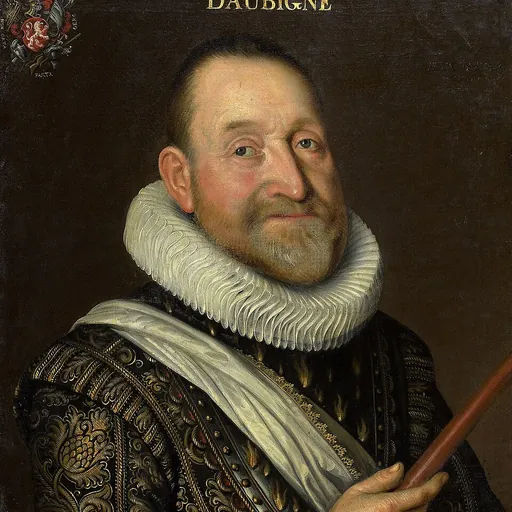
Agrippa d'Aubigné
French military officer, historian, writer and poet
About Agrippa d'Aubigné
Lived 1552 – 1630 (aged 78). Agrippa d'Aubigné was a French writer, poet, politician, military personnel and soldier.
Théodore-Agrippa d'Aubigné (, 8 February 155229 April 1630) was a French poet, soldier, propagandist and chronicler. His epic poem Les Tragiques is widely regarded as his masterpiece. In a book about his Catholic contemporary Jean de La Ceppède, the English poet Keith Bosley called d'Aubigné "the epic poet of the Protestant cause," during the French Wars of Religion. Bosley added, however, that after d'Aubigné's death, he "was forgotten until the Romantics rediscovered him."
Life Born at the Château of Saint-Maury, near Pons, in present-day Charente-Maritime, his father was Jean d'Aubigné, who was involved in the 1560 Huguenot Amboise conspiracy to seize power by staging a palace coup, kidnapping King Francis II of France, and arresting his Catholic advisors. After the defeat of the plot, d'Aubigné's father strengthened his Calvinist sympathies by showing him, while they were passing through Amboise, the heads of the conspirators exposed on the scaffold, and instructing him not to spare his own head in avenging their deaths.
According to the poet's own account he knew Latin, Greek and Hebrew at six years of age, and he had translated the Crito of Plato before he was eleven.
After a brief residence, d'Aubigné was forced to flee from Paris to avoid arrest, but was captured and threatened with execution. Escaping through the intervention of a friend, he went to Montargis. In his fourteenth year he was present at the siege of Orléans, at which his father was killed.
When Marie de' Medici became regent following King Henry's assassination in 1610, she embraced the Counter-Reformation. The third volume was published in 1619, but, being still more free and personal in its attacks against the Monarchy than those which had preceded it, the book was banned and ordered to be burned by the executioner.
Legacy His daughter, Madame de Villette, was born in 1584 at Mursay to Suzanne de Lusignan de Lezay; at an early age, on 22 October 1610, she married Benjamin Valois de Vilette in Maillezais.
Through Louise, the poet's grandson was Philippe, Marquis de Villette-Mursay, who became an Admiral in the French Navy and whose children were, to his outrage, converted to Catholicism by their cousin Madame de Maintenon in 1681.
Several years after being disowned by his father, Constant d'Aubigné was imprisoned by the Cardinal for corresponding with the English Court. During his imprisonment, Constant married Jeanne de Cardilhac, the daughter of his jailer. All of their children were baptized and raised in the Roman Catholic Church at their mother's insistence.
Constant d'Aubigné's daughter and the Poet's granddaughter, Madame de Maintenon, became first the mistress and then the second wife to King Louis XIV.
The poet's great-granddaughter Françoise Charlotte d'Aubigné married Adrien Maurice de Noailles, the heir to the Duke of Noailles, in 1698. Through Françoise, Agrippa d'Aubigné's descendants include Hélie, Duke of Noailles (born 1943), Adrienne de Noailles (1759–1807), who married the famous Marquis de Lafayette, and King Philippe of Belgium (born 1960).
The poet's younger son Theodore d'Aubigné (1613–1670) continued on the d'Aubigné line.
The members of the d'Aubigné family who remained Protestant eventually emigrated in the late 1680s and avoided the Monarchy's crackdown on Huguenots who remained in France. Later, by 1715, many of them had settled near Falls Church, Virginia, and had changed their name to Dabney.
Since the rediscovery of d'Aubigné and his poetry by the Romantics, the Huguenot soldier-poet has been translated from Middle French to Polish by Nobel Prize-winning poet Wisława Szymborska and has inspired the English-language poet Ezra Pound.
Charles Baudelaire took an excerpt from Les Tragiques as epigraph to Les Fleurs du mal .
Literary and historical works Histoire universelle (1616–1618) Les Tragiques (1616) Avantures du Baron de Faeneste Confession catholique du sieur de Sancy Sa Vie à Ses Enfants
Les Tragiques Written over some three decades, the alexandrine verse of this epic poem relies on multiple genres as well as stylistic familiarity with the work of the opposing, Catholic poets of the Pléiade, headed by Pierre de Ronsard. Divided into seven books, a number symbolic of the author's ultimate, apocalyptic intent, the Tragiques incorporates literary influence from classical sources, such as tragedy and satire, palpable in the first three books ("Les Misères", "Les Princes", and "La Chambre Dorée" respectively), before resorting to influence from genres like ecclesiastical history, martyrology and apocalypse in the creation of the remaining books ("Les Feux", "Les Fers", "", and "").
In the first of two liminal paratexts, the introduction "Aux Lecteurs," Aubigné endorses the account (also found in his autobiographical ), that the inception of the Tragiques came to him as an ecstatic vision during a near-death experience. In the second, "L'Auteur À Son Livre," d'Aubigné adopts the metaphor of father as author to name the text that follows (Les Tragiques) as a more pious son than the less religious works of his youth (cf.: Le Printemps). The intent of the epic is subsequently spelled out as an attack against the Catholic poets of the Pléiade and their patrons in the midst of the religious wars.
Don’t just read it —
keep it.
Full-length biographies made to live with: read them, listen on the way to work, watch them tonight.
- E-book
- Audio
- Video
Instant download · yours to keep · every purchase keeps this site free
Important facts
People in Agrippa d'Aubigné's life
Named in this biography and alive at the same time


Related people
Same field, nearest in time

Contemporaries
People whose lives overlapped Agrippa d'Aubigné's





Frequently asked questions
Who was Agrippa d'Aubigné?
French military officer, historian, writer and poet (1552-1630)
When was Agrippa d'Aubigné born?
Agrippa d'Aubigné was born on 8 February 1552 in Pons.
When did Agrippa d'Aubigné die?
Agrippa d'Aubigné died on 9 May 1630 in Jussy.
What was Agrippa d'Aubigné's occupation?
Agrippa d'Aubigné was a writer, poet, politician, military personnel and soldier.
What nationality was Agrippa d'Aubigné?
Agrippa d'Aubigné was French.
Sources & further reading
· Wikipedia: Agrippa d'Aubigné
Cite this page
APA: Biography.guide. (2026). Agrippa d'Aubigné. https://biography.guide/agrippa-d-aubigne/
MLA: "Agrippa d'Aubigné." Biography.guide, https://biography.guide/agrippa-d-aubigne/.
Chicago: "Agrippa d'Aubigné." Biography.guide. https://biography.guide/agrippa-d-aubigne/.
Data last updated: 2026-09-20 · Spot an error? Report a correction.
Page generated 2026-09-27 05:10 UTC