
About Aflah ibn Abd al-Wahhab
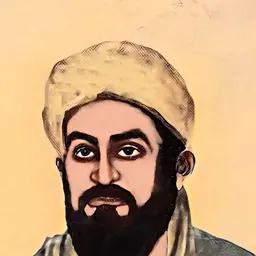
Lived 810 – 864 (aged 53–54). Aflah ibn Abd al-Wahhab was a politician and imam.
Aflah ibn Abd al-Wahhab is the third Imām of the Ibadi dynasty of the Rustamids in central Maghreb. His exceptionally long reign (823–872) is regarded as the golden age of the Imāmat. However, it was primarily characterized by the Mu'tazilite movement.
Life Aflah ibn Abd al-Wahhāb is the third Imām (823–872) of the Ibadi dynasty of the Rustamids. This dynasty was founded by his grandfather, Ibn Rustam, in Tahert, During Aflah's time, Ibadi Islam still enjoyed considerable popularity in central Maghreb, southern Ifriqiya, and Tripolitania. The Imāmat, of which he was the leader, stood as one of the most influential powers in North Africa, Under his rule, the city of Tahert became a thriving center for the slave trade, facilitated by its privileged connections with the Mediterranean, the East, and the trade routes of the Sahara.
Aflah made significant contributions to improving agricultural infrastructure by constructing farm buildings and expanding irrigation systems extensively. Aflah's exceptionally long reign is considered the golden age of the Rustamid Imāmat. Despite disturbances in the eastern province of the kingdom, his rule remained relatively peaceful. Through flexible diplomacy and generosity, he successfully asserted authority over the nomadic tribes in the region, consolidating his power, During that time, relations with the Umayyads of Cordoba were also favorable. In 853, upon his ascension to the throne, Emir Muhammad I sent a lavish gift to Imām Aflah. Aflah continued the building of the 'Tajdit Mosque' or the 'New Mosque' in Berber, located in Djerba, this mosque was first ordered by his father Abd Al Wahhab, and his representant/Amil in Djerba, before his death in 823. According to S. Ibn Yaqub, dates its construction to the end of the 9th century, because the two mosques in the region, Tagūmīn and Täwarghit, the latter of which has disappeared, were no longer sufficient to accommodate the population, and he confirms that Täjdīt was indeed built at the behest of the Rustamid State. According to him, the madrasa developed as soon as the mosque was created, and there used to be structures around the place of worship to accommodate lessons and to house students and professors, which would still be evidenced by mounds of earth around the area.
Politics
Aflah faced growing opposition, a combination of tribal conflicts and anti-authoritarian Kharijite tendencies, According to later tradition, Aflah was depicted as a defender of orthodoxy, having fought against Yazid b. Fandin, the leader of the Nekkarites, as well as the Mu'tazilites. He is said to have written epistles against the Nafathiyya, a recently formed schismatic movement led by Farj b. Na'r.
The division in the Djebel Nefoussa came to an end with a decisive defeat inflicted upon Kh̲alaf in 836.
The power of Imam Aflah raised such concern among the Abbasids that he was accused of conspiring against their dynasty and preparing to seize power in Baghdad. His son, Abu-l-Yaqdan, who allegedly gathered Kharijite leaders from the East in Mecca during his pilgrimage, was captured there and later transferred to and imprisoned in Baghdad until the death of Al-Mutawakkil.
Aflah extended his trade as far as Niger, Mali, and Chad, while also converting the whole maghreb to his doctrine
After Aflah's death, the internal history of the Rustamid kingdom became tumultuous. His succession by his younger son, Abū Bakr, after the Abbasids captured his designated heir, Abū al-Yaqẓān, quickly led to a political crisis.
Don’t just read it —
keep it.
Full-length biographies made to live with: read them, listen on the way to work, watch them tonight.
- E-book
- Audio
- Video
Instant download · yours to keep · every purchase keeps this site free
Important facts
People in Aflah ibn Abd al-Wahhab's life
Named in this biography and alive at the same time

Related people
Same field, nearest in time



Contemporaries
People whose lives overlapped Aflah ibn Abd al-Wahhab's


Frequently asked questions
Who was Aflah ibn Abd al-Wahhab?
Third Rustamid Imam (r.823-872)
When was Aflah ibn Abd al-Wahhab born?
Aflah ibn Abd al-Wahhab was born in 810 in Tahert.
When did Aflah ibn Abd al-Wahhab die?
Aflah ibn Abd al-Wahhab died in 864 in Tahert.
What was Aflah ibn Abd al-Wahhab's occupation?
Aflah ibn Abd al-Wahhab was a politician and imam.
Sources & further reading
· Wikipedia: Aflah ibn Abd al-Wahhab
· DBpedia: Aflah ibn Abd al-Wahhab
Cite this page
APA: Biography.guide. (2026). Aflah ibn Abd al-Wahhab. https://biography.guide/aflah-ibn-abd-al-wahhab/
MLA: "Aflah ibn Abd al-Wahhab." Biography.guide, https://biography.guide/aflah-ibn-abd-al-wahhab/.
Chicago: "Aflah ibn Abd al-Wahhab." Biography.guide. https://biography.guide/aflah-ibn-abd-al-wahhab/.
Data last updated: 2026-09-20 · Spot an error? Report a correction.
Page generated 2026-09-27 05:01 UTC