About Ælle of Sussex
Lived 500 – 514. Ælle of Sussex was a sovereign.
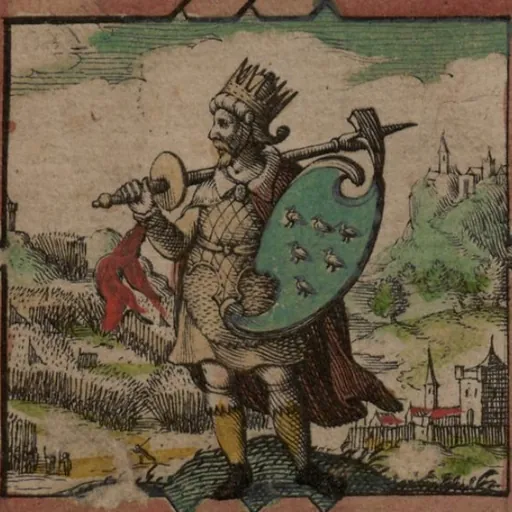
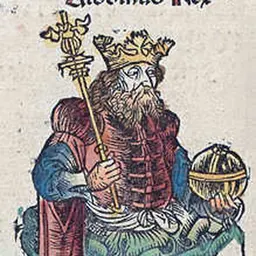
Historical context Imaginary depiction of Ælle from John Speed's 1611 "Saxon Heptarchy" Historians are divided on the detail of Ælle's life and existence as it was during the least-documented period in English history of the last two millennia.
By the early 5th century, Britain had been Roman for over three hundred and fifty years. Amongst the enemies of Roman Britain were the Picts of central and northern Scotland, and the Gaels known as Scoti, who were raiders from Ireland. Also vexatious were the Saxons, the name Roman writers gave to the peoples who lived in the northern part of what is now Germany and the southern part of the Jutland peninsula. Saxon raids on the southern and eastern shores of England had been sufficiently alarming by the late 3rd century for the Romans to build the Saxon Shore forts, and subsequently to establish the role of the Count of the Saxon Shore to command the defence against these incursions. Roman control of Britain finally ended in the early part of the 5th century; the date usually given as marking the end of Roman Britain is 410, when the Emperor Honorius sent letters to the British, urging them to look to their own defence. Britain had been repeatedly stripped of troops to support usurpers' claims to the Roman empire, and after 410 the Roman armies never returned.
Sources for events after this date are extremely scarce, but a tradition, reported as early as the mid-6th century by a British priest named Gildas, records that the British sent for help against the barbarians to Aetius, a Roman consul, probably in the late 440s. No help came. Subsequently, a British leader named Vortigern is supposed to have invited continental mercenaries to help fight the Picts who were attacking from the north. The leaders, whose names are recorded as Hengest and Horsa, rebelled, and a long period of warfare ensued. The invaders—Angles, Saxons, Jutes, and Frisians—gained control of parts of England, but lost a major battle at Mons Badonicus (the location of which is not known). Some authors have speculated that Ælle may have led the Saxon forces at this battle, while others reject the idea out of hand.
The British thus gained a respite, and peace lasted at least until the time Gildas was writing: that is, for perhaps forty or fifty years, from around the end of the 5th century until midway through the sixth. Shortly after Gildas's time, the Anglo-Saxon advance was resumed, and by the late 6th century nearly all of southern England was under the control of the continental invaders.
Early sources A page from the manuscript of the Anglo-Saxon Chronicle. Ælle's name, spelled "Elle", can be seen in two of the entries at the end of the page. The last entry on the page, for 488, refers to events in Kent and does not mention Ælle.There are two early sources that mention Ælle by name. The earliest is The Ecclesiastical History of the English People, a history of the English church written in 731 by Bede, a Northumbrian monk. Bede mentions Ælle as one of the Anglo-Saxon kings who exercised what he calls "imperium" over "all the provinces south of the river Humber"; "imperium" is usually translated as "overlordship". Bede gives a list of seven kings who held "imperium", and Ælle is the first of them. The other information Bede gives is that Ælle was not a Christian—Bede mentions a later king, Æthelberht, as "the first to enter the kingdom of heaven". The terms 'British' and 'Welsh' were used interchangeably, as 'Welsh' is the Saxon word meaning 'foreigner', and was applied to all the native Romano-British of the era.
Three of the places named may be identified: "Cymen's shore" ("Cymenes ora" in the original) is believed to be located at what is now a series of rocks and ledges, in the English Channel off Selsey Bill, on the south coast, known as the Owers. It has been suggested that Ower is derived from the word ora that is found only in placenames where Jutish and West Saxon dialects were in operation (mainly in southern England). It is possible that the stretch of low ground along the coast from Southampton to Bognor was called Ora, "the shore", and that district names were used by the various coastal settlements, Cymens ora being one of them. Some believe Andredes cester may have been an imperial stronghold somewhere else as Henry of Huntingdon described the place as a fortified city and gave a very full account of the siege which is inconsistent with the geography of ancient Pevensey and little archaeological evidence of sustained settlement there. Also, in his "Britannia", William Camden suggests that it could be Newenden, Kent.
There are other early writers whose works can shed light on Ælle's time, though they do not mention either him or his kingdom. Gildas's description of the state of Britain in his time is useful for understanding the ebb and flow of the Anglo-Saxon incursions. Procopius, a Byzantine historian, writing not long after Gildas, adds to the meagre sources on population movement by including a chapter on England in one of his works. He records that the peoples of Britain—he names the English, the British, and the Frisians—were so numerous that they were migrating to the kingdom of the Franks in great numbers every year, although this is probably a reference to Britons emigrating to Armorica to escape the Anglo-Saxons. They subsequently gave their name to the area they settled as Brittany, or la petite Bretagne (lit., "little Britain").
Evidence from place names in Sussex The early dates given in the Anglo-Saxon Chronicle for the colonization of Sussex are supported by an analysis of the place names of the region. The strongest evidence comes from place names that end in "-ing", such as Worthing and Angmering. These are known to derive from an earlier form ending in "-ingas". "Hastings" for example, derives from "Hæstingas" which may mean "the followers or dependents of a person named Hæsta", although others suggest the heavily Romanised region may have had names of Gallo-Roman origin derived from "-ienses". From west of Selsey Bill to east of Pevensey can be found the densest concentration of these names anywhere in Britain. There are a total of about forty-five place names in Sussex of this form, but personal names either were not associated with these places or fell out of use. The names of the founders, in other origin legends, seem to have British or Latin roots not Old English. It is likely that the foundation stories were actually known before the 9th century, but the annalists manipulated them to provide a common origin for the new regime. The origin stories purported that the British were defeated and replaced by invading Anglo-Saxons arriving in small ships. These stories were largely believed right up to the 19th century, but are now regarded as myths.
Reign A map of south-eastern England showing places visited by Ælle, according to the Anglo-Saxon Chronicle, and the area of modern SussexIf the dates given by the Anglo-Saxon Chronicle are accurate to within half a century, then Ælle's reign lies in the middle of the Anglo-Saxon expansion, and prior to the final conquest of the Britons. It also seems consistent with the dates given to assume that Ælle's battles predate Mons Badonicus.This in turn would explain the long gap, of fifty or more years, in the succession of the "bretwaldas": if the peace gained by the Britons did indeed hold till the second half of the 6th century, it is not to be expected that an Anglo-Saxon leader should have anything resembling overlordship of England during that time. The idea of a pause in the Anglo-Saxon advance is also supported by the account in Procopius of 6th century migration from Britain to the kingdom of the Franks. It seems likely that something at that time was interrupting the general flow of the Anglo-Saxons from the continent to Britain.
The dates for Ælle's battles are also reasonably consistent with what is known of events in the kingdom of the Franks at that time. Clovis I united the Franks into a single kingdom during the 480s and afterwards, and the Franks' ability to exercise power along the southern coast of the English channel may have diverted Saxon adventurers to England rather than the continent. The battles listed in the Chronicle are compatible with a conquest of Sussex from west to east, against British resistance stiff enough to last fourteen years.
The historian Guy Halsall argues that as Ælle immediately preceded a sequence of three contemporaries from the late sixth-century in Bede's original list (Ceawlin of Wessex, Æthelberht of Kent, and Rædwald of East Anglia), it is far more likely that Ælle dates to the mid sixth century, and that the Chronicle has moved his dates back a century in order to provide a foundation myth for Sussex which puts it chronologically and geographically between the origins of the kingdoms of Kent and Wessex.
Death and burial Ælle's death is not recorded by the Chronicle, which gives no information about him, or his sons, or the South Saxons until 675, when the South Saxon king Æthelwalh was baptized. If Ælle died within the borders of his own kingdom then it may well have been that he was buried on Highdown Hill with his weapons and ornaments in the usual mode of burial among the South Saxons. Highdown Hill is the traditional burial-place of the kings of Sussex.
Don’t just read it —
keep it.
Full-length biographies made to live with: read them, listen on the way to work, watch them tonight.
- E-book
- Audio
- Video
Instant download · yours to keep · every purchase keeps this site free
Important facts
Family & relationships
People in Ælle of Sussex's life
Named in this biography and alive at the same time


Related people
Same field, nearest in time
Frequently asked questions
Who was Ælle of Sussex?
first king of the South Saxons
When was Ælle of Sussex born?
Ælle of Sussex was born in 500.
When did Ælle of Sussex die?
Ælle of Sussex died in 514.
What was Ælle of Sussex's occupation?
Ælle of Sussex was a sovereign.
What nationality was Ælle of Sussex?
Ælle of Sussex's recorded nationality: Kingdom of Sussex.
Sources & further reading
Cite this page
APA: Biography.guide. (2026). Ælle of Sussex. https://biography.guide/aelle-of-sussex/
MLA: "Ælle of Sussex." Biography.guide, https://biography.guide/aelle-of-sussex/.
Chicago: "Ælle of Sussex." Biography.guide. https://biography.guide/aelle-of-sussex/.
Data last updated: 2026-09-21 · Spot an error? Report a correction.
Portrait: Wikimedia Commons · author & licence
Page generated 2026-09-27 05:00 UTC