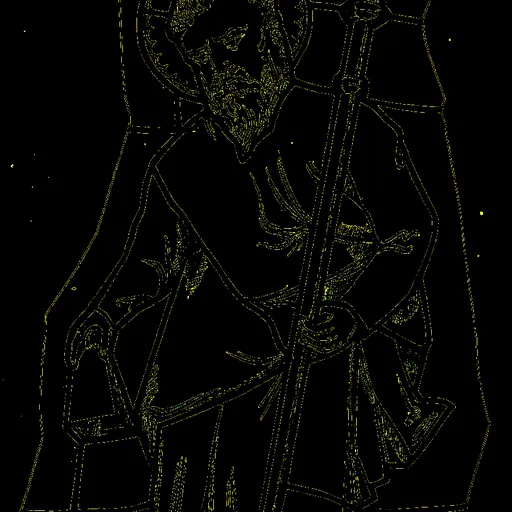
Aelhaearn
Welsh saint, disciple of Beuno
About Aelhaearn
Aelhaearn was a patron saint.
Life Saint Aelhaiarn is listed among the Bonedd y Seint (Genealogies of the Saints). He was the brother of saints Llwchaiarn and Cynhaiarn and son of Hygarfael (or Cerfael), son of Cyndrwyn, a prince of Pengwern, in modern-day Shropshire. The 18th-century version of the story given to John Ray at Llanaelhaearn provides a folk etymology for Aelhaiarn's unusual name. It claimed that Beuno (Byno) was accustomed to disappearing from his cell near Clynnog every night to travel to pray on a flat stone in the middle of the Afon Erch. One night, as Beuno returned, he saw a man hidden in the dark; he then prayed that, if the stranger were on some good errand, he should attain it but, if his intent were ill, that some example be made of him. Immediately upon saying this, he saw wild animals appear from the forest and rend the man limb from limb. Beuno reconsidered when he discovered that it was his own servant who had been spying upon him. The saint set the bones and limbs together except for the bone beneath his brow, which was lost. This, he replaced with an iron bit from his pike spike. (Thomas Pennant, in his Tour in Wales, called the story "too absurd to relate" and didn't. ) Baring-Gould, recounting it, compares it with Thor's restoration of his goats Snarler and Grinder in the Prose Edda. It is now a Grade I listed building. Its garden is also noted as an example of ancient yew trees set in a designed scheme.
The church at Llanaelhaearn bears walls from around the 12th century and was last refurbished in 1892. It is listed as Grade II*.
Both locations included a holy well. The well at Guilsfield was formerly visited by parishioners for a drink on Trinity Sunday. and much frequented the present enclosure dates from 1975.
During the Middle Ages, the inland reach of Meirionydd also bore a parish named Llanaelhaiarn near modern Gwyddelwern in Denbighshire. It was united with Gwyddelwern in 1550 and the site of its chapel is now only marked with a yew tree. In the early 20th century, its local village was still named Aelhaiarn but it is now known as Pandy'r Capel ("Chapel Fulling Mill").
Don’t just read it —
keep it.
Full-length biographies made to live with: read them, listen on the way to work, watch them tonight.
- E-book
- Audio
- Video
Instant download · yours to keep · every purchase keeps this site free
Important facts
Frequently asked questions
Who was Aelhaearn?
Welsh saint, disciple of Beuno
When was Aelhaearn born?
Aelhaearn was born in Kingdom of Powys, Wales.
When did Aelhaearn die?
Aelhaearn died in AD 7 in Llanaelhaearn.
What was Aelhaearn's occupation?
Aelhaearn was a patron saint.
What nationality was Aelhaearn?
Aelhaearn's recorded nationality: Kingdom of Powys.
Sources & further reading
Cite this page
APA: Biography.guide. (2026). Aelhaearn. https://biography.guide/aelhaearn/
MLA: "Aelhaearn." Biography.guide, https://biography.guide/aelhaearn/.
Chicago: "Aelhaearn." Biography.guide. https://biography.guide/aelhaearn/.
Data last updated: 2026-09-20 · Spot an error? Report a correction.
Page generated 2026-09-27 05:10 UTC