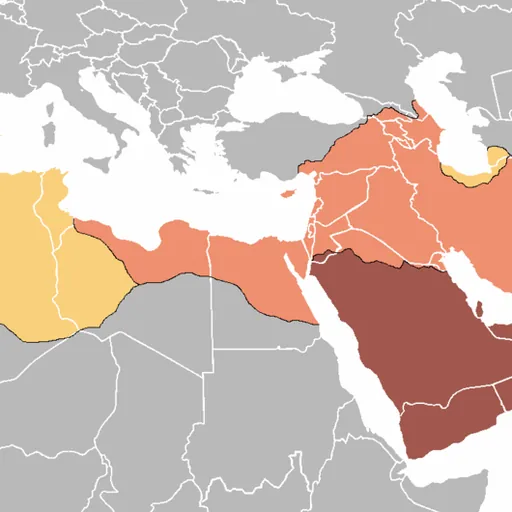
Abu Muhammad al-Sufyani
Umayyad prince and a pretender to the Umayyad Caliphate (died c.754)
About Abu Muhammad al-Sufyani
Abu Muhammad al-Sufyani was an Arab amir.
Ziyād ibn ʿAbd Allāh ibn Yazīd ibn Muʿāwiya , commonly known as Abū Muḥammad al-Sufyānī was an Umayyad prince and a pretender to the Umayyad Caliphate, which had been overthrown by the Iraq-based Abbasid Caliphate in early 750.
Abu Muhammad was a great-grandson of the first Umayyad caliph, Mu'awiya I, and thus belonged to the Sufyanid line of the Umayyad family, which ruled the caliphate between 661 and 684, after which they were succeeded by the Marwanid line. The last Umayyad caliph, Marwan II , imprisoned Abu Muhammad until releasing him at the end of his reign, when the Abbasids routed his army at the Battle of the Zab in 750.
To counter the ascendant Abbasids, Abu Muhammad and his tribal supporters from the Banu Kalb and the wider Yaman of Homs and Palmyra joined forces with their traditional rivals, the Qays under Abu al-Ward. Abu Muhammad claimed the mantle of the caliphate and took on the messianic role of the 'Sufyani', who would deliver a golden age for the Syrians. His tribal coalition was defeated by the Abbasids and he fled to the Hejaz, where he was killed during the early reign of Abbasid caliph al-Mansur .
Origins Ziyad ibn Abd Allah ibn Yazid ibn Muawiya, commonly known as Abu Muhammad al-Sufyani, was a member of the Sufyanid branch of the Umayyad family. He was the son of Abd Allah ibn Yazid and Umm Uthman bint Sa'id, a daughter of Sa'id ibn al-As. Through his father, he was a grandson of Caliph Yazid I , while through his mother he was descended from the prominent Umayyad family of Sa'id ibn al-As. He was related to Caliph al-Walid II through the latter's aunt, Atika bint Yazid.
Abu Muhammad was a resident of the Damascus area and was noted among the valiant warriors of the Umayyads. In the early stages of the Third Fitna, Caliph al-Walid II dispatched him to challenge the army of Yazid ibn al-Walid, but Abu Muhammad did not follow his orders. After a series of episodes in Homs and Damascus, during which he was twice captured and released, he eventually arrived in Qinnasrin and later Aleppo. The Umayyad caliph Marwan II had Abu Muhammad imprisoned in Harran for much of the second half of his reign. Abu Muhammad did not escape his incarceration when other inmates broke out; those inmates were caught and killed by Harran's inhabitants. Marwan released Abu Muhammad after his defeat by the Abbasids at the Battle of the Zab in January 750.
Revolt Following the Abbasid overthrow of the Umayyads and his release by Marwan II, Abu Muhammad arrived in northern Syria, where he declared himself caliph during the reign of al-Saffah. He adopted the epithet al-Sufyani both as a reference to his descent from Caliph Mu'awiya ibn Abi Sufyan and as a claim to the early Islamic messianic figure al-Sufyani. Recognized by thousands of followers, his claim was embraced by many in Syria, particularly the people of Homs, who believed him to be a messiah-like figure who would deliver a golden age and destroy the rising Abbasid Caliphate.
Later in 750, the Qaysi general, Abu al-Ward, launched a revolt to defeat the Abbasids, rallying his kinsmen and other Qaysis and disavowing his allegiance to the Abbasid governor of Syria, Abd Allah ibn Ali. Abu Muhammad joined the revolt as a leader of the Yaman tribal confederation of Homs and Palmyra. Abu Muhammad assumed political leadership of the revolt and issued a claim to leadership of the Umayyad Caliphate, reaching out for support from other Umayyad nobles. Abu al-Ward, meanwhile, served as the revolt's military commander, though this command was likely limited to the Qaysi troops, the Yamani troops being led by al-Asbagh ibn Dhu'ala al-Kalbi. Although the intent of the revolt was to combat the Abbasids, particularly their Khurasani soldiers, it became a joint Qaysi–Yamani effort to gain control of the Umayyad Caliphate.
Despite an initial victory against the Abbasids led by Abd al-Samad ibn Ali at Qinnasrin, Abu Muhammad's forces were defeated near Homs. In the latter battle, Abu al-Ward and many of his kinsmen and Qaysi soldiers were killed, while Abu Muhammad fled to Palmyra. The Abbasid commander Bassam ibn Ibrahim attempted and failed to capture Palmyra, but Abu Muhammad fled again, this time heading for the Hejaz (western Arabia). There, he found a safe haven near Mount Uhud. Abu Muhammad and his family remained in Arabia until they were tracked down and killed during Caliph al-Mansur's reign . Abu Muhammad's revolt, though short-lived, was the most significant threat the Abbasids faced in the period immediately following their successful revolution against the Umayyads. The revolt motivated the Abbasids to track down and eliminate other remnants of the Umayyad dynasty.
Sufyani The origin, role and identity of the Sufyani in Islamic tradition and Abu Muhammad's place in it is much debated. In the local Syrian context, the Sufyani was seen as a deliverer who would herald a golden age. But in Shi'ite tradition, due to his descent from Abu Sufyan—originally an opponent of Muhammad and the father of Mu'awiya, who was responsible for the downfall of Ali—he was an anti-Muslim figure, a sort of Islamic Antichrist and the opponent of the Mahdi. Scholars have debated the roots of this figure, with some claiming the existence of the legend already during Umayyad times. Henri Lammens suggested that Abu Muhammad was the origin of the legend, and that Syrians believed that after his execution he went into hiding—much like the Shi'ite Mahdi—and would reappear. Wilferd Madelung championed the view that the Sufyani was from the beginning an anti-Mahdi figure, and that he only acquired positive connotations in Syria at a later date. Several later rebels in Syria, from Abu Harb al-Mubarqa in the 840s all the way up to the 15th century, claimed the mantle of the Sufyani.
Don’t just read it —
keep it.
Full-length biographies made to live with: read them, listen on the way to work, watch them tonight.
- E-book
- Audio
- Video
Instant download · yours to keep · every purchase keeps this site free
Important facts
Family & relationships
Related people
Same field, nearest in time




Frequently asked questions
Who was Abu Muhammad al-Sufyani?
Umayyad prince and a pretender to the Umayyad Caliphate (died c.754)
When was Abu Muhammad al-Sufyani born?
Abu Muhammad al-Sufyani was born in Damascus.
When did Abu Muhammad al-Sufyani die?
Abu Muhammad al-Sufyani died in 754 in Hejaz.
What was Abu Muhammad al-Sufyani's occupation?
Abu Muhammad al-Sufyani was an amir.
What nationality was Abu Muhammad al-Sufyani?
Abu Muhammad al-Sufyani was Arab.
Sources & further reading
· Wikipedia: Abu Muhammad al-Sufyani
· DBpedia: Abu Muhammad al-Sufyani
Cite this page
APA: Biography.guide. (2026). Abu Muhammad al-Sufyani. https://biography.guide/abu-muhammad-al-sufyani/
MLA: "Abu Muhammad al-Sufyani." Biography.guide, https://biography.guide/abu-muhammad-al-sufyani/.
Chicago: "Abu Muhammad al-Sufyani." Biography.guide. https://biography.guide/abu-muhammad-al-sufyani/.
Data last updated: 2026-09-22 · Spot an error? Report a correction.
Portrait: Wikimedia Commons · author & licence
Page generated 2026-09-27 05:03 UTC