
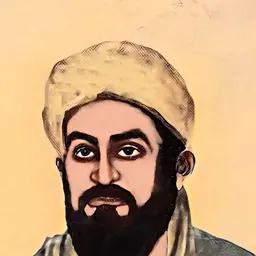
Abū Ḥanīfa Dīnawarī
Persian Islamic polymath (died 895)
About Abū Ḥanīfa Dīnawarī
Lived 828 – 895 (aged 66–67). Abū Ḥanīfa Dīnawarī was an Arab astronomer, geographer, mathematician, historian, astrologer and botanist.
Abū Ḥanīfa Aḥmad ibn Dāwūd Dīnawarī (; died 895) was an Islamic Golden Age polymath: astronomer, agriculturist, botanist, metallurgist, geographer, mathematician, and historian.
Life Of Persian or Kurdish stock, Dinawari was born in the (now ruined) town of Dinawar in modern-day western Iran. It had some importance due to its geographical location, serving as the entrance to the region of Jibal as well as a crossroad between the culture of Iran and that of the inhabitants on the other side of the Zagros Mountains. The birth date of Dinawari is uncertain; it is likely that he was born during the first or second decade of the 9th century. He was instructed in the two main traditions of the Abbasid-era grammarians of al-Baṣrah and of al-Kūfah. His principal teachers were Ibn al-Sikkīt and his own father. He studied grammar, philology, geometry, arithmetic, and astronomy and was known to be a reliable traditionalist. His most renowned contribution is the Book of Plants, for which he is considered the founder of Arabic botany. is possibly the earliest apparent effort to combine Iranian and Islamic history. While historians such as al-Tabari and Bal'ami devoted the introduction of their work to long discourses on the duration of the world, Dinawari attempted to establish the importance of Iranshahr ("land of Iran") as the centre of the world. In his work, Dinawari notably devoted much less space to the Islamic prophet Muhammad compared to that of Iran. Regardless, Dinawari was a devoted Muslim, as indicated by his commentary on the Qur'an. He concluded the history with the suppression of Babak Khorramdin's rebellion in 837, and the subsequent execution of the Iranian general Khaydhar ibn Kawus al-Afshin.
Besides having access to early Arabic sources, Dinawari also made use of Persian sources, including pre-Islamic epic romances. Fully acquainted with the Persian language, Dinawari occasionally inserted phrases from the language into his work.
Dinawari's spiritual successor was Hamza al-Isfahani (died after 961).
Works The tenth century biographical encyclopaedia, al-Fihrist written by Al-Nadim, lists sixteen book titles by Dinawari: 'Abd al-Munim 'Amir & Jamal al-din Shayyal, 1960; Isam Muhammad al-Hajj 'Ali, 2001), but has not been translated in its entirety into a European language. Jackson Bonner has recently prepared an English translation of the pre-Islamic passages of al-Akhbar al-Tiwal.
Book of Plants Al-Dinawari is considered the founder of Arabic botany for his Kitab al-Nabat (Book of Plants), which consisted of six volumes. Only the third and fifth volumes have survived, though the sixth volume has partly been reconstructed based on citations from later works. In the surviving portions of his works, 637 plants are described from the letters sin to ya. He describes the phases of plant growth and the production of flowers and fruit.
The first part of the Book of Plants describes astronomical and meteorological concepts as they relate to plants, including the planets and constellations, the sun and moon, the lunar phases indicating seasons and rain, anwa, and atmospheric phenomena such as winds, thunder, lightning, snow, and floods. The book also describes different types of ground, indicating which types are more convenient for plants and the qualities and properties of good ground.
Al-Dinawari quoted from other early Muslim botanical works that are now lost, such as those of al-Shaybani, Ibn al-Arabi, al-Bahili, and Ibn as-Sikkit.
Don’t just read it —
keep it.
Full-length biographies made to live with: read them, listen on the way to work, watch them tonight.
- E-book
- Audio
- Video
Instant download · yours to keep · every purchase keeps this site free
Important facts
People in Abū Ḥanīfa Dīnawarī's life
Named in this biography and alive at the same time

Related people
Same field, nearest in time





Contemporaries
People whose lives overlapped Abū Ḥanīfa Dīnawarī's




Frequently asked questions
Who was Abū Ḥanīfa Dīnawarī?
Persian Islamic polymath (died 895)
When was Abū Ḥanīfa Dīnawarī born?
Abū Ḥanīfa Dīnawarī was born in 828 in Dinavar District.
When did Abū Ḥanīfa Dīnawarī die?
Abū Ḥanīfa Dīnawarī died in 895 in Abbasid Caliphate, Dinawar, Jibal.
What was Abū Ḥanīfa Dīnawarī's occupation?
Abū Ḥanīfa Dīnawarī was an astronomer, geographer, mathematician, historian, astrologer and botanist.
What nationality was Abū Ḥanīfa Dīnawarī?
Abū Ḥanīfa Dīnawarī was Arab.
Sources & further reading
· Wikipedia: Abū Ḥanīfa Dīnawarī
· DBpedia: Abu Hanifa Dinawari
Cite this page
APA: Biography.guide. (2026). Abū Ḥanīfa Dīnawarī. https://biography.guide/abu-hanifa-dinawari/
MLA: "Abū Ḥanīfa Dīnawarī." Biography.guide, https://biography.guide/abu-hanifa-dinawari/.
Chicago: "Abū Ḥanīfa Dīnawarī." Biography.guide. https://biography.guide/abu-hanifa-dinawari/.
Data last updated: 2026-09-27 · Spot an error? Report a correction.
Page generated 2026-09-27 05:17 UTC