
About Abu al-Wafa Buzjani
Lived 940 – 998 (aged 58). Abu al-Wafa Buzjani was a mathematician and astronomer.
Abū al-Wafāʾ Muḥammad ibn Muḥammad ibn Yaḥyā ibn Ismāʿīl ibn al-ʿAbbās al-Būzjānī (, ; 10 June 940 – 15 July 998) mathematician and astronomer who worked in Baghdad. He made important innovations in spherical trigonometry, and his work on arithmetic for businessmen contains the first instance of using negative numbers in a medieval Islamic text.
He is also credited with compiling the tables of sines and tangents at 15' intervals. He also introduced the secant and cosecant functions, as well studied the interrelations between the six trigonometric lines associated with an arc. He was a contemporary of the distinguished scientists Abū Sahl al-Qūhī and al-Sijzi who were in Baghdad at the time and others such as Abu Nasr Mansur, Abu-Mahmud Khojandi, Kushyar Gilani and al-Biruni. In Baghdad, he received patronage from members of the Buyid court.
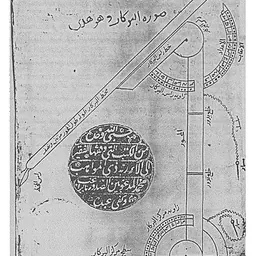
Astronomy Abū al-Wafāʾ was the first to build a wall quadrant to observe the sky. The result was very close to present-day calculations, showing a difference of approximately 1 hour between the two longitudes. Abū al-Wafāʾ is also known to have worked with Abū Sahl al-Qūhī, who was a famous maker of astronomical instruments. While what is extant from his works lacks theoretical innovation, his observational data were used by many later astronomers, including al-Biruni.
Almagest Among his works on astronomy, only the first seven treatises of his Almagest (Kitāb al-Majisṭī) are now extant. The work covers numerous topics in the fields of plane and spherical trigonometry, planetary theory, and solutions to determine the direction of Qibla. and may have discovered the law of sines for spherical triangles, however, other scholars like Abu-Mahmud Khojandi have been credited with the latter achievement:
where are the sides of the triangle (measured in radians on the unit sphere) and are the opposing angles.
Some sources suggest that he introduced the tangent function, although other sources give the credit for this innovation to al-Marwazi. "A Book on What Is Necessary from the Science of Arithmetic for Scribes and Businessmen", ( Kitāb fī mā yaḥtāj ilayh al-kuttāb wa’l-ʿummāl min ʾilm al-ḥisāb). This is the first book where negative numbers have been used in the medieval Islamic texts.
He also wrote translations and commentaries on the algebraic works of Diophantus, al-Khwārizmī, and Euclid's Elements.
Legacy The crater Abul Wáfa on the Moon is named after him. On 10 June 2015, Google changed its logo in memory of Abū al-Wafāʾ al-Būzjānī.
Don’t just read it —
keep it.
Full-length biographies made to live with: read them, listen on the way to work, watch them tonight.
- E-book
- Audio
- Video
Instant download · yours to keep · every purchase keeps this site free
Important facts
People in Abu al-Wafa Buzjani's life
Named in this biography and alive at the same time


Related people
Same field, nearest in time

Contemporaries
People whose lives overlapped Abu al-Wafa Buzjani's

Frequently asked questions
Who was Abu al-Wafa Buzjani?
Persian mathematician and astronomer (940–998)
When was Abu al-Wafa Buzjani born?
Abu al-Wafa Buzjani was born on 10 June 940 in Buzhgan.
When did Abu al-Wafa Buzjani die?
Abu al-Wafa Buzjani died on 15 July 998 in Baghdad.
What was Abu al-Wafa Buzjani's occupation?
Abu al-Wafa Buzjani was a mathematician and astronomer.
Sources & further reading
· Wikipedia: Abu al-Wafa Buzjani
· DBpedia: Abu al-Wafa' al-Buzjani
Cite this page
APA: Biography.guide. (2026). Abu al-Wafa Buzjani. https://biography.guide/abu-al-wafa-buzjani/
MLA: "Abu al-Wafa Buzjani." Biography.guide, https://biography.guide/abu-al-wafa-buzjani/.
Chicago: "Abu al-Wafa Buzjani." Biography.guide. https://biography.guide/abu-al-wafa-buzjani/.
Data last updated: 2026-09-20 · Spot an error? Report a correction.
Page generated 2026-09-27 05:30 UTC