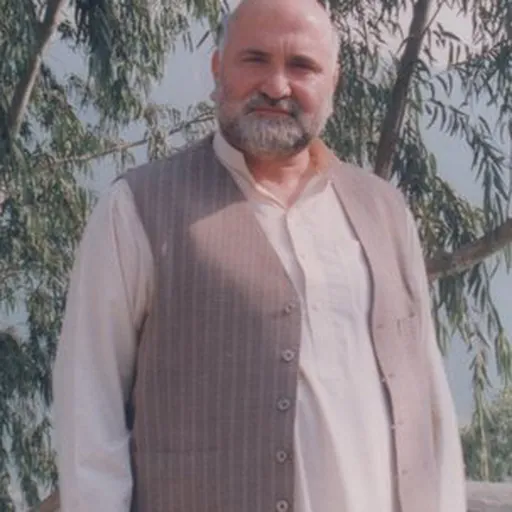
About Abdul Haq
Lived 1958 – 2001 (aged 43). Abdul Haq was an Afghan politician.
Mujahideen years Haq first engaged in the fight against the Afghan government in 1978, initially without external support, then with the Hizb-i-Islami faction led by Mohammad Yunus Khalis—not to be mistaken with the Hezb-i-Islami faction of Gulbuddin Hekmatyar. During the Soviet–Afghan War, Haq coordinated Mujahideen activities in the province of Kabul.
Haq was one of the CIA's few Afghan contacts in the early years of the war. Steve Coll wrote that he "grew to become Howard Hart's most important Afghan guide to the anti-Soviet war." Later in the 1980s he became a critic of Pakistan's Inter-Services Intelligence (ISI) and (after his relationship with them ended) the CIA. The CIA labelled him "Hollywood Haq"—the Hollywood Commander.
Haq was injured several times, including losing part of his right heel. Because of his injuries, he often fought battles against the Soviets on horseback.
In January 1999, unknown assailants killed Haq's watchman, entered his home, and murdered his wife and son in Hayatabad in Peshawar, Pakistan. Another of Haq's sons survived the raid.
Northern Alliance
From 1999 onwards a process was set into motion by Ahmad Shah Massoud and Haq to unite the various ethnic group in Afghanistan against the Taliban regime. Massoud united the Tajiks, Hazara and Uzbeks as well as several Pashtun commanders. Besides meeting with Pashtun tribal leaders and acting as a point of reference, Haq received increasing numbers of Pashtun Taliban who secretly approached him. Some commanders who had worked for the Taliban military apparatus agreed to the plan to topple the Taliban regime as the Taliban lost support even among the Pashtuns.
Senior diplomat and Afghanistan expert Peter Tomsen hoped that "he ‘Lion of Kabul’ [Abdul Haq] and the ‘Lion of Panjshir’ [Ahmad Shah Massoud] would make a formidable anti-Taliban team if they combined forces. Haq, Massoud, and Karzai, Afghanistan's three leading moderates, could transcend the Pashtun—non-Pashtun, north–south divide". The senior Hazara and Uzbek leaders took part in the process just like later Afghan president Hamid Karzai. They agreed to work under the banner of exiled Afghan King, Zahir Shah, who was residing in Rome, Italy.
In November 2000, leaders from all ethnic groups were brought together in Massoud's headquarters in northern Afghanistan travelling from other parts of Afghanistan, Europe, the United States, Pakistan and India to discuss a Loya Jirga for a settlement of Afghanistan's problems and to discuss the establishment of a post-Taliban government. In September 2001 an international official who met with representatives of the alliance would remark, "It's crazy that you have this today ... Pashtuns, Tajiks, Uzbeks, Hazara ... They were all ready to buy in to the process".
Death Following the US-led invasion of Afghanistan in October 2001, Haq entered Nangarhar Province of Afghanistan from Pakistan's Khyber Pakhtunkhwa province to implement his resistance plan against the Taliban. Some sources have speculated that the CIA supported this initiative but family members and other witness sources have denied this claim, writing that the CIA actually urged him not to enter Afghanistan. Former CIA director George Tenet reports that, at the recommendation of Bud McFarlane, CIA officials met with Haq in Pakistan and after assessing his capabilities urged him not to enter Afghanistan. After a chase, The Guardian speculates that his capture was due to betrayal by double agents.
An obituary in The Guardian called Abdul Haq an "astute leader".
Don’t just read it —
keep it.
Full-length biographies made to live with: read them, listen on the way to work, watch them tonight.
- E-book
- Audio
- Video
Instant download · yours to keep · every purchase keeps this site free
Important facts
People in Abdul Haq's life
Named in this biography and alive at the same time




Related people
Same field, nearest in time





Contemporaries
People whose lives overlapped Abdul Haq's



Frequently asked questions
Who was Abdul Haq?
Afghan Pashtun mujahideen commander (1958-2001)
When was Abdul Haq born?
Abdul Haq was born on 23 April 1958 in Nangarhar Province.
When did Abdul Haq die?
Abdul Haq died on 26 October 2001 in Islamic State of Afghanistan.
What was Abdul Haq's occupation?
Abdul Haq was a politician.
What nationality was Abdul Haq?
Abdul Haq was Afghan.
Sources & further reading
Cite this page
APA: Biography.guide. (2026). Abdul Haq. https://biography.guide/abdul-haq-politician-1958/
MLA: "Abdul Haq." Biography.guide, https://biography.guide/abdul-haq-politician-1958/.
Chicago: "Abdul Haq." Biography.guide. https://biography.guide/abdul-haq-politician-1958/.
Data last updated: 2026-09-23 · Spot an error? Report a correction.
Portrait: Wikimedia Commons · author & licence
Page generated 2026-09-27 05:08 UTC