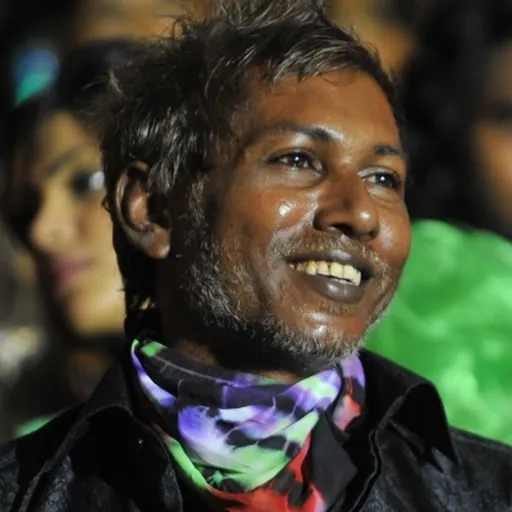
Abdul Faththaah
Maldivian film director, producer, editor, screenwriter and choreographer
About Abdul Faththaah
Born 1971. Abdul Faththaah is a film director, film producer, film editor, screenwriter and choreographer.
Abdul Faththaah Abdul Gayyoom (born 6 December 1971), commonly known as Abdul Faththaah was a Maldivian film director, producer, editor, screenwriter and choreographer. One of the most successful filmmakers in Maldivian Cinema, Faththaah is the recipient of a number of awards, including four Gaumee Film Awards, and two Maldives Film Awards. In 2004, Government of Maldives honoured him with the National Award of Recognition. He is known for his romantically stylish film-making.
Realizing his potential, after a successful venture at an inter-office teledrama competition, Faththaah made his directorial debut with a video single, "Dhan Dhan Dhanvaru". In 2000, he directed his first film Himeyn Dhuniye followed by Ranmuiy which was half-directed before he was roped into the project. He rose to prominence in Maldivian cinema with the commercially successful and acclaimed romantic drama Aan... Aharenves Loabivin (2002), and the horror film Eynaa (2004) — for which he received the Best Editing award at the Miadhu Crystal Awards. He followed it by directing a commercially unsuccessful film Hureemey Inthizaarugaa (2005) and the award-winning film Vehey Vaarey Therein (2003) which earned him his only Gaumee Film Award for Best Director. After establishing his own production studio, Red Productions, Faththaah directed a television drama series, Hinithun Velaashey Kalaa and a romantic drama Vaaloabi Engeynama (2006).
His most successful film was released in 2010, the romantic horror film Jinni (2010) for which he received a Maldives Film Awards Best Director nomination, followed by another romantic horror film 14 Vileyrey (2011). He received his second Gaumee Film Award nomination for Best Director with his romantic film Love Story (2012). His next release, the family drama Aadheys (2014) received mixed reviews from critics while he announced his retirement with his commercially successful film Hahdhu (2017)
Early life Abdul Faththaah was born on 6 December 1971 in Ha. Kelaa.
After his father's dismissal, Faththaah started working at the first Maldivian fast-food restaurant where he witnessed the "lavishing life" film actors use to be living.
In 2002, Faththaah directed a romantic film Aan... Aharenves Loabivin which starred Ali Seezan, Sheela Najeeb, Niuma Mohamed, Aminath Rasheedha and Neena Saleem which follows an only child of a family who had a bitter relationship with her lovers and an unfortunate incident leading her to suffer from amnesia. Upon release, the film opened to a positive response from critics and was a commercially successful project. His next directorial venture was the horror film Eynaa (2004), in which appeared Sheela Najeeb, Mohamed Manik, Ahmed Shah, Khadheeja Ibrahim Didi, Ibrahim Jihad and Nashidha Mohamed as six colleagues who go on a picnic to a haunted uninhabited island and their battle for survival. The film garnered critical appreciation especially for its technical department and was a commercial success.
The following year, Faththaah released two films. His first film, a romantic disaster film, Hureemey Inthizaarugaa (2005) featured a cast including Ravee Farooq, Mariyam Zuhura, Waleedha Waleed, Ibrahim Jihad and Neena Saleem. The film, heavily relied on the effect of the 2004 Indian Ocean earthquake on the Maldives, narrates the journey a couple separated due to husband's greed for wealth and their reconciliation following a traumatic event which destroyed their family. Featuring Yoosuf Shafeeu, Jamsheedha Ahmed, Khadheeja Ibrahim Didi, Mohamed Shavin, Amira Ismail and Aminath Rasheedha in main roles, the film narrates the story of unrequited love, and proved to be one of the highest-grossing Maldivian films of the year. In 2006, he established his own production company, Red Productions. The film follows a conflicted husband struggling to convey equal affection towards his two spouses. Based on true incidents that occurred in an island of Maldives, the film focuses on Javid who has been enthralled by a ghost. Prior to release, the film was marketed to be full of "suspense and uniqueness" compared to other Maldivian horror films. Upon release, the film received mixed reviews from critics; the majority of them complaining for having the "same old feeling" of prior horror films though the performances were noted to be satisfactory. Despite the mixed reviews, the film witnessed a positive response at the box office, declaring it as a Mega-Hit; financially the most successful film of Faththaah's. At the 1st Maldives Film Awards, Fatathaah received a nomination as Best Director and Editor while winning Best Choreographer award for the song "Thundimatheega". The film and his work received mixed to positive reviews from critics; "Faththaah has directed the film in a lavishly engaging manner until it reaches to a little inconvenient climax". The film did good business at the box office and was declared a "Hit". His collaboration with Ali Seezan and Aishath Rishmy was repeated in his next release, a romantic film Love Story (2012). The film and his direction received a negative response from critics. Displeased with the screenplay and performance of the actors, Ahmed Nadheem of Haveeru wrote: "None of the actors were given scope to build their characters and none was able to justify their character. Barring a charming poster and title, nothing works in the film; biggest letdown by Fathtaah in his career".
It was followed by a family drama film, Aadheys (2014) starring Niuma Mohamed, Hussain Sobah, Amira Ismail, Moosa Zakariyya, Fathimath Azifa and Ali Azim. Filming was completed in 2011, though it was released three years following the death of film producer Hassain Ali. It revolves around a sacrificing mother and her affection towards her child.
Faththaah announced his retirement after releasing his romantic drama Hahdhu (2017) which was his most expensive film produced. The film touched upon controversial issues in the Maldives including the depiction of flogging and also shines a light on mental health by featuring an attempted suicide. A reviewer from Avas wrote: "The film may not be a first class movie but it has integrated a benchmark in video quality. Camerawork, videography and direction deserves special mention". The film opened to mixed reviews from critics though it emerged as one of the highest grossing Maldivian films of the year.
In 2019, first Maldivian anthology film was released which credited Faththaah as the director of the segment titled Dharifiri which focuses on mother-son incest. The project was filmed in 2013 and digitally released six years later due to several delays in post-production, where the producer of the film criticizes Farooq for "failing" to complete his segment during the stipulated time period took over the post-production.
Personal life Faththaah is married to Aminath Azza, a teacher working at Aminiya School. 2001
2010
1999–2000
10 episodes
2003–2004
52 episodes
2006–2008
52 episodes
2019
The segment Dhari/Firi
Best Editing Eynaa (Shared with Ahmed Shah)
Best Director Jinni
Best Editing Jinni
2014
Best Choreography Love Story
Best Director Love Story
Don’t just read it —
keep it.
Full-length biographies made to live with: read them, listen on the way to work, watch them tonight.
- E-book
- Audio
- Video
Instant download · yours to keep · every purchase keeps this site free
Important facts
People in Abdul Faththaah's life
Named in this biography and alive at the same time





Related people
Same field, nearest in time




Contemporaries
People whose lives overlapped Abdul Faththaah's




Frequently asked questions
Who is Abdul Faththaah?
Maldivian film director, producer, editor, screenwriter and choreographer
When was Abdul Faththaah born?
Abdul Faththaah was born on 6 December 1971 in Kelaa.
What is Abdul Faththaah's occupation?
Abdul Faththaah is a film director, film producer, film editor, screenwriter and choreographer.
What nationality is Abdul Faththaah?
Abdul Faththaah's recorded nationality: Maldives.
Sources & further reading
Cite this page
APA: Biography.guide. (2026). Abdul Faththaah. https://biography.guide/abdul-faththaah/
MLA: "Abdul Faththaah." Biography.guide, https://biography.guide/abdul-faththaah/.
Chicago: "Abdul Faththaah." Biography.guide. https://biography.guide/abdul-faththaah/.
Data last updated: 2026-09-22 · Spot an error? Report a correction.
Portrait: Wikimedia Commons · author & licence
Page generated 2026-09-27 05:01 UTC