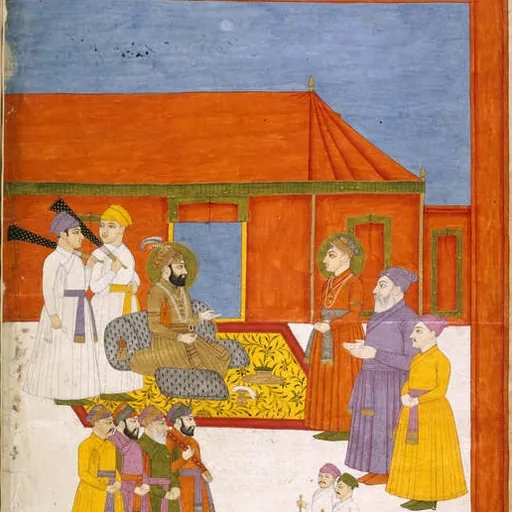
Abd al-Samad Khan
Political and military leader in the Mughal Empire
About Abd al-Samad Khan
Abd al-Samad Khan Al-Ansari or Abd-us-Samad Khan Al-Ansari (died 1737), also known simply as Abdus Samad Khan, was the Mughal subahdar of Lahore Subah from 1713 to 1726, and of Multan Subah from 1726 until his death in 1737. He was succeeded by his son Zakariya Khan Bahadur in both the provinces.
Early life Abdus Samad Khan was born in Samarqand. His father, Abdullah Ahrar, was a well-known Naqshbandi saint and a descendant of Khwaja Ahrar of Baghdad, while his mother came from the family of Shaikh Umar of Baghistan. Originally, the family lived in Tashkand before settling in Samarqand, where they remained until Abdullah Ahrar died on 20 February 1690.
Campaign against Banda Singh Bahadur
To subdue the uprising led by Banda Singh Bahadur, on 22 February 1713, Farrukhsiyar made key appointments. He appointed Abdus Samad Khan as the new Governor of Lahore, and at the same time, his son Zakariya Khan was assigned as the Faujdar of Jammu. Before setting off, the Emperor ordered Abd‑us‑Samad Khan to either drive Banda Singh Bahadur out of Sadhaura or, if possible, wipe him out completely.
When Abd‑us‑Samad Khan reached Sadhaura, he found that the siege initiated by Zain‑ud‑din Ahmed had hardly progressed. Banda Singh Bahadur had taken control of the fort at Lohgarh, while his men defended Sadhaura. Realizing that he could not attack both places at once, Abd‑us‑Samad Khan decided it would be best to tackle them one after the other. Orders were issued to Abd al-Samad Khan and his son Zakariya Khan to capture the Sikh leader Banda Singh alive. Despite commanding about 14,000 fighters, Banda Singh found himself cornered as the Mughal forces converged from every direction. Unable to reach the large, well-stocked fort at Gurdaspur, built to house up to 60,000 soldiers, he moved westward to take refuge in a fortified mansion at the village of Gurdas Nangal, about six kilometers from Gurdaspur, where he sheltered roughly 1,250 men and a few horses. The Mughal army quickly encircled this compound by digging deep trenches, setting up artillery batteries, and blocking any possible escape or resupply routes. Over the next eight grueling months—spanning a sweltering summer, a heavy monsoon, and a cold early winter—the defenders endured constant skirmishes and suffered severe shortages of food and fodder. Small groups of Sikhs repeatedly ventured out to gather what little supplies they could, but the siege gradually tightened until starvation and desperation took their toll. Finally, on 7 December 1715, the Mughal forces breached the defenses, ruthlessly killed many of the near-starved Sikhs, and captured Banda Singh along with his remaining 740 followers. On 22 December 1715, news of the capture of Banda Singh Bahadur was sent by Abd al-Samad Khan to Emperor Farrukh Siyar in Delhi.
After being taken from Gurdas Nangal, Banda Singh Bahadur and the other Sikh prisoners were brought to Lahore. Even though he had been captured and jailed, his enemies still feared his supposed supernatural powers so much that they were constantly worried he might escape while on the road. In response, one Mughal officer volunteered to be tied to the same elephant, declaring, "If he tries to escape, I will plunge my dagger into him."
Don’t just read it —
keep it.
Full-length biographies made to live with: read them, listen on the way to work, watch them tonight.
- E-book
- Audio
- Video
Instant download · yours to keep · every purchase keeps this site free
Important facts
Frequently asked questions
Who was Abd al-Samad Khan?
political and military leader in the Mughal Empire
When did Abd al-Samad Khan die?
Abd al-Samad Khan died on 26 July 1737.
Sources & further reading
· Wikipedia: Abd al-Samad Khan
Cite this page
APA: Biography.guide. (2026). Abd al-Samad Khan. https://biography.guide/abd-al-samad-khan/
MLA: "Abd al-Samad Khan." Biography.guide, https://biography.guide/abd-al-samad-khan/.
Chicago: "Abd al-Samad Khan." Biography.guide. https://biography.guide/abd-al-samad-khan/.
Data last updated: 2026-09-23 · Spot an error? Report a correction.
Portrait: Wikimedia Commons · author & licence
Page generated 2026-09-27 05:05 UTC