About Abaji
Born 1958. Abaji is an Armenian musician and composer.
Abaji is an Armenian singer, songwriter, composer and multi-instrumentalist.
Biography Early life
Abaji was born in Beirut, to a Greek father, who left the Greek city of Smyrna in 1922, and an Armenian-Lebanese mother from Istanbul.
He spent part of his childhood and early teenage years in Lebanon capital city, where he discovered music. He started to play the folk guitar at the age of 11. He had both the influence of Greek music from his family's heritage and of Oriental music that he was exposed to in the streets of Istanbul.
In February 1976 when Abaji was 17, the war in Lebanon forced him into exile. Upon his arrival in France, he started at a boarding school in a neighbourhood near Paris. That is when he began to write songs. Abaji says he was born again from that moment.
Before establishing his music career further, Abaji studied and has been specialised in Chinese medicine and tai chi, which he has practiced for over forty years. He became a therapist working for the psychiatric emergency services in Paris, using his tai chi and relaxation techniques with the patients.
Abaji started to get known as the “Bedouin's Troubadour” and began opening shows for artists such as Geoffrey Oryema, John Mc Laughlin and Suzanne Vega among others.
The Artist
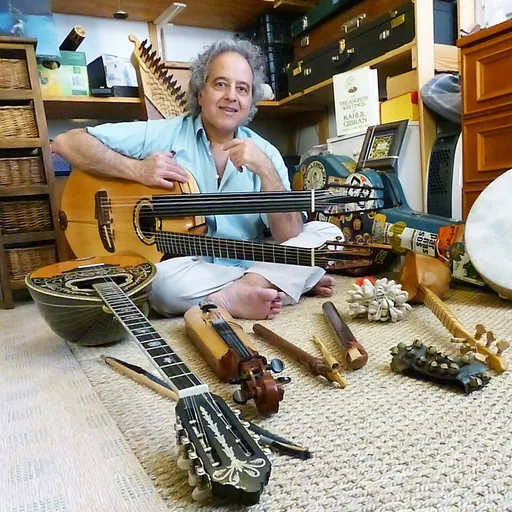
Abaji is an avid collector of instruments from all over the world. He owns over 300 instruments, which he has acquired in his travels and concert tours from countries such as: United States, New Zealand, South Africa, Pakistan, India, Lebanon, Morocco, Costa Rica, Oceania and Central America as well as many other countries in Africa and Europe. with new instruments. He sets himself to learn to play a new instrument every 4 to 5 months; he can play instruments such as: saz, zarb, flutes, bamboo saxophone, duduk.
His passion of lutherie and ancient instruments has inspired him to invent a 5-string sitar-guitar that he plays with a violin bow. His debut album Paris-Beyrouth was released in 1996 with Francis Varis playing the accordion. One of the album's songs, Zahra Hamra was chosen for the “Planète compilation” album by Radio France International. in the Olympia venue in Paris. Abaji also collaborated on the album Desert Blues 2 with the song "Gibran" in tribute to poet Khalil Gibran released by Network Medien record label in 2002 which becomes an international success. In this album he plays the oud, harp-guitar, bouzouki, sitar-guitar, daff, harmonica and flute in which songs such as Raml (Sand), Maa (Water), El Wahha (The Oasis) and Nejmet (Stars) can evoke the sounds of the desert.
On his next album Nomad Spirit, Abaji invited Indian percussionist Ramesh Shotham with his Thavil, Moroccan oud and guembri player Majid Bekkas and Armenian duduk master Djivan Gasparyan to take part on the recording. Later on, he went on to tour to Germany together with Ramesh Shotham. In this album Abaji is inspired by the spiritual heritage of his great-grandfathers from Smyrna and Aleppo. Abaji usually gets himself involved thoroughly in all of the process of recording, mixing, and mastering. at the Kennedy Center in Washington.
He has also collaborated with Pakistani virtuoso singer Ustad Naseeruddin Saami.
Film, TV, dance and theatre music
Abaji has worked as a music composer for TV shows, live shows and film. He recorded over 35 albums including Elements, which has been used as score in several films and documentaries. The thematic of the albums varies including India, Exile, the Middle East, the Investigation series focused in a geographic area, among others. All of his music has been used either for global television shows or film scores.
He regularly works for music agencies Kosinus and Cézame in Paris composing music for TV and films.
Abaji has composed music for theatre and dance. He has produced various shows together with Lebanese dancer Nawal Raad.
In 2016 the label 1 Revolution Music, directed by trailer music composer Yoav Goren, released Abaji's work called Middle East Soundscapes.
Discography 1996 : Paris-Beyrouth 2000 : Bedouin Blues 2003 : Oriental Voyage 2005 : Nomad spirit 2005 : Les mille et une nuits (Musical accompaniment to stories told by Jihad Darwiche) 2009 : Origine Orients 2016 : Route&Roots
Don’t just read it —
keep it.
Full-length biographies made to live with: read them, listen on the way to work, watch them tonight.
- E-book
- Audio
- Video
Instant download · yours to keep · every purchase keeps this site free
Important facts
People in Abaji's life
Named in this biography and alive at the same time




Related people
Same field, nearest in time



Contemporaries
People whose lives overlapped Abaji's



Frequently asked questions
Who is Abaji?
musician in France
When was Abaji born?
Abaji was born on 19 August 1958 in Beirut.
What is Abaji's occupation?
Abaji is a musician and composer.
What nationality is Abaji?
Abaji is Armenian.
Sources & further reading
Cite this page
APA: Biography.guide. (2026). Abaji. https://biography.guide/abaji/
MLA: "Abaji." Biography.guide, https://biography.guide/abaji/.
Chicago: "Abaji." Biography.guide. https://biography.guide/abaji/.
Data last updated: 2026-09-23 · Spot an error? Report a correction.
Portrait: Wikimedia Commons · author & licence
Page generated 2026-09-27 05:04 UTC